Showing posts with label human behavior. Show all posts
Showing posts with label human behavior. Show all posts
Wednesday, August 17, 2011
Wordless Wednesday: Scientific Americam Special Cities Issues


Thursday, July 28, 2011
Who are biologists and what do they do? Faces of Biology Contest
What does a biologist look like? Who are biologists? Where do they work and what exactly do they do?
For many grade school and middle school children, the image of an older (usually Caucasian) male with wild gray hair comes to mind. He's holding a test tube or flask and wearing a white lab coat and goggles. Other than the wild hair, none of those phrases describe me.
But why do so many people recall that image? I don't know, but I do know that the Faces of Biology Photo Contest presented by the American Institute of Biological Sciences is an excellent opportunity to expand everyone's preconceptions what a biologist looks like and what he/she does.
The contest is an opportunity to showcase the varied forms that biological research can take. Photographs entered into the contest must depict a person, such as a scientist, researcher, technician, or student, engaging in biological research. The depicted research may occur outside, in a lab, with a natural history collection, on a computer, in a classroom, or elsewhere. ~ from the official contest website.Like this one of me (and my wild hair, hahaha)

Seriously, you should consider a picture of your own to the contest. The grand prize is this

plus $250 cash.
Learn more about the contest and read the orginal full post at The Urban Scientist at The Scientific American.
Tuesday, May 24, 2011
When playing outside isn't safe: Gun fire on the playground in St. Louis
It was the middle of the day. A little more than a dozen children from the Peabody Apartments (near downtown St. Louis) were outside playing on the playground and jungle gym. Then shots rang out. Apparently a disagreement between two men who were nearby escalated with at least one of them wildly firing shots at the other. Did the assailant land a shot at his intended? No, instead one of his unaimed bullets hit a young 7-year-old girl in the head. The suspect is now in custody but the little girl is still in critical condition.
 |
| image courtesy of KMOV.com |
- National Trails Day - June 4, 2011: It's a volunteer event to help clean up and restore hiking trails at public lands all over the country. It's a great way to get outside and have fun. More info at Outdoor Afro.
- National Get Outdoors Day - June 11, 2011: It is an initiative that supports First Lady Michelle Obama's Let's Move Campaign to fight childhood obesity. Lots of state parks and campgrounds have signed on as official location partners for this event.
- Great American Backyard Campout - June 25, 2011: Many parks and campgrounds have signed up as partners. Check out the registry and events calendar and you could find a group near you.
- More? Please offer additional recommendations, local, regional or national.
Tuesday, April 12, 2011
Yuri Night - Celebrating 50 years of human space flight

Today marks the 50th anniversary of the very first human space flight, April 12, 2011. On this night, 50 years ago, Russian Cosmonaut, Yuri Gagarin completed an orbit around the earth. He became an instant international celebrity and a heor of the Soviet Union. Today, space flight and exploration isn't as new as it was then, but it's stilll exciting! Everybody's doing the moonwalk.
There's a celebration event here in my town, St. Louis, Missouri; but it's a worldwide party and you are invited. Ir create your own impromptu event like go outside and enjoy the beautiful night sky - alone or with friends and family.
You can also make a video about why you're excited about Yuri's Night. Say something cool about science, engineering, space and planetary science, and you could be the winner of the YURI'S NIGHT 2011 VIDEO CONTEST. The Yuri’s Night 2011 Video Contest is an open source competition to engage the public to create tribute videos for the 50th Anniversary of Human Spaceflight to share at Yuri’s Night events around the world. As more videos become available they will be posted on this website and notifications will be circulated via Facebook and Twitter @YurisNight.
Learn more about Yuri Gagarin at these links.
Yuri's Night
Biography of Yuri Gagarin, via Wikipedia.
Yuri Gagarin's space flight 50th anniversary: the view from Russia, includes video
Yay! Space Exploration!
 |
| Me, next to Space Exploration Patches, Boeing Museum taken at Boeing, St. Louis, Missouri - the Engineering company that designed and/or built most US space travel vehicle and equipment |
 |
| Skylab Patch at the Boeing Museum |
 |
| Commemorative glassware for US Space Flight, Boeing Museum |
 |
| Model of US Space Shuttle, Boeing Museum |
I know, my science geekiness surprises me, too.
See you outside, and tell me all about yur Yuri Night celebration!
Tuesday, April 05, 2011
Urban Environmentalism in Action: St. Louis North City residents sue city over recycling
We’ve only got one planet and the resources we need are limited. April is such an optimistic time for environmentalist and conservationists. Thanks to some great social marketing and patience, most people are now on board to Save the Earth and use our natural resources more responsibly. For a long time, major metropolitan areas were hold-outs on these efforts – slow adoption of recycling, fear of limiting water for recreational purposes. And many people had concluded that some people didn’t care at all. But as KSDK Channel 5 of St. Louis recently reported, North city women to file lawsuit over recycling.
Ms. Annie Cooper and Ms. Maxine Johnson, residents of North St. Louis residents are filing a discrimination suit against the city claiming their alderman, Mr. Jeffrey Boyd of the 22nd Ward, refused to provide city-ordered recycling bins because the residents in their neighborhood are "too dumb to recycle." Mr. Boyd says he never said such things; but he does admit to not making recycling bins readily available to his neighbors because saw other measures as having higher priority. To be honest, I wouldn’t be surprised if his decision to overlook placing recycling bins in his neighborhood was based on an opinion held by many that African-Americans and people from inner-city communities are not likely to be environmental advocates and his residents probably wouldn’t use them anyway. It’s not uncommon for neighborhoods like his to recycle less frequently and in smaller volumes than more affluent parts of the city. In fact, I’ve done some anecdotal observations of how often community recycling bins, the ones by the fire stations, would get filled in different neighborhoods in St. Louis. Just as a comparison, there are no fewer than 4 bins in my old neighborhood, Benton Park, which always seemed to get full rather quickly. However, in Old North St. Louis, where I worked and very near Mr. Boyd’s ward, there were only 2 and they seemed to be empty most of the time.
 |
| Ms. Johnson and Ms. Cooper claim their neighborhood did not receive alley recycling bins like these. (image courtesy of Threshold Properties blog) |
• engage his neighbors and help them understand why responsible trash removal is important to their health, well-being, property value, etc,
• raise awareness about the problem of filling up landfills, running out of natural resources, and illegal dumping,
• work with citizens to help them dispose of trash via ways that reduce environmental impact that are affordable, feasible and convenient,
• coordinate neighborhood cleanup efforts that give citizens a sense of pride and ownership in a clean, healthy community, and
• empower citizens to educate other residents in responsible trash removal and reporting illegal dumping activities.
Though it is often assumed that Black people and people from less-affluent neighbors aren’t interested in recycling and have more important things to worry about, that doesn’t seem to hold true for this neighborhood. Actually, I am quite energized by Ms. Cooper’s and Ms. Johnson’s actions; and I am proud of them, too! Far too often attention is placed on the lack of interest of people from urban, primarily minority, working-class neighborhoods to participate in environmental initiatives. This is a strong example of how people of color are as invested in environmental issues as well-to-do, mostly white citizens. It’s also a great example of citizens who have been traditionally marginalized, speaking up and demanding to be taken seriously on a very public issue. I think when citizens speak up, it behooves elected officials to listen and work with them. Especially in a situation that can be easily addressed like this one.
So, call me Alderman Boyd. I think I could help you out.
Sunday, August 22, 2010
Missouri State Fair - growing my own great memories
I've spent the last week at the 108th Annual Missouri State Fair in Sedalia, Missouri. It was a lovely week. I was there doing science outreach, participating in the 4 Days of Hands-on Science Fun which included a Street Science Fair, Show Me Robotics Showcase & Competition, and Aerospace Fun Day. Plus, there were the agricultural exhibits and showcases. I loved it all. it really reminded me of my agricultural roots.

When I was younger, I would go to the Mid-South Fair and Libertyland housed on the Fairgrounds in Memphis, Tennessee. I loved it: the rides, the games, the food. Being a city kid, I thought that's what the fair was all about. It wasn't until college - majoring in Animal Science that I came to know that wasn't what the Fair was about at all. Fairs are about the agriculture and home economics achievements of everyday folk - the people who grind and work to make their daily lives out of hard work and simple materials. It was eye-opening to learn not only about the science of raising livestock, growing crops, and the economics of practical living, using all resources adequately and respectfully, as well as the creativity and artsmanship of both agriculture and home economic endeavors. I had a new appreciation of fairs that continues today.
So, as I spent time at the Missouri State Fair, I was more excited about the animal exhibits than the rides at the mid-way. But don't get me wrong. I still had all of my fair favorites: corn dogs, funnel cake, lemonade,turkey leg, roasted corn, plus fried green tomatoes. Nom, nom, nom.


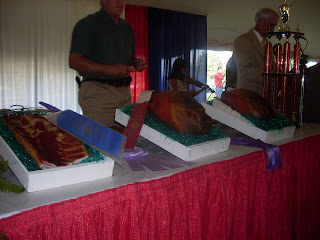

Check out more photos from the Missouri State fair at my Facebook Fan Page: Missouri State Fair 2010 Photo album.
And as I looked around, I realized that State Fairs are perfect opportunities for people to reconnect with their communities on a regional scale and appreciate what it has to offer. State fairs are ideal day trip destinations for the entire family - from the young kiddies, the teens, young adults, and grand parents. Load the car up and take everyone out for a great time. I met one family that comes to the fair every year. They camp out on the nearby campground and they pall around all weekend. Isn't that lovely (and affordable)? Now, that's how fond childhood memories are made.
The only thing I thought the fair was missing was diversity. People came from all over the state, but there was very, very little participation from St. Louis and Kansas City - the state's major metropolitan areas. It's a two-way street no doubt, but I can't recall a single piece of advertisement within the St. Louis Metro core. For the most part, fairs are rural events, but considering that every heritage has a rural and agricultural history (not to mention the fact that everybody eats), I think it's a shame that State Fair planners haven't found ways to engage multiple demographics, especially since many regional fairs are struggling. I can imagine a whole list of ways to attract urbanites to the State Fairs that wouldn't involve an overhaul of marketing efforts. And with the rise of people's interests in farmers markets, urban gardening, and local food, I think the urban markets are ripe for plucking and attending State Fairs. So, if any fair planners are serious about increasing reach in urban areas, then feel free to contact me. I am more than happy to offer my consultation services to your operation.
In the comments section, please feel free to share your State Fair Memories, too. Check out OutdoorAfro's blog post about State Fair memories. It's like she's in my head or something.
Enjoy!

When I was younger, I would go to the Mid-South Fair and Libertyland housed on the Fairgrounds in Memphis, Tennessee. I loved it: the rides, the games, the food. Being a city kid, I thought that's what the fair was all about. It wasn't until college - majoring in Animal Science that I came to know that wasn't what the Fair was about at all. Fairs are about the agriculture and home economics achievements of everyday folk - the people who grind and work to make their daily lives out of hard work and simple materials. It was eye-opening to learn not only about the science of raising livestock, growing crops, and the economics of practical living, using all resources adequately and respectfully, as well as the creativity and artsmanship of both agriculture and home economic endeavors. I had a new appreciation of fairs that continues today.
So, as I spent time at the Missouri State Fair, I was more excited about the animal exhibits than the rides at the mid-way. But don't get me wrong. I still had all of my fair favorites: corn dogs, funnel cake, lemonade,turkey leg, roasted corn, plus fried green tomatoes. Nom, nom, nom.


I also checked out the Home Ec. exhibits as well. You can tell the first placed pies....bigger slices cut out. lol.
 |
| It's a shame all of those lovely treats were only enjoyed by the judges. They stay on display throughout the fair and then discarded. I love sweets too much to commit that kind of abuse. |

And as I looked around, I realized that State Fairs are perfect opportunities for people to reconnect with their communities on a regional scale and appreciate what it has to offer. State fairs are ideal day trip destinations for the entire family - from the young kiddies, the teens, young adults, and grand parents. Load the car up and take everyone out for a great time. I met one family that comes to the fair every year. They camp out on the nearby campground and they pall around all weekend. Isn't that lovely (and affordable)? Now, that's how fond childhood memories are made.
The only thing I thought the fair was missing was diversity. People came from all over the state, but there was very, very little participation from St. Louis and Kansas City - the state's major metropolitan areas. It's a two-way street no doubt, but I can't recall a single piece of advertisement within the St. Louis Metro core. For the most part, fairs are rural events, but considering that every heritage has a rural and agricultural history (not to mention the fact that everybody eats), I think it's a shame that State Fair planners haven't found ways to engage multiple demographics, especially since many regional fairs are struggling. I can imagine a whole list of ways to attract urbanites to the State Fairs that wouldn't involve an overhaul of marketing efforts. And with the rise of people's interests in farmers markets, urban gardening, and local food, I think the urban markets are ripe for plucking and attending State Fairs. So, if any fair planners are serious about increasing reach in urban areas, then feel free to contact me. I am more than happy to offer my consultation services to your operation.
In the comments section, please feel free to share your State Fair Memories, too. Check out OutdoorAfro's blog post about State Fair memories. It's like she's in my head or something.
Enjoy!
Thursday, October 29, 2009
H1N1 Vaccination Hysteria Part 3: Alternative remedies vs. Vaccination
This is the third post in a series about the science and societal impacts of the flu and flu vaccination. Specifically, I emphasize the importance of sound scientific literacy in understanding this important topic. Please read the first posts in the series if you missed them.
Part 1: Is the Swine Flu Vaccine Safe?
Part 2: Should I get the shot?
In today’s post, I’ll address some of the responses commonly heard in response to the vaccination recommendations:
"I'll just take vitamins and natural herbs and I'll be protected from the Swine Flu."
Getting more Vitamin D
Particular to the Swine Flu, some people are recommending Vitamin D as a preventative to the disease. How does this work? Vitamin D is found in dairy and fish foods but our bodies are also able to manufacture Vitamin D if it sufficiently exposed to UV-B sun rays. Vitamin D is key for calcium and phosphorus uptake to keep your bones strong. Now there is some interesting research suggesting that Vitamin D might also be key in your immune response.
Vitamin D seems to be an important modulator in both your Primary and Secondary immune response. (See post 2 in the series where I define the immune response and immune cells) . A variant of the Vitamin D is apart of the molecular structure of some immune cells - like phages and B & T Memory cells. Without Vitamin D in the immune cells don't function to full capacity, have problem recognizing germs and don't attack and kill germs fast enough. The most compelling evidence shows that people who are deficient in Vitamin D are more likely to get sick from the flu, tuberculosis and suffer complications from Multiple sclerosis. This new research provides some very exciting news about how being adequately nourished is so important to maintaining good health.
What about eating organic foods?
Organic foods are delicious, and if you can afford to eat them then do. However, there is no evidence to suggest they are more or less healthy than traditionally raised and harvested foods. Eating fresher fruits, veggies, and whole grains is better for your general health than not eating fruits and veggies at all or eating processed foods. These foods provide vitamins and essential elements used by your immune cells to fight germs.
But I would like to make it clear, there is no evidence that Vitamin D or simply eating healthier foods alone are effective at preventative against any disease, including the Swine Flu. Simply, the results of the Vitamin D study and the benefits of eating organic foods reinforce the importance of a healthy, well-balanced diet. Eating well means getting all the nutrition you need to keep your body and your immune cells in tip-top shape.
Can't I just take care of myself in more natural/less invasive ways to avoid the Swine Flu?
The short answer is yes. Eating healthy, taking vitamins, getting some sunshine, exercise, a good night's sleep are perfect for keeping your body in its best condition to fight off any germ. Plus, nothing beats hand washing (but not with anti-bacterial soap) and sanitizing your home for killing germs and preventing exposure. And if you do get sick, then the routine regiment of rest, fluids, vitamins, seeing the doctor, and taking the prescribed medicine does the job. These are general precautions to any disease.
However, public health officials are adding an extra precaution this season because of the Swine Flu and here is why.
1. The Swine Flu is widespread and pervasive. It's only late October - still 2 months away from the peak flu season - and cases are a popping up everywhere. This is very odd, most seasonal flus don't show up so early and spread so quickly.

2. The Swine Flu doesn't pick on the usual suspects. This strange diseases is dealing its worst hand to teens and young adults. Typically, these are the healthiest people in the population and always the group people worry the least about when every pandemics come around. But the reports all indicate that these people are getting sick more. Most diseases pick on the weak -from an immune system perspective, this means the elderly, the very young, and people who are chronically sick - like cancer, diabetes, asthma, and heart disease . Their immune system is either slow or still too new to respond to serious germ, so swine flu could really do some harm to such people. 
That's why the doctors and public health officials recommend vaccination for the most at-risk groups: babies, toddlers, mommies (including pregnant women), the chronically ill, and young people (25 and younger). It seems the elderly have some immunity to swine flu due to previous exposure to the germ in the 1950s. But that still leaves a large number of people in the middle. If you are like me between the ages of 30-55, and in relative good health, you might not need the shot; and if you get the flu the odds are you will come through it just fine. However, you might want to get the vaccination to protect your family, especially if you spend time with anyone from one of the risk-prone groups listed above.
So, yes it is okay to wash your hands religiously, sanitize your home, school, and office space, cover your mouth and nose when coughing or sneezing, eat lots of fresh fruits and veggies, and take vitamins. But I still encourage you to seriously consider the Seasonal and Swine Flu vaccination for your family.
References:
Vitamin D, Wikipedia
Swine Flu Hospitalizing Mostly Young People In The US, Medical News Today October 2009
Organic food is no healthier, study finds, Reuters July 2009
AP Photo/The Post and Courier, Alan Hawes
CDC 2009 H1N1 Flu US Situation Update, October 23, 2009
Friday, October 23, 2009
H1N1 Vaccination Hysteria Part 2: Should I get the shot?
This is the second post in a series about the science and societal impacts of the flu and flu vaccination. Specifically, I emphasize the importance of sound scientific literacy in understanding this important topic. Please read the first post in the series if you missed it.
Is the Swine Flu Vaccine Safe?
Vaccines can be really scary and intimidating, so I completely understand if you're nervous; but your doctor, the news, and the public health departments advise you to get vaccinated. Today, I address the question on many people's minds:
Do I really need to get the Swine Flu Shot?
What I'm hearing from many people is "I’ll be fine. I don’t think I need the Swine Flu or Seasonal Flu vaccine." Perhaps. But think about this way: How can your body fight a disease-causing germ it has never come into contact with?
Your Immune System and Immune Response
Your best line of defense is to avoid contact with a germ. Stay away from sick people, wash hands, and keep germs from inside of your body - via mouth, nose, and eyes. If the flu virus does get inside it's going to do its best to get to a warm moist organ like your lungs and wreak havoc.
When germs get into your body, your Primary Immune Response gets to work. It is a non-discriminating attack system on anything foreign. There is an inflammation response or fever to kill the germs with heat. White blood cells attack and kill. Phages swallow germs whole. Neutrophils blow up germs.

(Inflammation Response)

(White Blood Cells)

(Phages)
(Neutrophils)
Next up is the Secondary Immune Response. It is a specific attack system that memorizes, hunts down, and attacks specific germs. Special Memory cells (B-cells and T-cells) are created that memorize signatures of every germ that you've have come into contact with and if it comes back into your body they go after the germ and destroys it. Vaccines are medicines derived from disease-causing germs that are intentionally introduced in your body to activate your immune response to create memory cells. Now, if or when you come into contact with the real live version of the germ, your immune system is ready and can fight it off. For some diseases like the flu and swine flu, catching the full-scale flu may cause you to get so sick that it may take a long time to recover or cause death.Why certain people are recommended for vaccinations
Babies & Young Children. Your immune system is a little less than perfect when you are young. Your body is a blank slate. Babies have only primary defenders and no secondary defenders - unless they are breast fed. Breast milk provides some of mom's defense cells but they provide only temporary assistance. As kids become exposed to germs - getting sick all of the time - they are actually building their Memory Cell army. Vaccinations help out in the same way, but without getting sick.
Older people. As you age, your defenders aren't as swift and handy as they use to be. Especially if you have health problems, your Memory Cells might need a help remember who the germs are. Vaccinations help maintain your Memory Cell army is its best possible condition.
These two groups are the most vulnerable becoming sick, especially from life-threatening diseases.
Moms and caretakers. As I hinted to above, mom can pass on some immune help to her baby in breast milk. But more importantly when mom gets the vaccine, she's protecting herself from getting the flu, and a healthy mama can't pass the flu onto baby and toddlers. The same thing for other adults who take care of young kids, older people or sick people.
Actually, between the ages of 17 and 22, you are at your peak immune response defense. Things decline after 22, but if you're healthy, eat right, and do all of the preventative things recommended by doctors, you're actually in pretty good shape to fight off non-lethal germs. This doesn't mean you may never get sick, but you should be fine. Typically, young adults and adults are not usually highly recommended for Flu shots - unless they are caretakers.
However, Swine Flu is breaking all of the rules - it's a Young Person's Disease. Otherwise healthy people 25 and younger are getting ill from this disease, being hospitalized at higher rates and dying from it. Frankly, that concerns me about this virus and that's why people 30 and younger are being recommended for vaccination. Moreover, both the seasonal and H1N1 (Swine) flu are already widespread and we are still 2-3 months from the peak Flu season. For these two reasons I think vaccination is worth serious consideration.
Deciding what to do
It's important to assess your risk for catching the flu. Right now, with the flu hitting early, I think it's a good chance many people will come into contact with.
You also need to assess your own and your family's health. Could you handle catching the swine flu? Could you handle the other things that come with it, like pneumonia and dehydration.
Finally, you must weight the side-effects of getting the shot to getting to flu. First and foremost, the vaccine is safe. Second, you will not get the flu from the flu shot, though many people believe they do. What usually happens is a immune response to the
weakened germ or a cold you were harboring to the shot.
But my take home point is that vaccines offer a way for your body to confront a serious disease without actually having to risk dying or becoming seriously ill. Ultimately, it's up to you to decide, but it's important to note that vaccines are only made and manufactured for very risky, life-threatening highly communicable diseases, not the less-threatening ones.
References:
2009 H1N1 Influenza Vaccine Questions & Answers, CDC
Flu Vaccine Fact Sheet, CDC
Experts say H1N1 vaccine is safe and time-tested
Flu Shot reactions
Why did I get sick after I had the flu shot?
Flu Symptoms including a zip-code tracker
Thursday, October 22, 2009
H1N1 Vaccination Hysteria Part 1: Is the Swine Flu Vaccine Safe?
Over the next few posts I’ll discuss the importance of sound scientific literacy in understanding the science and societal impacts of the flu and flu vaccination. Many people are rightly concerned about their health and the health of their family. Yet, we get so many messages that warn us to beware of vaccines or of the science behind them as if there are battalions of faceless sinister people in lab coats who want to do harm to the general public. It is this latter sentiment, of fear and mistrust, especially among people from minority communities, that I want to address. Though there are accounts from history that have abused helpless and oppressed peoples, it is important to know that today science is a transparent process consisting of many diverse peoples. Everyone is watching – other scientists, the community, independent professional overseers, and government regulators. And everyone is participating – people of color, people of pallor, people from wealthy nations and poor nations, people with children, parents, pets, and concern for the environment. “Scientist” is not a universal term to describe uncaring, reckless persons without regard for others.
In today’s post, I’ll address the concerns most people express:
“The H1N1 (Swine) Flu vaccine was made too fast and it can’t possibly be safe to administer.”
Selecting which flu viruses will go into the vaccine
The flu season coincides with the cold period, for us in the Northern Hemisphere, that’s means November – May, the worst is January-April. We spend more time indoors and in closer proximity to each other – the perfect social situation to share diseases.
The UN World Health Organization (WHO), along with our own Centers for Disease Control (CDC) tracks the worldwide prevalence of every kind of flu all year round. In February, WHO makes recommendations to Public Health Agencies of nations in the Northern Hemisphere. They say
The UN World Health Organization (WHO), along with our own Centers for Disease Control (CDC) tracks the worldwide prevalence of every kind of flu all year round. In February, WHO makes recommendations to Public Health Agencies of nations in the Northern Hemisphere. They say
“Hey, virus X, Y, Z are really causing some trouble in the world. Here are some strains of the virus. I suggest y’all get to cracking and making some vaccine.”
The US Food and Drug Administration (FDA) gets in on the discussion and they actually decide which strains will be developed and get word (and virus) out to contracted vaccine makers to get the ball rolling. Some manufacturers may already be cooking up early batches, in January, of virus if they have the strain with their fingers crossed that those strains will be selected by the FDA. If so, then they have a jump start.
How long does it take to manufacture seasonal influenza vaccine?
How long does it take to manufacture seasonal influenza vaccine?
Directly from the CDC website:
“It takes at least six months to produce large quantities of influenza vaccine. For vaccine to be delivered in time for vaccination to begin in October and November (prior to the start of the flu season), manufacturers may begin to grow one or more of the virus strains in January based on their best guess as to what strains are most likely to be included in the vaccine.”
To make the vaccine, the first thing that must be done is to make copies of it – millions of them – which happens in chicken eggs. Next, scientists remove the viruses, purify them – taking away the parts that will make you deathly ill but keeping enough of the virus’ signature elements to mount an immune response in your body. (I’ll discuss the immune system and immune response tomorrow). Stuff the vaccine in syringes or tubes and send them off to the places they are needed.
Companies were well under way making seasonal flu vaccine - to be distributed early August through October - when the first death from the swine flu was confirmed in the US in April 2009. The alarms were raised, and public health officials starting saying out loud, “We might want to be ready for this one. It’s the big, bad virus on the block for the Southern Hemisphere Flu season.” By all accounts, the US acquired the seed stock of the virus this spring, in April/May 2009 and production began immediately. Presumably, they’ve been working overtime to get it done with promises then to supply vaccine in October – which is now, a little shy of the 6 month period reported by CDC.
Vaccine Safety
The Swine Flu Vaccine is made and tested the exact same way our seasonal flu vaccine is made. In fact, had WHO made the recommendation and the FDA had access to a reference strain of the virus, it would have been included in the routine seasonal flu shot. There wouldn’t be a distinction between the varieties. In fact, H1N1 is also the name of the seasonal flu virus in the routine flu shot. They are related viruses, but vaccination against the routine version does not automatically protect you from the swine version. So, in my opinion the Swine Flu Vaccine and the Season Flu vaccine are safe.
The Swine Flu Vaccine is made and tested the exact same way our seasonal flu vaccine is made. In fact, had WHO made the recommendation and the FDA had access to a reference strain of the virus, it would have been included in the routine seasonal flu shot. There wouldn’t be a distinction between the varieties. In fact, H1N1 is also the name of the seasonal flu virus in the routine flu shot. They are related viruses, but vaccination against the routine version does not automatically protect you from the swine version. So, in my opinion the Swine Flu Vaccine and the Season Flu vaccine are safe.
Interestingly, many people’s conflict about taking the swine flu vaccine may not materialize. You may come into contact with the virus before vaccine is available. Already, the 2009 H1N1 Virus (Swine flu) is widespread across the US – and this is NOT, repeat, NOT the height of the official flu season for our region. That means people are getting it and dealing with it the old-fashioned way: rest, liquid, volunteer quarantine, and medical intervention ASAP.

The brown means widespread coverage of the Flu. Click on image to enlarge.
Moreover, to address the concerns of people who might think that there are boxes of ill-prepared vaccine out there because of the rush job, you can sit down for a moment. The most recent reports indicate that Swine Flu vaccination production is way behind and falling short of the numbers promised by manufacturers. From a scientific literacy point of view, this means that the process is working. There is no rush or by-passing of the approved methods for getting medicine out to people. Yes, I think it would be great to have more, but this all we have for now.
Isn't the real threat the Flu?
Among the general public there seems to be more concern for the vaccine than the strain of the flu itself. From a historical perspective, the flu has been a very important character shaping world events. The widespread use of vaccines has really quieted the flu in recent times. And like the saying, “those who do not know their history are doomed to repeat it”.
I hope not to re-live the lessons of Flu epidemics of the past. Perhaps our society’s less-than-impressed attitude with vaccines is because unlike our grandparents and parents before them, we don’t know what it is like to lose scores of relatives and neighbors from communicable diseases like they did. We don’t know what it’s like for school to be dismissed or factories closed for a disease only to find that when they re-open many of our classmates or work mates are forever gone. People use to drop like flies from the flu other flu-like illnesses e.g., Spanish flu, Hong Kong flu, Asian flu, yellow fever, and malaria. The 1918 Influenza Pandemic killed more people than World War I. No, we don’t realize how deadly the flu can be and how so many lives can be affected by a disease we think of as just a bad version of the cold. The fact is the success of vaccination in preventing severe epidemics is also its failure in helping people to remember why vaccinations are so important.
References:
Selecting the Viruses in the Seasonal Influenza (Flu) Vaccine
Centers for Disease Control and Prevention, updated August 1, 2009
More information about Swine Flu and Seasonal Flu vaccination production:
How Fast Could a Swine Flu Vaccine Be Produced? TIME, April 2009
Companies starting work on H1N1 vaccine- CDC Reuters, May 2009
Swine flu: why does it take so long to make a vaccine? Effect Measure Public Health Scienceblog, May 2009
Swine Flu Vaccine production way behind schedule Healthcare Digital October 22, 2009
More information about Influenza and its impact:
The Influenza Pandemic of 1918 M. Billings, Stanford University
Swine influenza, seasonality, and the northern hemisphere Virology Blog, April 2009
Influenza Pandemics of the 20th Century E.D. Kilbourne, New York Medical College
In tomorrow’s post I’ll address another concern: “I’ll be fine. I don’t think I need the Swine Flu or Seasonal Flu vaccine.”
Thursday, September 10, 2009
Travelog Europe: Green Transportation
Throughout this month, I am highlighting my experiences in Europe and comparing and contrasting the wildlife and ecology of the Old World continent to my home continent of North America. However a recent radio story on NPR about urban cycling tapped me on the shoulder.
Is Biking Easier In New York? Ask The Bike Snob by Jo Ella Straley
I thought in line with my own and this blog's committment of Environmental Education and Awareness, and my theme of comparing and contrasting European and North American Urban Ecology, I am going to discuss Green Transportation.
Though I own a bike (a pretty cool one at that), I will admit to being slow when it comes to using it as my primary source of transportation. Why? Laziness. I'm not in good enough of shape to bike to my destination in a decent amount of time and still be energized enough to get my business done. Capacity. Motorized vehicles have better capacity to help me take care of errands while I am out - shopping, picking up something, picking up someone, etc.
But while in Europe, and most notably in the Netherlands, bikes where EVERYWHERE. Thousands of bikes parked in lots at the train station, at bus stations, the plazas, shopping areas. Everywhere. Most of the street traffic was of bikes and some places had dedicated bike lanes - for each direction of traffic. Not only was I impressed with the infrastructure dedicated to cycle traffic - lots, bike rails, and roads - I was most impressed with how my two main biking concerns were non-issues for the Dutch.
1. Laziness. People still seemed to get to wherever they needed to be in a reasonable amount of time using bikes. Plus, most people were in good shape - not alot of heavy people there. Nor were they thin and sickly, just in shape...and no one seemed to complain. Biking, walking, and the train were just very common ways of getting about town and the region.
2. Capacity. Much like a carpool, groups of people biked together - keeping each other company, conversing and travelling. Plus, most bikes had a cargo bench on the back and/or baskets in the front. People carried parcels, packages, and books in them. I also observed quite a few people riding shot gun. It may look easy, but it ain't. That's some serious core muscles being used to maintain your balance...and many people were not holding on to the driver.
I mean young and old alike were just chilling on the cargo bench. Moreover, cycling did not prohibit families from traveling together. It was not at all uncommon to see parents with babies and toddlers strapped into special seats at the handle bars or right behind the parent, which is another feat of strength. Sometimes children rode their bikes along side parents and siblings. But my favorite was the cargo bike, complete with belts for securing young ones.
(See the photo slide show at the end of the post.)
The NPR story - listen to the audio or read the transcript - reports that commuter cycling is growing in popularity and use in New York City. That's good. As New York goes, so does the rest of the nation, and I'm very proud of my region and it's bicycling advocacy programs. (Trailnet, St. Louis Regional Bicycle Federation). However, the story does make it very clear there are some cultural attitudes of Americans that makes us very distinct from our European counterparts.
1. Cycling is still largely regarded as a recreational activity. The movement for cycle-friendly streets and highways will have to overcome this perception before we will truly adopt cycling as utilitarian. And it is. It is a practical form of transportation - cheap, even with all of the bells, whistles, and safety gear. Maintenance is minimal and more cost-effective than an auto and no vehicle insurance is needed.
2. Bike theft is real problem, but not taken seriously the authorities. Having one's bike and gear stolen is a major financial burden, particularly for working-class urbanites who could really benefit the most from bike transportation. In the Netherlands, bikes were everywhere. People still locked their bikes, but there was no overwhelming concerns about theft. In fact, I noticed many bikes just parked on sidewalks not secured to a bike rack or post. At first I thought these bikes were unsecured, but in actuality they were self-locked, with a device sort of like the Club. It locks on the back wheel and prevents the wheel from spinning. Neat.
3. People are concerned about getting sweaty or getting stinky when they ride to work. I co-sign this concern. However, while I was in Europe, this concern didn't cross my mind. The Dutch biked everywhere and I don't remember my nose being assaulted. So, I think that is good news.
Finally, I noted that the auomoblile culture of Europe was greener than ours, too. Motorbikes and scooters, as well as fuel-efficient sub-compacts were common. Plus, I noted this sign for electric car recharging station in Paris near the Arc de Triomphe.
A Photo Essay Of European Transportation
View more presentations from Danielle Lee.
Sunday, August 23, 2009
Ethology Conference - The Function of Behavior
Day Four of the Ethology Meeting is all about Function and Behavior.
For a long time I have always felt as if I had some sort of intution about marketing. Hmm, seems my intutition was merely cuing into my academic knowledge in animal behvaior which also includes pyschology and cognition. From the point of view of the function of behavior, there is a great intersection between Ethology, Consumer Pscyhology and Marketing that I might want to look into as a side hustle.
Today's plenary speaker is Dr. Jean-Charles Chebat who isn't an ethologist, psychologists or animal behavior scientist at all. He's a Martketing professor at HEC Montreal - a Business College in Quebec, Canada, and he studies the behavior of shoppers. Now, if you remember what ethology means - the scientific study of animal behvaior in relation to its habitat - you might be thinking, "What's the'natural habitat' of a shopper?"
Well, the shopping mall, of course. No kidding. His work on how people respond to subtle cues of sound, smell, and space (how things are arranged) is some interesting stuff. His research (and reasearch from other studies) indicates that the background music, specifically the tempo of the music, has an effect on how people pace themselves in a store, how quickly or slowly they peruse the aisles, how much time they spend in the store and not so suprisingly, how much money they spend. Aromas and colors have a simlar effect on shoppers, too. lavendar has a calming effect on shoppers.
 Here's some fresh lavendar I found in a park in Rennes, France.
 To bad there is no smell-o-vision.
Citrus makes younger shoppers feel as if they can find things more easily (then, I'll take a lemon with me the next time I visit Marshalls or TJ Maxx, I can never find anything on those long racks!)
The cool colors in the blue spectrum tend to have a calming affect on people, making them feel relaxed and comfortable while they shop. Warm colors in the red spectrum tend to encourage people to move at a quicker pace.
And the unconscious behavioral high-jacking doesn't just end with colors, smells, and space. Other people can influence shopper behavior, too.
For task-oriented shoppers like me - crowds have a negative cognitive and spending impact. Crowds can make shoppers and employees feel overwhlemed, that the product or services are somehow less valuable, and it the shopping experience feels depersonalized. Such people are less likely to spend much money or leave feeling irritaged. Perhaps a little lavender in the store and soothing music can do the trick.
However, on a smaller scale, any degree of shopper social interaction can (a friend, a relative or even strangers influence your shopping behavior). In fact, a study found that most people unconsciously fall into one of eleven customer roles (McGrath & Otnes 2000).
1. help-seeker: asks for help with a purchase, findinig something or opinion on a product
2. reactive-helper: offers help when asked
3. proactive helper: offers help without being asked
4. admirer: the co-signer
5. competitor: the body-checker and elbower in basement sales; wants to beat everyone else at acquiring the best purchases
6. complainer: person who is never happy with a store, product, or service
7. follower: people who tail strangers in a store watch what they say and buy
8. judge: slick hater who throws judgement on someone else or their purchases
9. accused: the one who worries about what others think about them and their purchases
10. spoiler: hater who always hates on someone else's purchase
11. observer: stationary, quiet person who just watches everybody else in the store
Which one are you?
Friday, July 31, 2009
Adventures on the High Seas with SEAPLEX
In search of……treasure, glorious plastic rubbish that is scientific treasure. Aaarrgh!
Seriously though, my BBFF (blogging best friend forever), Miriam G is headed out into the great vastness of the Pacific Ocean and leading her crew aboard the SEAPLEX - Scripps Environmental Accumulation of Plastic Expedition. Their mission… “Seeking the Science of the Pacific Ocean Garbage Patch”.
“From August 2-21, a group of doctoral students and research volunteers from Scripps Institution of Oceanography at UC San Diego will embark on an expedition aboard the Scripps research vessel New Horizon to explore the problem of plastic in the North Pacific Gyre. The Scripps Environmental Accumulation of Plastic Expedition (SEAPLEX) is the first of its kind and will focus on a suite of critical questions. How much plastic is accumulating, how is it distributed, and how is it affecting ocean life? The researchers hope to provide critical, timely data to policy makers and combine Scripps' long tradition of Pacific exploration with focus on a new and pressing environmental problem.”
[Emphasis mine]
 Photo: Scripps Institution of Oceanography research vessel New Horizon off San Diego on May 6, 2009.
Doesn’t this sound like the most exciting research ever? I think so. This type of research is not only interested in whole communities –t he plants, animals, and microbes of the sea – but also the entire ecosystem – marine – and how we humans and our activities influence the marine ecosystem and its communities. Have you ever thought about what happens with all of our plastic trash we discard? What about those plastic bags from the grocery store? There always seems to be bags floating in the air, sailing across the ground…and where does it end? What about plastic containers from water bottles, laundry detergent, juice or other food items? Unlike paper or fiber containers, plastic doesn’t obey the ‘rules of decomposition’. It doesn’t easily break down, so it just sits there – or floats – forever and ever. Okay, not forever, but for a time much longer than we live, and we and discard plastic like running water, so we must begin to think about managing it when we’re done with it.
 Photo: NOAA Marine Debris Program
Each day, the crew will post updates and let us all know how the weather is treating them, how the sampling goes, and what they are finding. I love how we are able to follow their progress and get a chance to observe a ‘real-life scientific expedition’ in progress. I’m looking forward to it all.
Join me in following SEAPLEX on its High Seas Adventures!
Visit and subscribe to the Blog: http://seaplexscience.com
Follow their every move and discovery at Twitter: @seaplexscience
Monday, July 27, 2009
Urban Wildlife Watch: Marine Mammals
Living in the middle of the United States, I often forget that major coastal cities experience a variety of urban wildlife that seems exotic to me. I am especially thinking of marine life such as dolphins, whales, sharks, sea turtles, seals, crabs, sea birds, and the like. I image it must be a very beautiful site to see these creatures while enjoying a day at the beach or strolling along the boardwalk.
photo credit: The Bizza.com website -the Biz Levity files
However, I am also reminded that anywhere people and thriving natural ecosystems meet, human-animal conflicts are also likely to occur. Observing urban wildlife can be wonderful, but some animals we only ever really notice them after they have died. I think of how commonly I come across dead opossums and raccoons as opposed to living ones. **Warning, previous link includes a real pictures of road kill.** Roadkill can be disgusting, but for hard to observe animals it's the best way for scientists and naturalists to prove an animal lives in a certain area. It also presents us with a chance to study the animal, learn more about it's anatomy and physiology, eating habits, and what diseases, parasites, and microbes it is vulneable to and successful against. We can use this information to create policy and make recommendations to government and non-government agencies. Plus, it presents the general public a chance to see an animal close-up. Recently, a fin whale was discovered dead beneath the bow of a cruise ship preparing to dock in Vancouver, Canada. Ship Docks With Dead Fin Whale on Bow. (Check it out the link includes a short video from an observer at the scene.)
 photo credit: The Greenlight Show blog - an Environmental Radio show aimed at young audiences in Melbourne, Australia
Though many of us may not think of whales are urban wildlife, they indeed can be (There's college text book about them). Think about all of the urban areas along the northern coasts of the east and west sides of the North American continent. Sightings of whales and orkas were recorded there for a few hundred years. And think about the fishing and whaling towns in the same areas. However, this is the largest case of roadkill imagineable, but if you checked out the National Geographic special on the Blue Whale, it discussed this very problem. Much bigger ships - like cargo ships and cruise ships - are travelling along routes in the sea that intersect with the traditional swimming routes of these fantastic creatures, including threatened species like the fin whale.
At the very least, I hope we gain some important insight into the biology of the species and continue a dialogue about how we humans might successfully coexist with our beautiful wild cousins - both marine and terrestrial.
Thursday, July 09, 2009
What's right and wrong with science?
Sorry, I missed Wordless Wednesday this week, especially announcing my "comeback". You see, I was in Chicago for the holiday, working on one super-fantastic post - a reflective piece about outdoor education, outreach, and my work experiences with the summer camp - complete with cool pictures, when my hard drive crashed...Yes. It just crashed. Thankfully, my laptop is still under warranty, so I'm getting a new one. I'm also very thankful that my dissertation - data, manuscripts, pdfs, graphs, and all were not lost. Whew! I keep my most current copy on a thumb drive. (And yes, I have backed ALL of that up again and again in new places).
But I did lose all of my nature photos - of urban landscapes, wildlife, insects, trees, plants, flowers, animal signs....everything. So I had nothing to offer. I'm still working on a plan to rescue those things, so look out for next week.
In the meantime, I wanted to spread the word on a great online project initiated by my friends and Year of Science 2009 Colleagues - Science Chicago! They are hosting a discussion about Ethics in Science. They want to know your opinions about what's right and what's wrong in science? Tell them your ideas, questions and opinions about bioethics and they will share them with our panel of scientists at "Bridging the Gap: Bioethics, Medical Humanities and Society" on July 29! This will be a FREE event hosted by Chicago Public Radio's Gabriel Spitzer.
The topic is about Stem Cell Research. Here's a little snippet:
"This week, the Obama administration released its guidelines for the development and use of stem cells for medical research... While the policy does indeed relax some of those rules (set by President Bush), it also highlights the complicated ethical issues involved in stem cell research...
We invite you to join us for a special July 29th evening Science Conversation on this topic: Bridging the Gap: Bioethics, Medical Humanities and Society. This lively presentation features two of Chicago’s leading experts on biological and medical ethics, Mark Siegler, M.D. from The University of Chicago and Laurie Zoloth, Ph.D. from Northwestern University. This event will be moderated by Gabriel Spitzer of Chicago Public Radio, and will focus on some current issues in bioethics.
And…we really want you to join this conversation and tell us in advance what you’d like the experts to discuss."
And…we really want you to join this conversation and tell us in advance what you’d like the experts to discuss."
Check out the full announcement:
Deciding Right From Wrong – Join a Conversation on Bioethics!site and leave a comment. I hope those of you in the Chicagoland area make time to attend.

Wednesday, April 22, 2009

Friday, March 13, 2009
Week of the Blue: What's next for the Blue Whale?

The show airs again Sunday, March 15, 2009. But what happens next? What can we do to help the Blue whale and the very much threaten marine ecosystem. Can there be a balance between human needs and nature? Must we always be in conflict?

image credit: http://s79.photobucket.com/albums/j129/Volcanoes9/WHALES/?action=view¤t=BlueWhale.jpg
For example, how does import and export of goods across the ocean impact wildlife. As the show detailed, it does, but we're not sure of exactly how deep the impact is. The special also introduced many of us to cultures that consume whale meat. How does the consumption of seafood products - including fish and shrimp impact marine ecosystems.
I hope it is becoming apparent to you that everything in this world is connected. Nothing we do is without consequences. As ecologists often say, there are downstream effects. I do know that nothing positive happens with out knowledge. The television special was just the first step in learning more. The next move is ours.
I've put together a list of web resources to help you in your research.Many of these links come from the books I recommended to you earlier this week. (Great books,huh?)
American Cetacean Society www.acsonline.org/factpack
Interspecies.com - hear sounds of beluga whales www.interspecies.com/pages/belgua%20sound.html
Save the Whales http://www.savethewhales.org/
Whale Net http://www.whale.wheelock.edu/
Whale Watch www.whalewatch.com/research/behaviors/php
NOAA Fisheries Kids Pages www.nmfs.noaa.gov/pr/education/whales.htm
National Geographic Animal Pages http://www.animals.nationalgeographic.com/
Cornell University Macaulay Library of Animal Sounds - Marine Collection http://www.birds.cornell.edu/MacaulayLibrary/explore/marine
Ocean Research and Conservation Association www.oceanrecon.org/research.htm
Finally, Cathy Preston, a graduate student in marine conservation at the University of California San Diego interested in Marine Policy and Conservation. Part of her research project is about sustainable seafood practices. Sustainable seafood practices might be one of the ways to balance human and nature conflicts. Her research involves asking people about their seafood consumption and choices. She has an online survey that you can fill out and only takes a few minutes. As a fellow graduate student and scientist, I know how hard it can be to get enough data. I am asking all you, my very lovely readers to participate. Here is the link to the survey.
Thank you very much.
Friday, September 26, 2008
Go Outside! Take A Child Outside Week & National Public Lands Day
Go outside and enjoy this weekend! It's that perfect time of year when the height of the summer heat has passed, and the autumn breeze is taking over. The weather is perfect - not too hot, not cold. Plus, it is National Take a Child Outside Week! No kidding, September 24 - 30, 2008, is recommended as a time to take your family outdoors and share the love of nature and fresh air with your children, or the children in your life.
The Missouri Department of Conservation has a host of ideas for this week(end) to get you and yours out of doors.
And here's a recommendation from me - Celebrate National Public Lands Day, which is tomorrow, September 27, 2008.
National Public Lands Day is the nation’s largest hands-on volunteer effort to improve and enhance the public lands Americans enjoy.
In 2007, 110,000 volunteers built trails and bridges, planted trees and plants, and removed trash and invasive plants.
This annual event:
- Educates Americans about critical environmental and natural resources issues and the need for shared stewardship of these valued, irreplaceable lands
- Builds partnerships between the public sector and the local community based upon mutual interests in the enhancement and restoration of America's public lands; and
- Improves public lands for outdoor recreation, with volunteers assisting land managers in hands-on work.
If you live in the St. Louis, Missouri Metro Area there are several opportunities for you to get outside and participate. Several public lands in the area will be hosting hands-on workdays and exhibits this weekend.
Sat Sept 27 – Sun Sept 28
Visit one of these natural places.
National Park Service Jefferson National Expansion Memorial at the Gateway Arch
Columbia Bottom Conservation Area - Missouri Department of Conservation
Confluence Point State Park - Missouri Department of Natural Resources
Riverlands Migratory Bird Sanctuary - U.S. Army Corps of Engineers
Ruth Park Woods - The Green Center
Learn more about these events on The Confluence website
See you Outside!
DNLee
Wednesday, May 28, 2008
Prolonging Landfill Life

Landfills only have a finite amount of space to hold trash and that means they can only last so long. One thing cities are trying to do is prolong the life of landfills.
Traditional landfills compact the trash to get more trash in a limited amount of space. The downside is that this reduces the oxygen in the ground which reduces the decomposition rate of the trash. This means it takes even longer for the trash to decompose. One answer to this problem is the Bioreactor Landfill. The bioreactor speeds up the decomposition rate so that the trash breaks down faster and makes room for more trash in the landfill.
But there are many efforts to keep things out of the landfill in the first place. And that starts with each of us.
#1: Precycling. Become more conscious of waste before we make it. Better than disposable, use re-usable supplies. For example, instead of paper towels and napkins use cloth napkins and towels. Use real dishes and utensils instead of paper plates and plastic cutlery. Basically, think how our grandparents may have done it, before there were disposable items readily available. Bring your own bags to the store.
#2: Recycling or Relifing. Put things back in the supply line, not the landfill. Most everything is recyclable now – plastic (#1-7), aluminum cans, food cans, food boxes, even glass. Or donate these items to an Education Recycling center. Items like 2 –liter bottles and potato chip canisters get a new life in arts & crafts and education projects. This is especially great for businesses that have lots of stuff they can’t use – like old letter head or file folders or containers. Don’t dump them, donate them.
#3: Composting. This is definitely Environmentalism 400. There’s no use putting organic waste in the landfill. Compost it in your kitchen, yard or garden and return those nutrients to the soil. Food scraps, leftovers, egg shells, fruit peelings, bones, fat and grease are all organic food waste. With the help of earthworms, they’ll help you get rid of all of that mess.
Alright, do what you can to help us sustain our urban communities now and for the the future.
Subscribe to:
Posts (Atom)