Showing posts with label urban ecology. Show all posts

Sunday, June 12, 2011

Urban Wildlife Watch: 13 Year Cicadas

Cicadas, sometimes called locusts or katydids, seem to be everywhere right now. Here in my part of the country - St. Louis, Missouri and as far away as Nashville, Tennessee - the flying insects seem to be everywhere. And the numbers of them seem to be in biblical proportions. That's not a mistake or judgement day occurance, it's simply Mother Nature at play. The ones that we are witnessing right now are called 13 year Cicadas. Scientific name Magicicada.

 from Bungalow Bill's Blogspot

Coming from the south, I have always been familiar with Cicadas, in fact I think fondly of them. That characteristic an an an sound from the trees actually lulls me asleep on warm humid nights. However, I never actually laid eyes on a cicada until last year. I had only heard them! There are thousands of species of cicadas that live all over the world. But this year, we are seeing a whole lot of these:
 from Bates County Live

These 13 year cicadas are about an inch and half long with dark brown bodies with orange coloring and red eyes. Despite their annoyance, they are not harmful. They don't bite or sting; and I have heard some people say they don't have mouth parts or eat. (But I need to get an up close look at these guys to see if that part may be true. Look out for a blog post about dissecting a cicada.) So other than just being a pest, they really aren't a problem for people or pets. As to your plants, that's another story. Cicadas feed on the juices from plants, as well as lay their eggs in the bark of trees.

Overview of a cicada life cycle
from Enchanted Learning
Adults emerge in the summer and life approximately 6-8 weeks. The tend to be found in wooded areas and perched in trees and chorus on hot summer days and nights. They mate during this time and all adults by the end of summer.

Eggs are laid by the females in brood patches of up to 20 eggs or so in the bark of trees. Incubation can last 6-8 weeks. When they are hatched tiny nymphs emerge and drop to the ground.

Nymphs burrow holes in the ground (near the tree where they were 'born' and live the majority of their lives underground as juveniles no wings) http://en.wikipedia.org/wiki/Nymph_(biology). Nymphs live in the soil eating tree root juice or sap, before finally emerging to the world above. Depending on their species, they remain underground 3, 4, 7, 13, or 17 years (periodical cicadas) or one year (annual cicadas) to feed on juices from roots of plants and trees. Once they are mature, they burrow to the surface and leave distinctive holes in the soil (about the diameter of a fat pencil or dime) often near trees, bushes and other tall green vegetation. The nymphs then hold on tight to a leaf or stem or tree tunk and begin its final metamorphosis into an adult cicada with fancy wings. The shell or exoskeleton of the nymph is left behind and serves as a great indicator of the abundance of cicadas in a particular area. (pic)


To answer some questions posed by others already:
Why are there so many of them all at the same time? 13 year Cicadas are what biologists referr to as a developmentally synchronized species. They all emerge at the same time and time their activity together. Right now, we are witnessing the finally stage in the life cycle of this cicada – the adult stage when they mate, lay eggs (the next generation) and soon die. This timing is actually benefical to them. With so many coming out at the same time they actually overwhelm predators such as birds, wasps, and praying mantises. With so many cicadas available the predators get plenty of food and there are still plenty of cicadas left to mate and continue the species.

Why do they make so much noise? That distinctive sound is the mating chorus of male cicadas announcing they are available for mating. So, that's their mating call we hear. Males perch in trees and chorus together in a rhythmic sound to attract females for mating. There are other calls for courtship as well as for distress - as when attacked by a wasp or praying mantis - but most people are not familiar with those sounds. I certainly am not.

Where does the sound come from? The sound comes from vibrations of tiny membranes lining the outside of the abdomen or belly of males. Males perch in trees and chorus together in a rhythmic sound to attract females for mating. There are other calls for courtship as well as for distress - as when attacked by a wasp or praying mantis - but most people are not familiar with those sounds. I certainly am not.

It seems like they make more noise when it's hot and sunny outside, does the weather condition have anything to do with how loud they are? Yes, the amount of noise they make seems to correspond with the temperature. For example, Saturday, June 11th was an overcast day and it was considerably cooler than it was earlier this week. Some people noticed that the cicadas in their yards and nearby parks were not as noisy yesterday compared to how they sounded before when it was very hot outside. The thinking is that it has to do with body temperature regulation. When it is cooler outside, the insects spend more energy staying warm and less on singing. It may also have something to do with sound traveling faster in warm air.

Those bugs are really annoying. They fly in my face, in my car, make a lot of noise and get everywhere. What good are they? As nymphs, cicada live underground and dig through the soil. This aerates the soil to benefit plants. Although we don't know very much about their behavior at this stage, I am pretty sure that nymphs are food for underground insect predators like moles and shrews, plus they are an important part of the food chain above ground for many animals.

Wednesday, April 13, 2011

Wordless Wednesday: Crab apple flowers

I've had this on-going relationship with crab apple trees since my childhood.  In the front yard of my paternal grandparent's house was a crab apple tree.  It was tall and thin and I would often wrap my arms around it when I was a little girl (and I'm drawing memories that go way back to the age of 3 or so).  I remember fat, round crab apple fruits, about the size of a jack ball that hung heavy on the limbs.  The fruits would litter the front yard, which interferred with my grandfather cutting the grass or my boy cousins playing touch football.

That tree was the focal part of the front yard.  I would guess that others thought warmly of the tree, too. I remember for my grandparents 50th anniversay there was a special framed portrait/clock that included individual photos of my grandparents flanking a photo of that crab apple tree in the middle, with the thin gold clock hands originating at the branching part of the tree. Tiny little tics encircled the tree, which represented each of the 12 hours of the day.

A few years later, late 1980's/early 1990's the tree was struck by lightning, bring down the front portion of the limbs and leaving a very bad scar.  It was large and quite dark.  I remember being sad about it. Without its full rounded crown of leaves in the spring and autumn, it just seemed to droop on one-side. It looked like it was slumped over, like a family-member in declining health, feeling sad and awaiting death.  Eventually, the decision was made to cut it down, because it was bad off afterall. I gasped with shock and lost when I saw missing one day.


Sigh....but in all of that, I never really paid attention to the tree in spring, so the memory of flowers isn't as salient for me. And in my fuzzy memory, I don't remember the flowers of that tree in my grandparents' yard being this pink or this colorful.  For some reason, I recall the flowers being white or blush. But now that it's gone, I can't confirm it.


Do you have any nostalgic memories of trees from your childhood?  Do you hold some wild spaces or things as special friends?

Wednesday, April 06, 2011

Wordless Wednesday: Red buds bloom

Red buds are by far my most favorite flowering tree.  I think I've dedicated more blog posts to blooming red buds than to any other species.  Here are photos I took recently, in St. Louis between the bouts of cold.  Our spring is starting in spurts and fits, but the flowers are still blooming.

I love to photograph young red buds against the bright blue sky.  The contrasts is just aaaah-mazing to me.


Check out my previous posts about red buds, including more pretty photos.

Wordless Wednesday: Red Buds Blooming (from April 2009)

Have you spotted any red buds blooming in your backyard? What is your favorite flowering treet in your urban nature habitat?

Wednesday, March 30, 2011

Wordless Wednesday: First signs of spring

Crocus, the first flower of spring

Bi-color Daffodils

tiny white lawn flowers, now identified as Star of Bethlehem flowers.
(thank you, readers)
Yellow pansies
With the exception of the tiny white flowers (whose name I do not know), all of these are examples of cultivated flowers.  Each was once a wild species of flower that a long time ago, people decided were pretty enough to plant by their home and in public spaces.  Over time, people select some traits to be exaggerated, such as color, petal size and size of the flower itself.  All of them are perennials, meaning you plant them once and they keep coming back year after year assuming the roots stay healthy and alive.  Perennials are a great part of the 'urban nature lanscape' in that is something directly related to people, we manage and control it, but it's still pretty and wild, but not so wild.

Thursday, March 03, 2011

Urban Wildlife Watch: How to Find Signs of Animals in City Parks (Guest Post)

Today's post was contributed by an Urban Science Adventures! © reader, Ashley Warner.  Ashley is an astute animal observer and has always been interested in the ways that animals get around human habitation. Ashley asked to write a guest post for outlining tips for finding signs of wild animals in city parks.  I am very glad to host her first contribution.  Please be sure to leave comments.

"Living in the Northwest I get a lot of chances to see animals in and out of the city."


A city park does not need to be just for taking a casual stroll. Instead, it can be a learning opportunity for anyone that wishes to discover more about the animals that may be residing in an area. While finding animals in your local park may sound challenging, the truth is that you don’t need to have an online biology degree or even an encyclopedic knowledge of animals to do so. In fact, you can find wildlife almost anywhere by simply knowing how to look for their nests, dens or other areas that they may inhabit.

Undoubtedly, there are some animals that are going to be found no matter where you go. For example, squirrels are a common animal that can be found in most national parks, city parks, and even some back yards. Yet when paying a visit to your local park you are also likely to come across some less common animals as well, such as owls, ducks, geese and maybe even swans. These animals will especially be present in parks where visitors frequently put out food for wildlife or there is an abundance of open water.

The best way to spot a squirrel is to look very hard. These animals blend in with their surroundings very well. In fact, you might want to look for their nest first, which is about the size of a football and comprised of twigs, grass and bark. Many times these nests will be in between the branches of trees or sometimes in a hole inside the tree. Keep in mind that these nests are going to be more dominant in areas where there are many trees.
Squirrel Nest. Photo by Rodd Dierker.
Another resident of city parks that may be difficult to find are owls. Since these birds prefer to be out in the dark, it is unlikely that you will see them unless you visit the park at night. However, during the daytime you can search for their nests. Look for a hole inside a tree, where the tree is in the shade. Owls generally prefer this location since light does not come into the hole. In addition, you can also determine if owls are in the area by looking for small pellets that consist of decayed bones on the ground, which are the remnants of whatever the owl had for dinner.

If there is some form of water in your park or if people frequently feed the wildlife there, there is a good chance ducks and geese will be at hand. One sign people can use to determine if there are indeed waterfowl in the area is the presence of a nest. These nests will usually be along the path of water or sometimes in the middle of a cluster of weeds. Most of the time the animal is hid from view among all the weeds so people may actually be stepping over them and not even realizing that they are there. The same can also be said for swans. However these birds usually prefer to have their nest right on the water and hardly ever venture far from their home.

Overall, a city park can be a great place to find wildlife. Squirrels, owls and waterfowl are just a few of the animals you can expect to find in your local park. Better yet, if the area was once home to wilderness, you may even encounter foxes, raccoons, ground squirrels or even coyotes.

That ws a fantastic post about spotting animals and animal signs in your backyard.  Also check out Urban Wildlife Watch: Squirrels and Dreys.  Thanks Ashley for sharing your own Urban Science Adventures!  ©. I hope more of you feel excited about sharing your own stories of urban science exploration.

Friday, February 11, 2011

First Bird Friday! A Survey & New Nature Blogging Meme

I wish I could say this was my idea. It isn't. (But to my knowledge the title is my idea).  Audubon California has a weekly survey. Each Friday they ask online readers to tell them the identity of of the first bird they see each Friday Morning and let them know your city.  You can submit your answers until 12 noon (PST) and then they share the results on their blog - The Audublog.  That's it.  It's quick, easy, and fun.  Click here.

Me & a fledgling baby goldfinch. Fell out of the tree and one to one of my campers (Summer 2010).  I had to take take some pictures with it...it's like a local urban wildlife celebrity. J

But other than fun, another reason to do is to get you to start to deliberately taking notice of the wildlife around you.  And that's what I inspire you to do everyday.  We can't begin to make our communities safer and cleaner and greener until we take stock in what we have - the good and the bad. And Urban wildlife is all good.

All all bird life counts, as they say:
And if you don't see a Bald Eagle or a California Condor, don't worry. That's not what this is all about. This is about celebrating the common right alongside the rare and unusual.
Don't worry if you don't know the name of the bird you saw. Make note of the bird's characteristics -- size, color, general shape. You can use that info to look up the bird's identity on the Audubon's online bird guide. Then complete the survey.
If you want to follow all of the First Bird Friday! excitement, then check out the Audubon California on Facebook, their blog, or Twitter @AudubonCA hashtag #firstbird.

And yes, I've submitted my answer....American Robin.  I spotted it on a little patch of ground (cause it's snow all over the place here in St. Louis, MO) at Hazelwood East Middle School by a Paper birch tree.

Fellow nature bloggers, help spread the word.  Readers, tell me in comments what you saw and visit their site to submit your answer.

Wednesday, February 02, 2011

Ground Hog's day 2011

Other than holidays that are celebrated with candy, Groundhog's Day is my FAV.O.RITE.  I'm biased because it's my birthday. I didn't lay eyes on a for-real-groundhog until I was an adult, but I've always felt attracted to all animals, small rodents in particular.  Seems coincidental that my research has been with field mice and in prairies and woodlands. 
Since I was a kid, I was outdoors, playing in the grass, trying to get a closer look at the animals.  Now that I'm a trained biologist, what are considered professional skills seem almost like super powers that I learned to wield.  Part of me sometimes wonder if being born on Groundhog's Day pre-destined my steps in zoology.  Is the Groundhog my spirit guide? Am I ruled by the Order Rodentia? I don't know.


But even as a young child - and still today - I always have had this unexplicable attraction to animals and wild places.  I can just spot a nest or den or an animal hiding in plan sight. I've got the eye or ear or something.  I always seem to be in the right place at the right time. (Though I seldom have a camera or a good lens to document the occassions). This was one of those luck times, however.


Groundhogs in the City.
Recorded summer 2010, behind a business park parking lot off of Brentwood Boulevard in St. Louis, Missouri. Shout out to my sister who pointed out the little guys to me.

Tuesday, November 02, 2010

Snakes up close

I've got to make a confession.  I really don't give reptile (or amphibians) their just due on Urban Science Adventures! ©. I'm a mammalogist, true and through. But I'm also an opportunitist, which is why I feature so many plants, flowers, and trees in my post.  They never go anywhere.

But I was able to get a really great photo of a garter snake this summer at camp.
On my list of 100+ Things to do outside – a growing list of suggestions for family-friendly outdoor activities, this is activity #47. See a wild snake.


This little fellow was making his way through the cracks of this stone that border the walking/biking trail at Forest Park (St. Louis).  He poked his head out for a while, several of the kids saw him and quietly watched.  I came over and didn't see him at first, and then I did.  I took out my little camera and snapped as quickly as it would allow and was very proud of my two images.

Garter snakes are common urban snakes. Most people have encountered one in the back yard or park.  If you have tall grass, then you've created a cozy place for them.  They can live in/near woody areas with water. So if your neighborhood has some wooded lots and/or overgrown fields and subject to soggy boggy ground in the spring and summer, then you live in perfect garter snake habitat.  They feed on the smaller critter like mice, insects, worms, and small toads and frogs.  I know of many people who handle them (they aren't venomous), because they don't tend to bite.  But I recommend against it anyway.  A bite can still cause irritation and call for a tetanus shot. No fun!.

This time of year, garter snakes are preparing for winter.  They hibernate in very large groups or aggregations of sometimes a hundred or more snakes.  Both males and females overwinter in the hibernaculum and research suggests that individuals return to the sames hibernaculum year after year.  They remain there for 4 months and emerge in the spring ready to mate. 

Most garter snakes are our of sight, but depending on where you are in the country, and if you get a warm snap, you might spot a snake or two.  If so, let me know.

Sunday, October 17, 2010

To Catch a Frog or Toad

I have a list of 100+ Things to do outside – a growing list of suggestions for family-friendly outdoor activities.


#77. Catch a Frog. I’m actually pretty good at this. I think it’s because of my years of handling voles. Voles are quick little field mice. I handled them throughout graduate school. I had to learn to handle them in a way that was firm – because they will squirm and wiggle and try to get away, but at the same time gentle – because I wanted them alive. After accidently killing a vole trying to handle it, I learned quickly how to catch, pick up, handle and move the little critters – both with gloves and without. I later found on a class field trip to Guyana, that this skill was transferrable to other small, fast critters.

So, I caught my very first frog. It was in the evening in the mountains near Kaiteur Falls. There are these teeny tiny frogs, about the size of a quarter, maybe smaller that have skin so thin you can see the organs in their bellies. Armed only with a head lamp and listening closely, I reached out onto the tall bushy grass and just grabbed at the distinctive metal like croak…and I caught one. In my hand, tiny and wet and fabulous was this little guy with a big voice, singing into the night – along with all of his brothers in search of a willing mate.

I was exhilarated. Since then, I’ve been a frog and toad catching queen. Grabbing and holding and posing away. Her e are some shots from this summer, the urban summer day camp with Boys & Girls Club kiddies.


 Gray tree frog
 
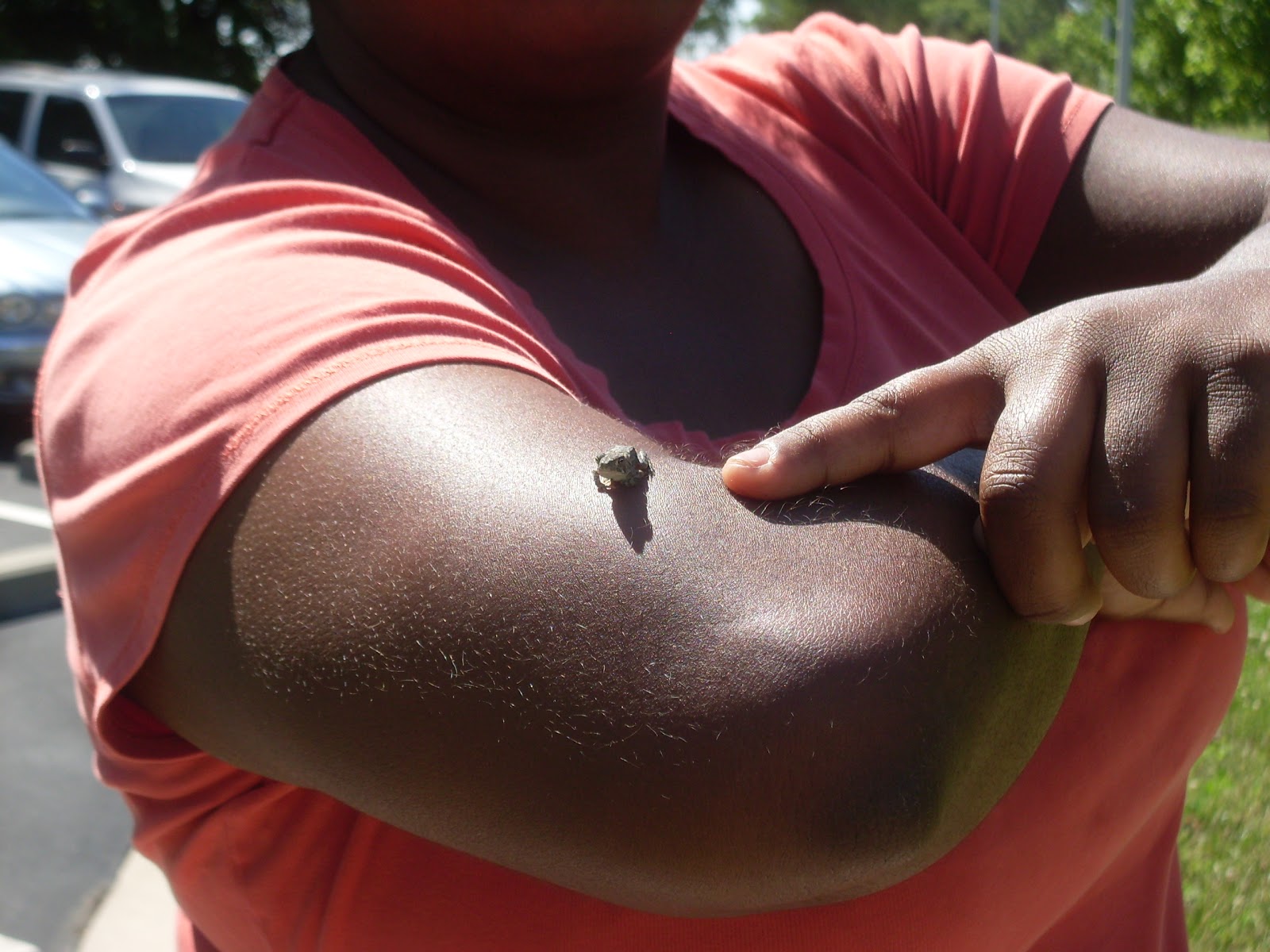
 Fowler's toad
 The little girls at the camp were initially resistant to touching frogs.  But after they saw me handle one, they were more curcious than afraid and couldn't help themselves.
The Best was when a little girl was simultaneously anxious but competitive, trying and trying to catch a frog squeeling the whole time. Some were so proud of overcoming their anxiety we had to coax them to leave the frogs and toads behind.

 Gray tree frog
Fowler's Toad

Tuesday, August 03, 2010

Election Day - Vote for Urban Science Adventures! (c)

It's Election day in many parts of the United States. I got up early this morning and voted in the Missouri Primaries and ballot initiatives.
But it also the beginning of the Black Weblog Awards Election season.

Thanks to you all, this blog has once again made the short list and is a finalist for the 2010 Black Weblog Awards in the Science & Tech Category.

Thank you, thank you, thank you!

To vote, please visit this link and vote for all of your Black Weblog Favorite Finalists (there are some really great and new blogs) in the 35 categories. Check out all of the nominees. Voting ends August 31st. You will have to provide a valid email address to cast your ballot.  And while you are there, consider makiing a pledge to the 2011 Black Weblog Awards Kickoff campaign.  The award committee is actually trying to create a live award presentation program next year.  So, maybe I could receive my blog award in person. Who knows.

And...I have submitted a proposal for SXSW 2011. Yes, THE interactive social media conference event!  Panel title: "OMG! Ur Prof is tweeting Science!" a dual panel to discuss how social media can be used to reach and engage broader and diverse audiences in science.  Voting for panels begin Monday, August 9th and continues until August 21st.  I'll keep you all posted on details.

In the meantime, I'll leave you with pictures from this summer and the great urban wildlife spotted at summer camp in St. Louis, MO...and remind you why my blog should win best Science blog.
a lightening bug (also called firefly) in the day time on this bee balm flower (also called wild Bergamont)
Me holding a Fowler's toad
a dead crayfish, next to an OutdoorAfro lip balm tube for size comparison
pointing to a frog
it's a Grey Tree Frog
another Fowler's toad
What's the difference between a toad and a frog?  They are both amphibians (having a life cycle in the water and on land) and both have tadpods - the baby stage.  But the quick way to tell the difference is by the skin. Toads are dry and have warty skin. Frogs are moist and slippery skin.  Color doesn't matter. Both frogs adn toads can be green, gray or brown.

Happy Urban Wildlife sighting.

Wednesday, June 30, 2010

Wordless Wednesday: Wild Morning Glories

I was stopped at the westbound I-70 exit of Kingshighway (in St. Louis, Mo) and I noticed these wild morning glories growing from the crack of the sidewalk. These wild flowers, sometimes called hedge bindweed, tend to be white or white and pink (like these). The flower is near the ground and doesn't grow tall but it is viney so it spreads across lawns easily.  Here in the city, I often find them growing out of concrete or asphalt and near buildings.

This patch of wild morning glories was thriving in the urban area.
This is a close up of the flower. This one was growing on the lawn of Forest Park.


Have you ever noticed this flower before in your neighborhood?

Monday, June 07, 2010

Mums the Word

Photos of mums (a few bugs, too) I took October 2009 at the Missouri Botanical Garden.

I love these warm colors, oranges and yellows.  Makes me want to just make a hair bow out of them.


Friday, June 04, 2010

Preparing for summer camp

Oh, I love summer! I love it, love it, love it.
And I'm very happy to annouce I have secured a fantastic summer position as the supervisor of a local Urban Nature Summer camp program. (Yes, the same one I did last year).

I'm working behind the scenes: interviewing hopeful Outdoor Instructors, calling facilities, making arrangements for the program.  I'm also assembling the handbook of activities.  We have a notebook full of classic raccoon circle activities that are always a hit and I've come across some new gems related to the same ideas.  I just had to share these with you.  I want everyone to appreciate how much the outdoors can be (and how much fun learning about ecology is, too.)

Thinks of these links as activity guides for any children you may have this summer (camp counselor, family reunions, scouting trips, babysitting, anything)
101 Nature Activities from Sanborn Western Camps
Environmental Education Activities & Games 
100 + Things You Can Do Outside! - recommended by me
 

I'm so looking forward to working this summer.


Picture of a may apple flower. I learned about this plant and how to identify last year when I worked for this program.  I hope to learn as much as I share with the kiddies this summer.

**************

And the Adventures continue...online. I have created an Urban Science Adventures! © Facebook Fan Page. Now you can share your pictures and stories all year long with other urban nature and environmental education enthusiasts.

Related Posts with Thumbnails