Showing posts with label science and the public. Show all posts
Showing posts with label science and the public. Show all posts
Wednesday, August 17, 2011
Wordless Wednesday: Scientific Americam Special Cities Issues


Thursday, July 28, 2011
Who are biologists and what do they do? Faces of Biology Contest
What does a biologist look like? Who are biologists? Where do they work and what exactly do they do?
For many grade school and middle school children, the image of an older (usually Caucasian) male with wild gray hair comes to mind. He's holding a test tube or flask and wearing a white lab coat and goggles. Other than the wild hair, none of those phrases describe me.
But why do so many people recall that image? I don't know, but I do know that the Faces of Biology Photo Contest presented by the American Institute of Biological Sciences is an excellent opportunity to expand everyone's preconceptions what a biologist looks like and what he/she does.
The contest is an opportunity to showcase the varied forms that biological research can take. Photographs entered into the contest must depict a person, such as a scientist, researcher, technician, or student, engaging in biological research. The depicted research may occur outside, in a lab, with a natural history collection, on a computer, in a classroom, or elsewhere. ~ from the official contest website.Like this one of me (and my wild hair, hahaha)

Seriously, you should consider a picture of your own to the contest. The grand prize is this

plus $250 cash.
Learn more about the contest and read the orginal full post at The Urban Scientist at The Scientific American.
Sunday, May 22, 2011
Summer of Science Book Reading Club kicks off May 23, 2011
Hey parents/grandparents/summer camp mentors!
Looking for fun yet academically engaging things to do with your young ones and teens this summer? Want to make sure they don't lose step and let all of that great knowledge slip out of their heads. Want to keep them on task with reading and literacy? Want to subtly kindle that inner science/engineering/tech spirit in them?
Well check out this super great summer reading program by SCIENTICITY, this amazing online community of people who promote the public understanding and engagement of science. They host a variety of science engagement programs, but the youth reading program is their summer emphasis.
There are actually two programs, broken down by age group.
1) Kids Read Science - for children ages 8-12 years of age
2) Teens Read Science - for teens 13-18 years of age
The rules for both are the same:
1. Choose a non-fiction book about nature, science, engineering, or math, or about people who work or worked in those fields. The book should help you understand more about what science is and how it works. Textbooks are not acceptable choices. If you need suggestions it's good to ask a science teacher or librarian for ideas.
2. Read your book.
3. Make a video about your book. It's like a video book report. The video must be less than 5 minutes long, and you must give the name of the book, the name of the author, and reasons why you would or would not recommend the book to your friends.
4. Post the video online. They prefer that you post it to your own account on YouTube.com and tag it with "KidsReadScience2011" or "TeensReadScience2011". There are other posting options in the long form of the rules. Visit the website for more details of both reading events.
5.Fill out our official online submission form, for Kids Read Science or Teens Read Science. This allows the judges to locate your video and they will know how to contact you if you win one of the fabulous prizes. Sorry, so far only US residents are able to win prizes this year.
6. Do all this before the deadline: 11pm (CDT) on 23 September 2011.
When I was a kid I participated in summer reading programs sponsored by our city library. I loved them! It was the highlight of my summer. At the end of the summer the library branch threw a party for all of us kids and had an award ceremony. Prizes were awarded to children in different age groups who read the most books. I was so competitive. Although children and teens who submit videos are competing nationwide for prizes, there is no reason not to reward students locally for participating in this event, and it doesn't have to be fancy or anything. Just something to keep them encouraged and let them know they are supported.
And why should the kids and teenagers have all of the fun? SCIENTICITY also hosts a Science Book Challenge for adults. Read three science related books and drop them a note telling them how you liked each book and they'll post your book reviews for others to see. That's it.

And if you're not sure what to read or where to get started, check out my blog posts about great science literature I've read - for youth, teens, and adults.
Happy reading!
Sunday, April 10, 2011
Citizen Science Spring & Summer Field Season opens
The warmer weather calls us outside to run, jump and play. And if you take a close look or listen, you'll notice that the nature is all-abuzz, too. All of that new life sprouting and peeping around is waiting on someone just like you make very important scientific observations and report them. There are alot of projects out there and scientists like myself who could use a hand and your eyes!
Why get involved in a citizen science project?
It's a perfect way to spend time with your family. You're always wondering what you can do that's different, will make for a great adventure and doesn't cost alot of money.
Start a fun learning project. If you're a home schooling parent, after-school teacher or camp counselor and you want the kids to have a meaning experience that will go with them forever. This is it. Just a little time once a week or once a day yields the perfect opportunity to do a big end-of-camp presentation and capstone experience.
It is so easy! Seriously, simply visit a website, sign-up for a project (and sometimes you don't have to do that), and email the results back (or fill out an online form). If you find a local project, then you show up and lend a scientist a hand and get a chance to get up close and personal with some exciting plants and animals.
Here are some Citizen Science projects you can do right now!
Why get involved in a citizen science project?
It's a perfect way to spend time with your family. You're always wondering what you can do that's different, will make for a great adventure and doesn't cost alot of money.
Start a fun learning project. If you're a home schooling parent, after-school teacher or camp counselor and you want the kids to have a meaning experience that will go with them forever. This is it. Just a little time once a week or once a day yields the perfect opportunity to do a big end-of-camp presentation and capstone experience.
It is so easy! Seriously, simply visit a website, sign-up for a project (and sometimes you don't have to do that), and email the results back (or fill out an online form). If you find a local project, then you show up and lend a scientist a hand and get a chance to get up close and personal with some exciting plants and animals.
Here are some Citizen Science projects you can do right now!
1. Nature Notebook with The USA National Phenology Network.
 Basically, you adopt a special place, like your backyard, special area of your neighborhood park, your school yard, or even the empty lot along your street. You visit your special place at least once a week. Make notes in your nature journal (are you journaling? if, not it is so much fun and you should do so right now) and share your results with the online data base. The data from you and others all over the nation will be used to track any changes our natural world is making to climate changes and human influences. Go to their website to learn more and sign up. Also follow them on Facebook and Twitter.
2. Firefly Watch. As a child I loved catching lightning bugs and putting them in a jar. I didn't know it then, but the little fluorescent bug was a scientific wonder - producing this yellow-green glow to communicate with other fireflies to mate or catch prey. How neat! Now, you can take that simple pastime and make a difference. Scientists using that information to track any changes in firefly distribution, habits, and population growth. You can sign up to be an observer and submit your weekly observations at the website sponsored by the Museum of Science.

3. If you live in my neck of the woods, you can participate in BioBlitz in Creve Coeur Park! The Academy of Science of St. Louis is leading an expedition of citizens and scientists on a 6-hour exploration and cataloging of urban wildlife biodiversity of this St. Louis Metro area park on Saturday, April 16, from 6 am - 12 noon. This is Creve Coeur Park’s first BioBlitz. Teams of public volunteers led by biologists, naturalists and environmental enthusiasts search natural areas within the park, listing as many different species as they can find. You can follow the Academy @AcademyofSciSTL on Twitter.

4. Shark tagging. My friend David Shiffman needs volunteers to help him with his research for school. Do you like Shark Week? Then, you're going to love being a citizen science with David. He tags (small) sharks for his research in sharking feeding behavior and ecology; and his research also helps to measure the size and health of the shark populations in the Coastal South Caroline sea. Over 30 different species of sharks call that coast home. It's very interesting work and definitely will give you something to talk about at parties forever. You can learn more about his research here and follow his blog about sharks, marine biology and conversation of the ocean and its creatures at Southern Fried Science and on Twitter @WhySharksMatter.
5. Interested in more citizen science ideas? Then check out Science for Citizens. You can look up upcoming projects or submit your own ideas. I bet you find something perfect. Be sure to come back and let me know what you've been up to.
DNLee
demystifying nature letting everyone experience
DNLee
demystifying nature letting everyone experience
Friday, February 18, 2011
When was the last time you visited a science center or museum?
I'm in Washington, DC now. I'm in town for the AAAS (Science Magazine) conference. I love science conferences and I love this gathering in particular. It's the world's largest science conference and an inter-disciplinary mix of scientists, social scientists, engineers, educators and science-tech policy makers . The energy is amazing. Nerd heaven, I say. Nerd heaven, indeed.
And on February 16 and 17, 2011, I attended the first ever International Public Science Events Conference, a pre-conference gathering of outreach scientists, science educators (formal & informal) and related institutions. We shared ideas, successes, and challenges to promoting science and engineering to the general public - you - via small and large events and celebrations. I co-moderated a workshop on Broadening Participation with the incomparable and kindred Madhu Katti of Reconciliation Ecology.
 |
| Me with Madhu Katti |
All the conference participants shared ways to make our science meet-ups,science cafes, science cabarets, and science events more accessible and engaging. That was the objective of the entire pre-conference. Then as I listening to Dr. Dennis Wint, President and CEO of The Franklin Institute, Philadelphia, PA, discuss how and why science centers/museums matter in public engagement, I began to wonder...How important is science and math education to people who aren't in the business of science or math education. I mean, yeah, I know you think it's important, but how would you articulate that to another parent or community member?
 |
| Me with Dr. Wint of the Franklin Institute |
Then Dr. Wint touched on how science centers/museums are a great science educational resource, sometimes the best thing going if your school system is slashing and burning education in science, math, and arts - like many are. I agree, and I wondered how many people are taking advantage of these continuing education centers?
So I did my own social media poll. When's the last time you, your friends/family visited a science center or museum? Which one? What city? Folk responded on twitter using the hashtag #scicenter.
I got about 20 responses. Most people attended fairly recently (within the last few months, I assume spending family time over the holiday). Here's a summary of responses.
- MIT Museum for opening of MIT150 exhibit
- Ontario Science Center in Toronto
- Franklin Institute in Philadelphia!
- American Museum of Natural History in NYC x2
- Science Centers of San Jose, Philadelphia and Cleveland
- Science Museum & Childrens Museum of Atlanta
- Hong Kong Science Museum for the exhibition "Marvelous Inventions of Leonardo da Vinci"
- Liberty Science Center Jersey City, NJ
- Discovery Centre in Halifax, Nova Scotia
- National Space Center Leics, UK.
- Science Museum, London x2
- Natural History Museum, London x2
- North Carolin Museum of Natural Sciences in Raleigh-Durham
- Museum of Life + Science in Raleigh-Durham, North Carolina
- Fels Planetarium (Part of the Franklin Institute, so it gets another tally)
- St. Louis Science Center x4 (my backyard)
- McAuliffe-Shepard Discovery Center Concord NH
- Smithsonian Museum of Natural History in DC
- The Field Museum of Natural History in Chicago
- Cape Fear Museum in Wilmington, NC (they have a giant ground sloth skeleton)
- Taupo Vocano Centre in New Zealand
- Museum of Science and Industry in Chicago
also got some Zoo/Aquarium/Botanical Garden responses, too
- North Carolina Aquarium at Pine Knoll Shores
- St. Louis Zoo
- Missouri Botanical Garden
Thursday, January 13, 2011
Discussing The Immortal Life of Henrietta Lacks
Without a doubt, Henrietta Lacks was the most significant contributor to medical science and microbiology. She wasn't a scientist or a doctor. She was a mother and wife and grand-daughter of a tobacco farmer of Clover, Virginia. In February1951, she went to see doctors for what turned out to be cervical cancer at Johns Hopkins Hospital in Baltimore, Maryland. In the course of her treatment, doctors biopsied her cells to study them...and they never stopped growing. Though she died months later (October 1951), her cells lived on as a result she has cured polio, developed in-vitro fertilization technology, visited outer-space, and helped unlock the mystery of the HIV virus.
Rebecca Skloots top-selling nonfiction book about Henrietta Lacks and her immortal cell line, Hela cells, is coming out in paperback form. If you have yet to read it, then hesitate no more.

Confronting Science: African American Perceptions of Science and Medical Research
Tuesdays, February 8, 22, and March 8, 2011
African-Americans, as well as other minority and socio-economic marginalized groups, have had tumultuous relationships with the science research community. The period post American slavery was a time of racial definition and some scientists were set to demonstrate superiority of some groups over others. Combine this with secretive research missions, such as the Tuskegee Experiment which took place between 1932 and 1972, and it is very easy to understand why African-Americans are wary of experimental research. Compare these historical feelings of fear and distrust and it may also explain many inequities within the African-American community, including health disparities, participation in research studies, and pursing science-related careers. Ethics, Accessibility, and Faith were three of the major themes presented in the book The Immortal Life of Henrietta Lacks by Rebecca Skloot; and these themes are also major filters through which many African-Americans view science today. I will lead a three-part book discussion that confronts science and the research community via these filters and help the audience explore opportunities to see science and research in a wider and more inclusive way.
Part 1 - Ethics: Before any fruitful discussion about improving health care, access to resources, or increasing diversity in the sciences can occur, the painful accounts of science research must be fully addressed. The ethical issues presented in The Immortal Life provide an introduction to exploring the history of ethics in science research in the US, as well as thoroughly exploring people’s prejudices and perceptions of science, scientists, and the research community at-large.
Part 2 - Accessibility: The children and neighbors of Henrietta Lacks lacked access to quality long-term health care. This was not only due to their economic situations, it was exacerbated by their poor comprehension of science and medical terminology. Such barriers to understanding, as well as to care and career options, still exist for many today. I will lead a discussion on accessibility to science and health care – then and now – as well as share programs that aim to address these disparities.
Part 3 - Faith: Both Henrietta Lacks and her daughter, Deborah, were women of faith. Faith and religion have often been pitted as contrary to science. Moreover, faith plays a powerful role in health and healing within the African-American community. We will explore the role of faith for the subjects in the book, including the author who describes herself as agnostic, and how one’s personal faith is a filter to accepting or rejecting science and research.
Tuesdays, February 8, 22, and March 8, 2011
5:30 pm-7:30 pm
Schnucks Learning Center
Missouri History Museum
Participation is free, but registration is required; call (314) 361-9017.
If you live in the St. Louis Metro area, then please come on down.
Saturday, January 08, 2011
ScienceOnline Bound, Baby!
Happy New Year!
Good day good people. I am SOOOOOOOO geeked and excited about the upcoming science blogging conference MLK weekend in Research Triangle, North Carolina. It's one of my favorite meetings: it's science, it's social media and it is definitely ALL fun. I live for this stuff! (LOL)
I'm also quite proud of the fact that I'll be attending this meeting as the NESCent Blog Travel Award Winner. (My Kanye West blog entry about the evolutionary significance of gold digging was the winning entry: How some females respond to nuptial gifts.)
I'll be lending a hand here and there and you can chime in and follow along at home.

Here's how.
1. Offer some really great input to my session. I'll be co-moderating a super-cool session on the how social media can be used for science outreach in ecology, marine biology, conservation, and other 'outdoorsy' science disciplines.
Technology and the Wilderness – co-moderated by Miriam Goldstein, Jason Robertshaw, Danielle Lee and Karen James
Technology offers unparalleled opportunity for outdoor education – yet it is viewed as a cause of “Nature Deficit Disorder.” But little glowy screens can be amazing educational tools. Potential directions include tools (for example: a citizen science iPhone app from Mote Marine Laboratory), networking (e.g., Outdoor Afro bringing people of color outdoors together), and exploration (e.g., following up on the Blogging From the Field/Trash Gyre sessions from past years, citizen science, teenagers blogging their discoveries).Please feel free to add your input for this session in my comments, below.
2. Check out the full conference lineup and weigh in on other sessions, too. Afterall the goal of the conference is to make connections and improve how science is communicated to everyone, everywhere. Link to the full program.
You can also follow the conference online via: Ustream chatroom, Twitter, and FriendFeed. If appropriate, volunteers will convey good questions/comments from the virtual audience into the room.
Here are the links to follow along online at home:
On the Scienceblogging.org blog:
on Twitter: @scio11 and hashtag #scio11 and Follow me, too @DNLee5 (I'll be tweeting all weekend)
You can also offer comments and follow my session at the hashtag #TechWild
on FriendFeed: scienceonline2011 and Follow me, too DNLee
on Facebook: Scienceonline2011 and I'll be posting on my Facebook Fan page, too
Live stream (and recorded): Scienceonline2011 Ustream (Thanks to sponsorship by AAAS, Science, & Eureka Alert and National Association of Science Writers)
Science Online app for iPhone, it's free: http://itunes.apple.com/us/app/science-online-2011/id412080541?mt=8
3. I'm also part of the band of misfits putting on the Open Mike Night. There'll be all kinds of carousing and nerdy-shenanigans for this event.
I hope you're able to participate in some way. It really is an open access feel. Sharing science with general audiences, like all of you is my passion and the passion of the most participants. Our goal is make science accessible and engaging for everyone. Please, help us do so by sharing your honest feedback with us.
Until later,
Stay warm and safe
DNLee
Wednesday, December 08, 2010
Educational Gift Giving Ideas for the Holidays
Happy Holidays!
It’s that time of year for good cheer, celebrating, and holiday parties. I especially love attending networking holiday parties. And in the spirit of the holidays, many of these parties have charitable notions. Some ask for food donations, or to adopt-an-angel/family/child/senior. I love these themes.
However, my time serving and working in social service really forced me to confront the objectives of these gift-giving soirees. I mean, what does it mean to give a family requesting assistance with their utility bills a brand new game system or iPod? Something about that is not only ironic but completely opposite of the goal of helping families get on their feet. Moreover, I believe the gifts one gives should be meaningful to the giver, too.
When I was younger, and my mother made holiday gift donations, she always provided books. She didn’t want to bother shopping for clothes that might not fit or be appreciated and she hated fighting crowds in the toy aisle. Plus, she’s a big proponent of education so books are the best gift, fits everyone, lasts forever and keep on giving. So when I am asked to bring a toy for a child, I find myself browsing through the book shelves instead of the toy aisles. Moreover, as a scientist interested in sparking the excitement and wonder of nature in youth and adults of all ages, I tend to favor books about science, ecology, and achievement. But I’m biased. I liked books as a kid. I loved reading. I know there are children (and adults) who don’t like to read and might find such a gift insulting. So, I’ve stretched my imagination some, however, I still believe in educational gifts – gifts that inspire creativity and imagination, gifts that foster critical thinking and team work, and gifts that are gender-neutral.
So here’s my list of suggested educational, science/engineering, youth and adult friendly, gender neutral gift ideas.
1. Jigsaw puzzles (but depending on the age, not too many pieces, that could be discouraging). I chose one with North American Animals. I thought that perfectly reflected my values related to environmental education.

2. Rubik’s cube

3. Board games: old-fashioned strategy games like Scrabble, Othello, Connect 4, Memory (for the tots)
4. LEGOs and other building and engineering-inspring games. Did you know that LEGO sponsors all kinds of Educational Competitions? Sometimes childplay can turn into something awesome. Legos are the gateway to robotics, engineering, computer science, and technological sciences.
5. Books are still a great idea. Such as the ones I’ve read and reviewed about animals, nature, and environmental science. Also check out the AAAS Science Books & Film Gift Guide 2010 list of science books for all ages. Lots of great titles.
Wednesday, November 17, 2010
Connecting Minds to Science
The United States is ranked 35th in Math and 29th in Science. Other nations such as China, Finland, Australia, and Japan outrank us. Think about it, what are the things we love in this society? Our technologies - tech gadgets, televisions, high performing cars, digital communication, digital music, green technologies, convenience foods, all the conveniences of life. Have you ever stop to think about the minds that go into making these technologies? These industries are beyond lucrative. Those who work in those industries, whether on the creative side, innovation and improvement side, manufacturing and distribution side, or marketing and selling side - individuals who work in these industries earn good livings. Our society is moving ever-more rapidly to innovation. So if you wanted to be on board this very fast moving train, you would have to be ready for it.
You can‘t simply wake up and decide today you will invent or enhance such a technology. Even if a great company moved into your neighborhood and offer jobs with amazing salaries, the question you must ask yourself, would I (or my friends, family, etc) be eligible to apply? Do I or we have the requisite or foundation skills to apply for that job.The Connect a Million Minds campaign held a Math, Science & the Future of Our Nation Global Town Hall meeting earlier today. Here is a link to a video as why this is a very important matter.

When opportunity meets preparation
Many of us want opportunities and chance for grand lives. The conversation within families and communities must now include a frank dialogue about the role preparation, if it hasn’t already. As Astronaut Sally Ride shared before the Global Town Hall, she happened to see an ad in the university newspaper calling for applications to the NASA space program. Being an astronaut was a fantasy of hers, but as she read the list of requirements to apply, she realized that she had taken all of the required math and science courses and decided to give it a try. The rest is history.
How many opportunities have some of us (or our children) closed the door on, simply because of our disinterest in science and math? How many of us are blind to the many opportunities available in science, engineering, and technology?
My fear, is that the answer is too many, especially for individuals from communities of color who are still under-achieving in math and science class and under-represented in math and science classes and work industries.
Furthermore, how does the image of scientists and engineers and perception of science, technology, engineering, and math as ’uncool’ play into that? No doubt, a lot. In other nations, such as China, the smart kids are the ones who are admired and respected by peers. In Australia, youngsters compete to make good grades and take challenging courses in chemistry and physics. These young people celebrate the innovative genius of Bill Gates and Steve Jobs. Quite the opposite of US attitudes that avoid hard classes and turn in assignments late or our great pre-occupation to celebrate sports over academics. These attitudes result in an apathy for the subject matter, which leads to our poor standing in these subjects. That in turn leads to our nation’s declining ability to work in these industries.
But there is a cool factor to STEM. The popularity of Mythbusters, Adam Savage & Jamie Hyneman, attest to that. So does the participation of Video Game designer Kudo Tsunado, in the town hall. He explained how much math, such as algebra, calculus, and physics are apart of game design and development. Those games are math and science in action. When a designer has a god understanding of math, he/she designs better games. As the dialogue considered ways to change the attitudes of young people about science it really became apparent to me is that Profile matters. There is something to be said of raising the profile of individuals who are innovative. In this case, the media markets and starlets in entertainment could be king makers. With one simple tweet or mention or sincere gesture of acceptance, something becomes cool. Instantaneously.
And what can only be described as kismet, the December 2010 issue of GQ magazine features a spread of the Rock Stars of Science. By lending some if star power, the music industries brightest is sharing the limelight with some amazing scientists. In fact, this strategy is not new. It simply uses very smart social marketing strategies to create a cultural shift of attitudes about anything. And as I was reading another timely piece of online writing, Christopher A. Boudy’s post about "Where Are the Black Nerds At?" I thought of how dope it would be do a similar spread in an African-American target magazine, such as an Ebony, Source, or VIBE. Couldn’t you see a spread with Kanye West, Little Wayne, Mary J. Blige, Alicia Keys, and Drake standing in the lab or field with some of the brightest up-and-coming-scientists, engineers, and doctors. That would be so hype.

FYI: I recognize that I came with one amazing idea. I expect to be fully credited and compensated if such a magazine (print or online) decides to go full steam ahead with that. Thanks and love ya! DNLee
Wednesday, September 22, 2010
Wordless Wednesday: Water Quality

I'll be at Spring Valley Park in Kansas City, Mo leading water quality monitoring activities with the families that come to the Kids Fishing Derby for Urban Outdoor Day presented by Urban American Outdoors and Kansas City Missouri Parks & Rec. I hope people see the obvious connection between the activity - fishing - and the importance of maintaining healthy waters for wildlife and future outdoor recreational activities. I also hope they make the next obvious connecton to their own daily habits and how that might relate to water quality.
Water Quality can be monitored in two different ways: abiotic monitoring and biotic monitoring.
Abiotic monitoring involves measuring the important physical parts of the water environment such as
- the pH of the water: how acid or basic it is
- the amount of dissovled oxygen in the water
- turbidity: how clear or cloudy the water is
- temperature: how warm or cool the water is
 |
| Macroinvertebrates are very good indicators as to the health of a stream, lake, or pond |
 |
| The presence of many different species and other predatory invertebrates is a good sign that the water habitat can support many food chain levels. |

 |
| Healthy fish species are also a good sign. Remember, vertebrate species like fish and birds ultimately depend on invertebrate, microbe, and plant species for their survival, too. |
Are you celebrating World Water Monitoring Day? If so, how? Tell me about your adventures.
Monday, September 13, 2010
Summer activity recap - having adventures all summer long.
I have been busy. As I am sure you all have noticed by my blogging frequency. (And let me say I am very thankful that you all have still been with me through all of this). 2010 is definitely becoming a breakthrough year professionally: defending the dissertation, graduation, working, presenting.
The truth is, the busy-ness I am experiencing in real life is the result of my online science blogging activities. How paradoxal, huh? If you follow the blog on Facebook, you might have noticed the tick in professional activities. I've been trying to convert the blogging audience into an online community and so far so good. I've been posted pictures and updates directly to the Facebook Fan page. (And if you're so inclined, please join, too.)
Quick recap of this summer achievements:
1. Submitted a video to the Oprah Winfrey Network contest to have my own televison show. I didn't place, but I'm still proud that I finallyput my vision to words, pictures, audio and video. Many thanks to my sister for editing and creating this audition video. So, if anyon out there knows of a media outlet that would be interested in such a program (produced/hosted by me of course), please feel free to get at me.
2. Blogging While Brown Conference in Washington, DC. Attending and speaking at this conference has spurred many other social media engagement opportunities. I met some amazing bloggers (The Cubicle Chick and Glamazini) from St. Louis and we hosted a tweetup - a real life meetup of local area Twitter & facebook users and bloggers. We plan to have more tweetups in the future. Plus, one of my co-hosts is hosting her own blogging conference: Show Me the Blog on Saturday, October 23rd.
3. Forest Park Summer Youth Program job. Oh, I had a blast working with the kids this year, and the staff. I worked as a counselor last year and got a chance to use alot of the lessons learned in Experiential Education - that I also promote here on the blog - in real life. Plus, I was proud of my professional growth. I was the program supervisor this year and the staff seemed to enjoy themselves and no kids were injured....so I'd say I did alright.

4. St. Louis Magazine. Earler this summer I was recommended by the St. Louis Academy of Science to answer the "Big Question: If you had $10 million dollars, what idea would you fund to transform St. Louis". If you're able to secure a copy of the September 2010 edition of the magazine, you'll see I'm one of 45 people who answered the question. I'm really honored because I share some print space with some local heavy hitters like Economic Developer John Edwards and Beer Hier Adolphus Busch IV.

5. Featured in the Science & Tech Section of the Charlotte Observer. Each Monday, a new science blogger is interviewed and featured in the newspaper. Here is the link to my interview in the August 23, 2010 paper: City dwellers can see science all around town by TD Beeland.
6. I got a job! Perhaps this is the single biggest accomplishment over the summer. I believe in the Law of Attraction I asked for an opportunity to do science outreach for pay and it happened. I'm presently sharing science and consulting on matters related to STEM diversity and outreach for a fabulous St. Louis-based non-profit - SCOPE (Science & Citizens Organized for Purpose & Exploration).
7. Upcoming speaking engagements. Actually the presenting started in the summer when I was invited to Miami University in Ohio. I presented part of my dissertation to the Biology Department for their Research Experiences for Undergraduates program. Also, I'll be presenting at the Urban Outdoor Summit in Kansas City on September 24 & 25th. It's a great meeting to discuss the recreational and career opportunities in outdoors and nature for diverse audiences. It is a free meeting which culminates in a Kids Fishing Derby at Spring Valley Park. Plus, I've been invited to present at The Missouri History Museum as apart of the Perspectives on Science and History Lecture Series for the Exhibit: Home Lands: How Women Made the West. If you're in St. Louis, Missouri on the evening of Tuesday, October 19, then feel free to check out the lecture on Homestead Earth: An Evening with Women Environmentalists.
See, I told you I've been busy.
Sunday, August 22, 2010
Missouri State Fair - growing my own great memories
I've spent the last week at the 108th Annual Missouri State Fair in Sedalia, Missouri. It was a lovely week. I was there doing science outreach, participating in the 4 Days of Hands-on Science Fun which included a Street Science Fair, Show Me Robotics Showcase & Competition, and Aerospace Fun Day. Plus, there were the agricultural exhibits and showcases. I loved it all. it really reminded me of my agricultural roots.

When I was younger, I would go to the Mid-South Fair and Libertyland housed on the Fairgrounds in Memphis, Tennessee. I loved it: the rides, the games, the food. Being a city kid, I thought that's what the fair was all about. It wasn't until college - majoring in Animal Science that I came to know that wasn't what the Fair was about at all. Fairs are about the agriculture and home economics achievements of everyday folk - the people who grind and work to make their daily lives out of hard work and simple materials. It was eye-opening to learn not only about the science of raising livestock, growing crops, and the economics of practical living, using all resources adequately and respectfully, as well as the creativity and artsmanship of both agriculture and home economic endeavors. I had a new appreciation of fairs that continues today.
So, as I spent time at the Missouri State Fair, I was more excited about the animal exhibits than the rides at the mid-way. But don't get me wrong. I still had all of my fair favorites: corn dogs, funnel cake, lemonade,turkey leg, roasted corn, plus fried green tomatoes. Nom, nom, nom.


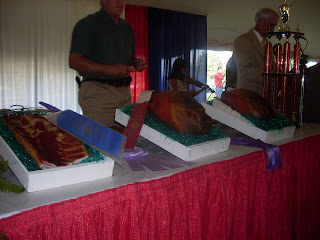

Check out more photos from the Missouri State fair at my Facebook Fan Page: Missouri State Fair 2010 Photo album.
And as I looked around, I realized that State Fairs are perfect opportunities for people to reconnect with their communities on a regional scale and appreciate what it has to offer. State fairs are ideal day trip destinations for the entire family - from the young kiddies, the teens, young adults, and grand parents. Load the car up and take everyone out for a great time. I met one family that comes to the fair every year. They camp out on the nearby campground and they pall around all weekend. Isn't that lovely (and affordable)? Now, that's how fond childhood memories are made.
The only thing I thought the fair was missing was diversity. People came from all over the state, but there was very, very little participation from St. Louis and Kansas City - the state's major metropolitan areas. It's a two-way street no doubt, but I can't recall a single piece of advertisement within the St. Louis Metro core. For the most part, fairs are rural events, but considering that every heritage has a rural and agricultural history (not to mention the fact that everybody eats), I think it's a shame that State Fair planners haven't found ways to engage multiple demographics, especially since many regional fairs are struggling. I can imagine a whole list of ways to attract urbanites to the State Fairs that wouldn't involve an overhaul of marketing efforts. And with the rise of people's interests in farmers markets, urban gardening, and local food, I think the urban markets are ripe for plucking and attending State Fairs. So, if any fair planners are serious about increasing reach in urban areas, then feel free to contact me. I am more than happy to offer my consultation services to your operation.
In the comments section, please feel free to share your State Fair Memories, too. Check out OutdoorAfro's blog post about State Fair memories. It's like she's in my head or something.
Enjoy!

When I was younger, I would go to the Mid-South Fair and Libertyland housed on the Fairgrounds in Memphis, Tennessee. I loved it: the rides, the games, the food. Being a city kid, I thought that's what the fair was all about. It wasn't until college - majoring in Animal Science that I came to know that wasn't what the Fair was about at all. Fairs are about the agriculture and home economics achievements of everyday folk - the people who grind and work to make their daily lives out of hard work and simple materials. It was eye-opening to learn not only about the science of raising livestock, growing crops, and the economics of practical living, using all resources adequately and respectfully, as well as the creativity and artsmanship of both agriculture and home economic endeavors. I had a new appreciation of fairs that continues today.
So, as I spent time at the Missouri State Fair, I was more excited about the animal exhibits than the rides at the mid-way. But don't get me wrong. I still had all of my fair favorites: corn dogs, funnel cake, lemonade,turkey leg, roasted corn, plus fried green tomatoes. Nom, nom, nom.


I also checked out the Home Ec. exhibits as well. You can tell the first placed pies....bigger slices cut out. lol.
 |
| It's a shame all of those lovely treats were only enjoyed by the judges. They stay on display throughout the fair and then discarded. I love sweets too much to commit that kind of abuse. |

And as I looked around, I realized that State Fairs are perfect opportunities for people to reconnect with their communities on a regional scale and appreciate what it has to offer. State fairs are ideal day trip destinations for the entire family - from the young kiddies, the teens, young adults, and grand parents. Load the car up and take everyone out for a great time. I met one family that comes to the fair every year. They camp out on the nearby campground and they pall around all weekend. Isn't that lovely (and affordable)? Now, that's how fond childhood memories are made.
The only thing I thought the fair was missing was diversity. People came from all over the state, but there was very, very little participation from St. Louis and Kansas City - the state's major metropolitan areas. It's a two-way street no doubt, but I can't recall a single piece of advertisement within the St. Louis Metro core. For the most part, fairs are rural events, but considering that every heritage has a rural and agricultural history (not to mention the fact that everybody eats), I think it's a shame that State Fair planners haven't found ways to engage multiple demographics, especially since many regional fairs are struggling. I can imagine a whole list of ways to attract urbanites to the State Fairs that wouldn't involve an overhaul of marketing efforts. And with the rise of people's interests in farmers markets, urban gardening, and local food, I think the urban markets are ripe for plucking and attending State Fairs. So, if any fair planners are serious about increasing reach in urban areas, then feel free to contact me. I am more than happy to offer my consultation services to your operation.
In the comments section, please feel free to share your State Fair Memories, too. Check out OutdoorAfro's blog post about State Fair memories. It's like she's in my head or something.
Enjoy!
Wednesday, July 21, 2010
And the bottom falls out of the Science Blogging Universe
I love soda. That should be no such a big surprise if you saw my previous post where I admitted to loving junk food. I love science. And you know I loves Science Blogging. But if I had known my little affair of junk food and science and social media would end up in the mess now regarded as #PepsiGate/#SbFail, I would have shunned the tasty but not-so-healthy beverage long ago. You see, Cola has shattered my science blogging world.
July 7th, news began to spread that Scienceblogs (operated by SEED Media Group) was now hosting Advertising blogs - Blogs that paid to be in the Sb Community to blog about a particular subject. At first the idea of Advertising blogs didn't raise any alarms until I read the critique of the whole matter at the much respected Knight Science Journalism Tracker: ScienceBlogs trashes credibility: Leaked response from editor. I then understood why many of my fave Sb bloggers were in an uproar.
I was grateful that not everyone reacted too quickly or strongly to PepsiGate, e.g. Dr. Isis and Greg Laden. I tend to be rather oblivious to tensions and in-fighting of others. Unless I'm personally affected by the madness, I remain agnostic about strife and that was my initial response to this matter.
See, what had happened was....
Junk food giant Pepsi Cola purchased blog space for their new social media baby - Food Frontiers. It was supposed to blog written by their Food/Nutrition Scientists about Nutrition and Food Science and all of the yummy ways corporate America makes us healthier one bite/gulp at a time. No kidding. None of that sounded right to Sb bloggers or to me. And the reasons why Pepsi purchased blog space as opposed to being invited are articulated quite well here and here.
But before I could adjust to this madness, I started reading blog posts or twitter feeds like this:
Culture Dish Doesn't Live Here Anymore (Best-selling HeLa cells Author, Rebecca Skloot leaves)
My Official Farewell (My co-dissertator and high-heel shoe friend SciCurious leaves)
A Pepsi-Induced Hiatus Exodus (Super popular,science writer paleo style blogger Brian Switek departs)
What's going on here?!
Sciencebloggers striking and others were jumping ship like rats off of the Titanic.
Can't this be fixed? Is the party ending already?
After all, SB was this idyllic place in my head. Once a upon a time, I would dream of being invited to join this great science blogging community. Me, or rather this blog, would be in the company of the Greats! Yes! But no invite came. More blogs were being added to the Sb fold and none of them looked or sounded like mine. Eventually, I shrugged it off and kept it moving. I realized that as a niche blogger (science introduction) that targets a particular audience (African-Americans), joining Sb might not be a good move for this blog. I would certainly get more traffic and attention; but not necessarily from the people I was trying to reach. Until such a thing as an AfroWorld Blogging Community, something akin to the SB model, existed, then my blogging platform was just fine.And so it has been. I've been a firm member in both the Science Blogging Community and the Black Blog-o-sphere, doing my thing and bridging the two communities where ever, whenever, and however I could.
However, with the exodus of great bloggers from Sb, Emerald City hasn't been looking so shiny lately. And then the bottom fell out. On July 19, 2010, the leading link in the header of Scienceblogs read Bora leaves ScienceBlogs with superb history and analysis of science blogging. I actually gasped and teared up. No, not Bora! The Papa Smurf of the ScienceBlogs village. Always level-headed and fair. His virtual leadership in Sb was always obvious. Like Papa Smurf, he seemed to know, accept, and even appreciate every single Scibling as he or she was - sweet, the crusty, the potty-mouthed, and the antagonistic. Everyone looked to him and no doubt he was the nucleus of Sb. Read Bora's Farewell- a long but thorough history of Sb,science blogging and new media science communication.

The bottom has dropped off!
Adam Bly, you messed up big time. Big Time! And if you still don't get why losing Bora is a big deal, I mean a REALLY big deal, then check out the Twitter Feed all about him #IOweBora. And if that wasn't enough, as I was trying to write this post (taking me 2 days to do so), I read on Twitter that PalMD, Zuska, and Abel Pharmboy is departing, too. Wow, those last two departures sting, too. Both have been great SM mentors to me. Zuska reached out to met at ScienceOnline09 in the sessions about STEM diversity and jumped immediately on board the Diversity in Science Carnival. And if Bora is Papa Smurf, then Abel Pharmboy is certainly my Fairy God-father. When I needed assistance getting to the Blogging While Brown Conference in DC, he came through in a flash. His mentoring spiriting and influence on science blogging and outreach to diverse audiences is summed up nicely in these lines:
"Preaching to the choir certainly has value in galvanizing the science communication community. However, I can't think of a single science blogger who doesn't view this exercise as a form of outreach - to share and demonstrate to our constituents, the humble taxpayers, that what we are charged to do for world health is well-spent and communicated in an objective and approachable manner."
*Throws this soda away. Turns the lights down low. Departs the room*
Monday, July 05, 2010
Blog Book Review: Jack in the Box presents Science Kids Mini-books
I love junk food. I just do. And one of my guilty pleasures are kids meals. The other evening I was picking up a hamburger meal at Jack in the Box. BTW, I love Jack. I'm from the south, so this fast food chain was so novel to me when I moved to the Midwest. They serve all kinds of tasty and savory treats. But I digress.
I gobbled my right size burger with the right amount of ketchup and mustard and right size fries and soda. I then automatically grabbed the toy and prepared to just toss it on the back seat. But this was no ordinary kiddie meal toy. It wasn't a toy at all, it was book, a science book, just for kids.
This is the book I have.

Author: Angela Wilkes
Publisher: Kingfisher
It's a book that explains a very important concept in ecology - habitats. I love how the author explains why animals need homes, how different animals build and use homes, and the different places animals build homes - trees, under ground, and in the water. It is a trade book for sure, but only 7 x 5.5 " it fits perfectly in smaller hands. The bright bold photographs of birds, fish, mammals, insects, rodents, and more in the their homes illustrate the importance of homes - or habitats - to our wild neighbors. Plus, it is just the right amount of text for young readers. Along the footer of each page are definitions of some of the more complex words used in book I recommend for pre-K-grade 1 students. And my absolute favorite part of the book...Activity suggestions! Yes, Jack encourages the youngsters to 'investigate the world of science' and offers simple instructions, using upcycled materials, to watch their wild neighbors.
Synopsis from Jack in the Box Kids Toys website.
ANIMAL HOMES
In this book about animal homes, you'll discover an ant colony, learn about animals in mobile homes and take a look at how some animals live underground. More fun included with hands-on projects for you to do.
Okay, Jack. I didn't realize you loved sharing science and encouraging the citizen science in your younger patrons, like me. But now that I know, expect a call from me. I see us doing great science outreach together in your urban markets.
Dr. DNLee, at your service!
demystifing nature, letting everyone experience.
Saturday, June 19, 2010
Friday, April 30, 2010
I'm speaking at the Blogging While Brown Conference
I have been selected as a panelist/presenter at the 3rd Annual Blogging While Brown Conference. I attended this same conference last year and was initially unsure of what I might gain from the conference, I was pleasantly surprised and was very glad I had attended. I learned some new things about the technology and direction of social media among communities of color. But more importantly, I met some amazing people, some amazingly supportive people. I was feeling as if the Black Blog-o-sphere seemed dominated by pop culture and political commentary, and that blogs about science/nature/education written by people of color seemed overlooked.

Social media (and the real life interactions that come about from it) are just one of many ways to engage people in ideas and actions. The people in that room helped me realize that we could work together, leveraging our strengths (and blog audiences) and helped me achieve some very important goals related to growing my blog. It was at this same time I entered the Blog Your Way to Antarctica Contest. Before I was out fo the Chicago city limits, my newly minted @BWBConference friends were the very first to jump on bandwagon. Thanks to their support (and the support of many, many, more) I was in 8th place (out of nearly 800 contestants)!
Check out the official Speaker Announcement video on YouTube.
I will be representing for the science/nature/education/outdoor recreation blogs out there! I will discuss using online tools to engage under-represented audiences in STEM and how to enhance scientific literacy and research participation via Citizen Science Projects, Science fairs, etc. Plus, I'm excited to get STEM on the forefront. Blogs about basic yet equally important issues like education and specific to my interests - science education - always seem to be overlooked, especially among blogs authored by people of color. Even when political issues required some better understanding of science, the science is often overlooked in favor of a sensationalized story. I hope to change that.
My goals as a presenter are three-fold:
1) to initiate a dialogue about STEM education in formal and informal settings with other bloggers;
2) encourage communities of color to become more engaged in science/nature activities (online and in real life); and
3) share my strategies of how I managed to become one of the more popular African-American science/nature bloggers on the web.
Registration is open to all. I hope some of you will come out. The line-up of speakers is great. Plus, they are offering a free Beginner's Bloggers Bootcamp on June 18th. More information about the conference (including the bios of all of the speakers) can be found at the conference website.
Finally, if you're interested in assisting my efforts to attend the conference, then feel free to drop me a line and we can discuss sponsorship options. In the meantime, I appreciate your support of my blog and professional endeavors.
Many thanks to each of you!
DNLee
demystifying nature, letting everyone experience
Wednesday, April 07, 2010
Happy International Beaver Day
Happy International Beaver Day!

Today, Tuesday, April 7th is International Beaver Day!
The Beavers, Wetlands and Wildlife Organization is trying to show people how important beavers really are, and the group has produced an educational DVD and sent 1,000 copies to teachers all over the state of New York.
One member says the beaver is one of the most important wild animals for a number of reasons. First, because they build dams and prevent flooding. And second, because beavers protect us from greenhouse gas emissions.
"Beaver wetlands, like all wetlands, are the best ecosystem for storing carbon," said Sharon Brown, of Beavers, Wetlands, and Wildlife. "And if they are destroyed, carbon dioxide goes into the air and that's a dangerous greenhouse gas."
April 7 was chosen as International Beaver Day because it is the birthday of the late Dorothy Richards of Little Falls, who studied beavers for 50 years.
Beavers, scientific name Castor canadensis, are the largest rodent in North America, and the second largest rodent in the world. Beavers are important animal ecologically and historically. In fact, Missouri (the state where I live now) and the westward expansion of the United States can credit the humble beaver for its place in history. Why? Beaver fur was the number one commodity in the new world and the many systems of rivers and wetlands in the western half of North American proved to be very successful trapping grounds in the 1700 and 1800s. Even today, Beaver are still very important fur species. Though I am no fan of fur, I recognize the important roles trapping, hunting, and fishing have in wildlife species management plans. Because we value our current and urban lifestyles, it is important that we take the time to appreciate wildlife and understand more about their behavior and ecology so that they will be around for centuries to come.
In fact, I know a fellow scientist who researches on beavers. I found one of his scientific papers online that you could read for yourself and learn more about Beavers and why they are important.
Understanding North American Beaver Behavior as an Aid to Management
by Bruce Schulte and Dietland Mueller-Schwarze
Understanding North American Beaver Behavior as an Aid to Management
by Bruce Schulte and Dietland Mueller-Schwarze
The next question you may be wondering is, "Do beavers live in or near cities? Or do they only live out in the forest or country?" The answer is a big YES, to both questions. Beavers do live in and near urban areas if the habitat is right. What's the right habitat? Flowing water like rivers (large or small) or streams and creeks. Beavers live right here in St. Louis along the Mississippi and Missouri Rivers. I've see their dams under the bridges - the MLK near downtown, the I-270 and the Old Chain of Rocks Bridges. Huge, big, towering dams. Sorry, I don't have any photos (another reason I wish I had bigger, better camera equipment. I love to show real pictures and proof to you.) But they look like this:

photo credit: Skip Mackey Fishing Stories webpage
If you've ever notice a huge pile of sticks and branches in the water, then you can best believe you have come across a beaver dam. Another sign of beaver activity is this:

This chewed off stump, often near a river or stream means you have active, healthy beavers near by. Beavers are important wetland species, because they are engineers, literally. They create habitat for other animals - like fish, insects, birds, other mammals. Create pools of water for land animals to drink from, and bridges for land animals to cross from one side of the habitat to another. This exposes them to new resources like shelter, mates, food, and places to hide from predators. So, think fondly of the beaver and keep your eyes open for these amazing creatures.
Thursday, April 01, 2010
It's April no fooling
Wow! It's April already. The last couple of weeks have been like a whirlwind. I was completely preoccupied with defending my dissertation, but things didn't slow down after that. It picked up speed. Let me recap the last couple of weeks.

I defended March 10. That's my celebration cake featuring, yes, buttercream prairie voles - a whole family, including mama vole with attached pinky pups.

Visited San Francisco for the first time in my life. It was grand. I love it. Saw all of the sights. Took one of those double-decker tour buses and saw all of the sights.

Really, really great science museum. It's a Planetarium, Aquarium, Natural History Museum, and Terrarium all in one. Plus, it has a living roof. I checked out the Sharks & Rays swimming.

Chinatown
I serendipitously discovered that the American Chemical Society was in San Francisco a the same time for the Spring 2010 National Meeting & Exposition. This scientific society is so large they host spring and summer meetings. Insane. I tried to stop through and check out the exhibit hall, perhaps meet some chemists to interview; but I couldn't get through security. No kidding.
Then I took the BART over to Berkeley, homeland of my academic parents. I was lured to the Bay for a focus group meeting with COPUS, or the Coalition on the Public Understanding of Science. It's a grassroots community of researchers, scientists, engineers, teachers, and everyday people who want to share science with everyone.
 Here's just a sample of some of the grand people I met with. I'm super excited about the future direction of COPUS and I'm looking to engage every single of one you. Look out.
 I also got to catch up with some friends and fellow bloggers who live in The Bay area.
My friend Alex is an awesome science photographer.
 And I finally got to meet my newest blogging BFF, Rue of Outdoor Afro. We had a blast. If I land a job out here, I already having a running buddy. She's the best.
Wow! Which brings me to today. It's a beautiful spring day in my part of the country. How's the weather in your neighborhood? The sunny days, warmer weather, the need to move and exercise more fills me with such energy. Everything is sprouting and growing, almost overnight. Have your cameras ready and take lots of photos. The trees and lawns will be blooming in no time.
 The sunny days, warmer weather, the need to move and exercise more fills me with such energy. Everything is sprouting and growing, almost overnight. Have your cameras ready and take lots of photos. The trees and lawns will be blooming in no time.
And April is the perfect time to celebrate Green. Through the many earth-centered initiatives you're bound to find a way to connect to the mother of us all - Mother Earth. Join me and others in these initiatives.
National Environmental Education Week: April 11-17, 2010
Earth Day: April 22, 2010
National Arbor Day: April 30, 2010
 All this Greeness has inspired the upcoming edition of the Diversity in Science Carnival. The April carnival will be hosted at Rooted in the Earth (no the pun did not escape me). Since April is the month we celebrate earth day, arbor day, environmental awareness and all other earthy-eco-related things, the the theme for Diversity in Science Carnival will be “All Shades of Green” Diversity in Outdoor and Environmental Awareness. If you are blogger interested in participating, please submit your posts via the carnival submission form.
But also be sure to check out the super-fab March Diversity in Science Carnival. Wild About Ants did a superb job with the Women's History Month theme.

Subscribe to:
Posts (Atom)