Showing posts with label science literature. Show all posts

Sunday, May 22, 2011

Summer of Science Book Reading Club kicks off May 23, 2011

Hey parents/grandparents/summer camp mentors!
Looking for fun yet academically engaging things to do with your young ones and teens this summer? Want to make sure they don't lose step and let all of that great knowledge slip out of their heads.  Want to keep them on task with reading and literacy? Want to subtly kindle that inner science/engineering/tech spirit in them?

Well check out this super great summer reading program by SCIENTICITY, this amazing online community of people who promote the public understanding and engagement of science.  They host a variety of science engagement programs, but the youth reading program is their summer emphasis.

There are actually two programs, broken down by age group.
1) Kids Read Science - for children ages 8-12 years of age
2) Teens Read Science - for teens 13-18 years of age

The rules for both are the same:
1. Choose a non-fiction book about nature, science, engineering, or math, or about people who work or worked in those fields. The book should help you understand more about what science is and how it works. Textbooks are not acceptable choices. If you need suggestions it's good to ask a science teacher or librarian for ideas.


2. Read your book.

3. Make a video about your book. It's like a video book report. The video must be less than 5 minutes long, and you must give the name of the book, the name of the author, and reasons why you would or would not recommend the book to your friends.

4. Post the video online. They prefer that you post it to your own account on YouTube.com and tag it with "KidsReadScience2011" or "TeensReadScience2011". There are other posting options in the long form of the rules. Visit the website for more details of both reading events.

5.Fill out our official online submission form, for Kids Read Science or Teens Read Science. This allows the judges to locate your video and they will know how to contact you if you win one of the fabulous prizes.  Sorry, so far only US residents are able to win prizes this year.

6. Do all this before the deadline: 11pm (CDT) on 23 September 2011.


When I was a kid I participated in summer reading programs sponsored by our city library. I loved them! It was the highlight of my summer.  At the end of the summer the library branch threw a party for all of us kids and had an award ceremony.  Prizes were awarded to children in different age groups who read the most books.  I was so competitive.  Although children and teens who submit videos are competing nationwide for prizes, there is no reason not to reward students locally for participating in this event, and it doesn't have to be fancy or anything.  Just something to keep them encouraged and let them know they are supported.

And why should the kids and teenagers have all of the fun? SCIENTICITY also hosts a Science Book Challenge for adults.  Read three science related books and drop them a note telling them how you liked each book and they'll post your book reviews for others to see. That's it.

And if you're not sure what to read or where to get started, check out my blog posts about great science literature I've read - for youth, teens, and adults.
 
Happy reading!

Thursday, January 13, 2011

Discussing The Immortal Life of Henrietta Lacks

Without a doubt, Henrietta Lacks was the most significant contributor to medical science and microbiology.  She wasn't a scientist or a doctor.  She was a mother and wife and grand-daughter of a tobacco farmer of Clover, Virginia. In February1951, she went to see doctors for what turned out to be cervical cancer at Johns Hopkins Hospital in Baltimore, Maryland.  In the course of her treatment, doctors biopsied her cells to study them...and they never stopped growing.  Though she died months later (October 1951), her cells lived on as a result she has cured polio, developed in-vitro fertilization technology, visited outer-space, and helped unlock the mystery of the HIV virus.

Rebecca Skloots top-selling nonfiction book about Henrietta Lacks and her immortal cell line, Hela cells, is coming out in paperback form.  If you have yet to read it, then hesitate no more.


Moreover, I'll be leading a three part book discussion about this book at the Missouri History Museum (St. Louis, Missouri).
Confronting Science: African American Perceptions of Science and Medical Research
Tuesdays, February 8, 22, and March 8, 2011


African-Americans, as well as other minority and socio-economic marginalized groups, have had tumultuous relationships with the science research community. The period post American slavery was a time of racial definition and some scientists were set to demonstrate superiority of some groups over others. Combine this with secretive research missions, such as the Tuskegee Experiment which took place between 1932 and 1972, and it is very easy to understand why African-Americans are wary of experimental research. Compare these historical feelings of fear and distrust and it may also explain many inequities within the African-American community, including health disparities, participation in research studies, and pursing science-related careers. Ethics, Accessibility, and Faith were three of the major themes presented in the book The Immortal Life of Henrietta Lacks by Rebecca Skloot; and these themes are also major filters through which many African-Americans view science today. I will lead a three-part book discussion that confronts science and the research community via these filters and help the audience explore opportunities to see science and research in a wider and more inclusive way.

Part 1 - Ethics: Before any fruitful discussion about improving health care, access to resources, or increasing diversity in the sciences can occur, the painful accounts of science research must be fully addressed. The ethical issues presented in The Immortal Life provide an introduction to exploring the history of ethics in science research in the US, as well as thoroughly exploring people’s prejudices and perceptions of science, scientists, and the research community at-large.

Part 2 - Accessibility: The children and neighbors of Henrietta Lacks lacked access to quality long-term health care. This was not only due to their economic situations, it was exacerbated by their poor comprehension of science and medical terminology. Such barriers to understanding, as well as to care and career options, still exist for many today. I will lead a discussion on accessibility to science and health care – then and now – as well as share programs that aim to address these disparities.

Part 3 - Faith: Both Henrietta Lacks and her daughter, Deborah, were women of faith. Faith and religion have often been pitted as contrary to science. Moreover, faith plays a powerful role in health and healing within the African-American community. We will explore the role of faith for the subjects in the book, including the author who describes herself as agnostic, and how one’s personal faith is a filter to accepting or rejecting science and research.
Tuesdays, February 8, 22, and March 8, 2011

5:30 pm-7:30 pm

Schnucks Learning Center
Missouri History Museum

Participation is free, but registration is required; call (314) 361-9017.
If you live in the St. Louis Metro area, then please come on down. 

Monday, July 05, 2010

Blog Book Review: Jack in the Box presents Science Kids Mini-books

I love junk food.  I just do. And one of my guilty pleasures are kids meals.  The other evening I was picking up a hamburger meal at Jack in the Box.  BTW, I love Jack.  I'm from the south, so this fast food chain was so novel to me when I moved to the Midwest.  They serve all kinds of tasty and savory treats.  But I digress.
I gobbled my right size burger with the right amount of ketchup and mustard and right size fries and soda.  I then automatically grabbed the toy and prepared to just toss it on the back seat.  But this was no ordinary kiddie meal toy.  It wasn't a toy at all, it was book, a science book, just for kids.

This is the book I have.

Title: Animal Homes
Author: Angela Wilkes
Publisher: Kingfisher

It's a book that explains a very important concept in ecology - habitats.  I love how the author explains why animals need homes, how different animals build and use homes, and the different places animals build homes - trees, under ground, and in the water. It is a trade book for sure, but only 7 x 5.5 " it fits perfectly in smaller hands. The bright bold photographs of birds, fish, mammals, insects, rodents, and more in the their homes illustrate the importance of homes - or habitats - to our wild neighbors.  Plus, it is just the right amount of text for young readers.  Along the footer of each page are definitions of some of the more complex words used in book I recommend for pre-K-grade 1 students. And my absolute favorite part of the book...Activity suggestions!  Yes, Jack encourages the youngsters to 'investigate the world of science' and offers simple instructions, using upcycled materials, to watch their wild neighbors.

Synopsis from Jack in the Box Kids Toys website.
ANIMAL HOMES

In this book about animal homes, you'll discover an ant colony, learn about animals in mobile homes and take a look at how some animals live underground. More fun included with hands-on projects for you to do.

Okay, Jack. I didn't realize you loved sharing science and encouraging the citizen science in your younger patrons, like me. But now that I know, expect a call from me. I see us doing great science outreach together in your urban markets.

Dr. DNLee, at your service!
demystifing nature, letting everyone experience.

Tuesday, March 02, 2010

Honey Bees Buzz with Individuality

I'm going to do something a little extra today - present a research paper to you. It's about a common urban species - Honey Bees; and the topic is related to what I study - individual differences in behavior.


ResearchBlogging.org
by: Sarah D. Kocher, Julien F. Ayroles, Eric A. Stone, Christina M. Grozinger


Study Summary
The researchers examined a behavior in honey bees known to regulate the social behavior of the hive – the retinue response. Retinue response is the amount of time and attention worker bees pay to the queen because of a special pheromone or chemical she sends out. This chemical keeps the hive socially connected. In any group of animals, individuals will behave differently. Some worker responses have a very high retinue response – spending a lot time very close to the queen and picking up the pheromone; and some others have a very low retinue response. The authors set out to measure the amount of individual differences in behavioral and physiological (internal body function) responses to queen pheromones.

Normally, the Queen pheromone is spread over the hive by daughter worker bees. However, there are some worker bees who either don’t prefer the pheromone or avoid the queen altogether. When that happens, physiological changes occur and these daughters have somewhat developed ovaries. These stand-offish daughters have been known to lay their own eggs (usually a no-no in polite Hymenopteran society) which can develop into reproductively capable sons. That doesn’t often happen because other sisters who find nephews (and not brothers) in the bee nursery have been known to discard or destroy the eggs or pupae.

Worker honey bees from two different sub-species (or races): Carniolan and Italian bees were observed. These are very old and well-known races of bees that are morphologically distinct (different physical appearance and shape). The researchers studied 5 colonies of the Carniolan bees and 4 colonies of the Italian bees.

Carniolan queen bee with attendants on a honeycomb. from Wikipedia

Each colony in this study was comprised of full sister worker bees. In bees (and in other Hymenoptera like wasps, hornets, and ants) full sisters are related to each other by 75%. Unlike people (and other mammals), full bee sisters are more related to each other than they are to their mom. I got half (50%) of my chromosomes from my mom, and half (50%)from my dad. Any of my full siblings get the same percentage, but not necessary the exact same chromosomes, so we’re related to each other by 50%, too. In bees, mothers give their daughters half of their chromosomes (50%), but dads give daughters everything – the whole set of chromosomes (100%). So it’s a family affair in the bee hive. With that being said, the authors set out to know how can full sisters that are so highly related still behave so very differently from each other?

Drops of diluted queen pheromone were placed on a slide and introduced to smaller groups of bees (from each colony). The researchers counted the number of worker bees that came into contact with the pheromone and the number of times each bee visited the slide over a period of time (25 minutes). They did this for 5 consecutive days, doing it in the spring and again in the fall.

What did they find?
Well, first not all worker bees behaved the same. There was considerable variation, some visited the pheromone more than others, but there were no big differences between Carniolan and Italian bees. However, they did find worker bees that visited the pheromone less were the ones who had better developed ovaries than sisters who visited the pheromone more. Not only were there behavioral differences among sisters, there were also internal changes that corresponded to this behavior. The researchers confirmed that retinue response to Queen hormone is important for suppressing worker be ovary development which keeps them from having their own baby bees sons.

So what could be driving these differences? Like I mentioned before, all of study bees were full sisters to each other so it can’t be the genes, right? Well, not quite. The researchers did identify the genes they believe responsible for retinue response. What they found was that although the sisters may have been similar to each other in the types of genes they had, gene expression differed from bee to bee. It’s one thing to have the same gene as another person. It’s something else to have that gene actually work and perform in your body. The same gene in your body may do more work (or less work) than that same gene does in my body. This is called individual variation in genetic expression and that is what seems to be at play with the bees. Retinue response is correlated to ovarian development which is correlated to gene expression.

They were the same, but different – inside and out.


Why does any of this matter?
In a natural colony of honey bees, the hive must survive. Though most of the time the Queen is laying eggs to make more worker bees, change does come. Queens don’t live forever. When the old queen dies, worker bees go into fast action to raise a sister queen bee – who will have the next generation of bee babies. Who does this important work? Worker bees with higher retinue response. They raise the next and future queen. They make sure any eggs already laid get the necessary nutrition (royal jelly) to put them on the fast track to the throne. (Worker bees and queen bees are genetically similar, the time to develop and type of food fed as a pupae is what makes them physically, physiologically, and behaviorally different from each other).

On the hand, worker bees with lower retinue response, those with better developed ovaries, are able to lay eggs and produce sons. Now, raising nephews is not as big of a deal since they will soon leave the hive and go and mate with other queens when he becomes mature. In this way, bees are able to reproduce and spread the love or genes around.


Full Citation: Kocher SD, Ayroles JF, Stone EA, & Grozinger CM (2010). Individual variation in pheromone response correlates with reproductive traits and brain gene expression in worker honey bees. PloS one, 5 (2) PMID: 20161742

Related articles: Urban Wildlife Watch - The Buzz about Bees

My comments to this article: PLoSone.org

Tuesday, February 23, 2010

Open Lab is here. Buy yours today!


Yes, the long awaited, highly anticipated The Open Laboratory 2009 Edition is here!
*trumpets blow and confetti bombs released*

Yours truly can now say I have official publishing cred and is one heckuva of science blogger, too. I'm just saying. The book, yes - a for real, printed on paper, trees had to die, ISBN stamped paperback book is available for you all to purchase.
Give the gift of science...literacy to one and all. And if you do, I am more than happy to sign your physical copy (if we meet in person).
Proceeds of the book (beyond the cost of publishing, of course) will be contributed to funds for future ScienceOnline Meetings - the science blogging conference I attend.

Buy a book, it's almost better than buying Girl Scout cookies....and you all know how much I love Girl Scouts and Girl Scout Cookies.

There should be a patch for buying Open Laboratory 2009.
(I wish I had Dr. Isis' Photoshop skillz.)
Watch your sashes. I've always wanted one of my own.

Monday, January 25, 2010

Open Laboratory: The Best Writing on Science Blogs 2009 Edition

With the decline of science journalism and just good science writing in traditional media altogether, someone hatched the idea to pluck out the best science writing online and put it into a printed book. In 2006, a community of science bloggers, many from the SEED sponsored collective known as ScienceBlogs put words to action and the first anthology of blog posts showcasing the quality and diversity of writing on science blogs was created and it was named Open Laboratory: The Best Writing on Science Blogs.

I submitted two essays and one was selected by a panel of judges for Open Laboratory 2009, an anthology of the best science blogging for the year. Only 50 posts were selected per year and I am told it was a very competitive selection process, with an unprecedented 760 entries submitted this year. Whew, that was some very, very stiff competition and the selected works are amazing in range and topical diversity. I am indeed head-over-heels excited to have been selected, thanks Scicurious (edition editor), Bora (anthology editor), and Open Lab judges (referees). The submissions will be sent off to the publishers and available to buy. The 2006, 2007, and 2008 editions are available to purchase, and the 2009 version will be available later this spring.


My blog post “The Rightful Place of Science in Society and the African-American Community”, originally posted at YBPGuide and also published in the 2009 Black History Month edition of the St. Louis American weekly newspaper. Below is the essay, with revisions for the upcoming 2009 Open Laboratory Anthology.

*******
In President Barack Obama’s Inauguration Speech on January 20, 2009, he vowed “to restore science to its rightful place” in society. Wow, that fills me with an excitement and eagerness to do and share science more than before, particularly to audiences that have long been under-represented in science. I ask myself, “What is science’s rightful place in society? Furthermore, what place should science have in the African-American community?”

There has been a long and understandably uneasy relationship between the Black Community and Science. Being regarded as less-than-human by other groups has put many of our fore-parents in harm’s way. I could speak volumes about unethical medical research and heartless medical providers; acknowledging the pain of the past is important. However, in order to move forward me must also accept that “this is a new day”, as Obama declared. It is time to restore Science – the offspring of Education and Intellectualism – to its rightful place in the African-American community.

The rightful place of science in our society and in the African-American community is within us. Science rightfully belongs to us, the people. It is not some mysterious activity done by others. In fact, many of the greatest scientists of all time came are also African-American: Dr. Charles H. Turner – Zoologist, Dr. Edward Bouchet – Physicist & the first Black American to earn a Ph.D., George Washington Carver – Agriculture Scientist, Dr. Neil deGrasse Tyson – Astrophysicist & Director of the Hayden Planetarium, Dr. Mae Jemison – Physician & NASA Astronaut, Dr. Ian Smith - Physician, Dr. Shirley Jackson – Nuclear Physicist & President of Rensselaer Polytechnic Institute, Dr. James Gates - Physicist, Dr. Shirley Malcolm – Ecologist & Head, Education and Human Resources of the American Association for the Advancement of Science, and Dr. Maydianne Andrade – Behavioral Ecologist.

In order to restore science to its rightful place, we must first acknowledge what science is. Science is a pursuit of knowledge. It drives us to question, to critique, to hypothesize, to measure, to evaluate, to interpret, and to propose solutions to the most pressing needs of our communities. It is an exercise of intellect, discipline and curiosity that compels us to want to understand our world and to make it better. Science is simply information about our world, our environment, and our health.

Science is the handiest of tools in our arsenal against discrimination, poverty, hunger, socio-economic disparity and environmental injustice. People’s lives are impacted by information, and failing to comprehend information can be very detrimental. Many have paid the price of ignorance and misinformation. I have personally witnessed the heartbreaking consequences of scientific illiteracy within the African-American community, such as individuals deciding to forgo life-saving medical procedures, not following a doctor’s health advice, or moving into environmentally hazardous buildings. Many people have confused superstition as fact and shared false information about health or medical issues. We come to depend heavily on the advice of well-spoken, sometimes well-meaning celebrities and nationally-syndicated radio personalities. They share information that they believe to be true, but they are often under-informed.

Restoring science to its rightful place requires a dedication for every single citizen to become scientifically literate, to understand science, and use it to enhance our lives. Moreover, this restoration must include people who have been under-served and under-represented in science for too long. One way to achieve this is to integrate science into our everyday lives. One barrier to this is the fact that many of our social circles do not include scientists or doctors so we have no one to call when questions arise. Imagine how much more informed we would be if more people had access these experts. How much better would our lives be if science were a part of the decisions we made about our health, our children, and our environment?
The rightful place of science is in the social commentary of popular speakers, in our day-to-day dialogue with friends and family, at our dinner table, happy hour gatherings, within the banter of men in barber shops and among the chatter of ladies in hair salons. It is time to restore science in the African-American Community.

Monday, October 05, 2009

Book Review: Sparrows


Title: Sparrows
Authors: Hans Post, Kees Heij
Illustrator: Irene Goede
Publisher: Lemniscaat, a derivative of Boyds Mills Press

This book details the natural history and seasonl life cycle of the House Sparrow, Passer domesticus, in its native home – Europe. These little brown birds live in the countryside, in backyards, near fields, meadows, and woodlands in Great Britian, Europe, and now North America. The delightful illustrations show house sparrows at courtship, building nests, lay eggs, raising young, finding food and avoiding predators. All of these wondrous events take place right under our noses; that’s because House Sparrows have become so close to humans. Anywhere people are, they are, too. This is a great read along book for early readers. The accompanying illustrations enhance comprehension of the written material.
This book is ideal for pre-school - 3rd grad readers.
In fact, these LBJs (little brown jobs - a common nick-name for commonly seen little brown birds) are now more common here in the United States and Canada than they are in their native land.

Sparrows can be spotted in parking lots, near restaurant & grocery store dumsters, and sidewalk cafes. They have built a good livelihood eating crumbs and other light discarded food items. They are also often spotted near shrubs and bushes like the one above. Learn more about House Sparrows at my previous post: Urban Wildlife Watch: House Sparrows.


While I was in Europe I didn’t notice many and I was unable to get a shot of one. In fact, some of my science friends in Europe say the species is in trouble. We certainly have enough here to send them some to re-establish the species in their native land. Birds I saw in Europe but failed to photograph included Jackdaws and Magpies. Interestingly, the birds I was able to photograph were species that now call the Americas home - Pesky birds. So much for me trying to share something new with you all.

Jackdaws. image credit: Dragon Ridge - pest control website

Magpie. image credit - wikimedia

Monday, September 07, 2009

Book Review: Puzzle of the Platypus

In fulfillment of my duties as a member of the Animal Behavior Society’s Outstanding Children’s Book Award committee I present one of the finalists for this year’s award.


Title: The Puzzle of the Platypus: And Other Explorations of Science in Action
Author: Jack Myers
Illustrator: John Rice
Publisher: Boyds Mills Press


It isn’t often that children get a chance to read fun stories about science and scientists. The scientific process can be hard to explain to students and it often they failed to comprehend how scientists follow their curiosity to solve problems and learn more about animals and nature. But I suppose it takes a scientist who appreciates the joys and challenge of science discovery to present these tales with wonder and creativity. Dr. Myers, a biologist and science writer, served as the science editor Highlights for Children Magazine writing numerous science stories for the periodical. This book is a collection of eleven of his most touching stories of animal behavior and science discovery. Each story is an account of current animal behavior research from science journals and text books translated into four-to-six page short articles with original illustrations for young readers. The introductory illustration for each story is a fun summary of the story with colorful accompanying illustrations that detail the work of the scientists. This book introduces readers to a variety of animals from around the world including hibernating polar bears, enigmatic platypuses, gregarious cliff swallows, clever crows, and deducing dolphins. For students who are warming to reading, this book offers short, yet engaging stories for active little minds who find it hard to read an entire book in one-sitting. Youth can revisit the book several times to enjoy the pictures, read the stories, and reflect on the scientific challenges and successes of each tale.
Ideal for students in grades 3-6 and great story-time book for younger students.

Saturday, May 02, 2009

135th Kentucky Derby

Today marks the 135th Anniversary of the Run for the Roses in Louisville, Kentucky. I love the Derby. It is the first race of the Triple Crown races. Three year colts (and the occasional Philly) compete to win the one and a quarter mile race at Churchill Downs – a truly beautiful track. It is described as the most exciting two minutes in sports.

Though I usually review books on Mondays, I have two books all about horseraces I wanted to introduce you to. It’s timely.

Title: Behind the Scenes The Racehorse
Author: Nikki Tate
Publisher: Fitzhenry & Whiteside

This book explains the domestic history of horses and how humans have harnessed their strength and speed over the ages. Thoroughbreds and Quarter horses are the preferred breeds for racing. The book is a great intro book – explaining the various employment roles of people at racetracks, companion and training animals, training facilities, husbandry and horse racing culture. It also explains how to read a program book. Full of great factoids.

Title: The Last Black King of the Kentucky Derby
Author: Crystal Hubbard, Illustrator: Robert McGuire
Publisher: Lee & Low Books Inc.

This book is actually written by a local author (St. Louis, Missouri). I am hoping to meet her and have her sign this book before I donate it to the children of Clay Elementary School. Jimmy “Wink” Winkfield was born and raised in rural Kentucky and love to ride horses. He was a natural. By the age of 19 he was racing horses professionally, and won his first official race in 1899 at the Harlem Racetrack near Chicago, Illinois. The following year he raced in the famed Kentucky Derby and placed 3rd. In 190l, Wink rode His Eminence and won the first race of the Triple Crown; and won again in 1902. His final Derby race was in 1903. He placed second and that was also the last year an African-American competed in the Kentucky Derby.

Well, now I’m off to find my hat and find a great seat to watch the race!

Monday, April 27, 2009

Book Review: Paleobiology and Animal Behavior

Title: Super Crocs & Monster Wings: Modern Animals’ Ancient Past
Author: Claire Eamer
Publisher: Annick Press

I have read many books about ecology and animal behavior, but this is the first book I have come across that explains the behavior of animals of the past and present. It is children’s book about evolution, paleobiology and systematics. Paleobiology is a discipline related to paleontology but include a comparison of extinct, prehistoric organism to current, living organisms. When scientists come across a fossil, they begin a long, creative process of puzzle-solving, much like the scientists from Waking the Baby Mammoth. They usually compare the animal –its body, its behavior, and its habits – to living relatives and descendants. This trade book introduces readers to the ancient relatives of some of today’s common animals – crocodiles, dragonflies, birds, rodents, camels, armadillos, and of course elephants!
And the book includes many colorful pictures and fun facts to communicate to readers.
In chapter 5 – Size Isn’t Everything: Where Did All of the Giants Go?, the author discusses the possible reasons why the great Woolly Mammoths may have gone extinct. Ideal for students in grades 3-7.

So check out this book and the next airing of Waking the Baby Mammoth, Wednesday, April 29th, 8:00pm.

Monday, April 20, 2009

Book Review: The Poetry of Environmental Education

April is a spectacular month celebrating the environment and the written word. This week we celebrate Earth Day (April 22) and Arbor Day (April 24) and we're still celebrating National Poetry Month. So, this week I am recommending a book of poems about the nature world.

Title: The Seldom-Ever-Shady Glades
Author & Illustrator: Sue Van Wassenhove
Publisher: Word Song of Boyds Mill Press

I have never experienced a book quite like this one. The illustrations of natural scenes of the Florida Everglades are actually quilts! For each poem there is a corresponding quilted illustration – of herons fishing, manatees and rays swimming in the deep blue, palm trees swaying in the wind, birds nesting, and alligators with mouths agape. She uses poems, both short and long, to portray very accurate scenes of food web dynamics, colorful biodiversity, animal courtship rituals, animal behavior, and life in the perilous Everglades. Ideal for students in grades 4-7.

I'm very taken by the art of this book. As a child I only thought of quilts as sets old heavy bed covers made scrap pieces of materials. It wasn't until I was older that I came to appreciate the artistry, craftsmanship, mathematics, and creativity of quilts. In African-American history classes I learned that many slaves and later freed slaves used quilts to tell family histories and stories of escape. I later learned about the art and craft of quilting. Quilters - whether individual or a group, would work for hours arranging scraps of cloth in precise geometric patterns to create something both beautiful and functional. So, I am really in awe by the author and illustrator of this book for creating such lovely nature scenes that are so colorful and creative. Textile art is such a beautiful way to express oneself and it uses products of nature, too. How green!

I'll be thinking about this book when I go visit the Mary Lee Bendolph, Gee's Bend Quilt Exhibit at the Missouri History Museum in St. Louis. If you live in the area or if you and your family are coming in the St. Louis area for vacation this summer you must stop by and see it. The exhibit is on display until September 13, 2009.

Monday, April 13, 2009

Book Review: Environmental Education Books

Monday is my book review day but did you know that April is also National Poetry Month and that this is National Library Week? It is also a month dedicated Environmental Awareness because we celebrate National Environmental Education Week (April 12-18) Earth Day (April 22) and Arbor Day (April 24).

Knowing how much I love to piggy-back on themes I’ll be recommending some great environmental titles and poetry books that you can check out at your local library.

Title: The Monarch’s Progress: Poems with Wings
Author & Illustrator: Avis Harley
Publisher: Word Song of Boyds Mill Press

I thoroughly enjoyed this book of poems about Monarch Butterflies. Ms. Harley uses clever poems to explain monarch butterfly development, behavior and their impressive migration flight. At the end of the book, she elaborates on the butterfly lifecycles. I especially like the cross-disciplinary potential of the book. She uses over a dozen poetic styles that are easy to read and entertaining. It is also a great book to for literacy and language arts. Ideal for students in grades 2-5.
Title: Our Three Bears
Author: Ron Hirschi; Photographer: Thomas D. Mangelsen
Publisher: Boyds Mills Press

Can you name the three species of bears that call North America home? They are the Black bear of the United States and Canada, the Grizzly Bear of the Pacific Northwest including Canada and Alaska, and the Polar Bear of the Arctic regions of Alaska and Canada. Our three bears – black, brown, and white – are apart of our shared national heritages. They are the largest land predators of their respective environmental systems. What I like best about this book is how the author presents a compare and contrast picture of the three bears in this photograph-rich trade book. Ideal for students in grades 3-5.


Title: Marvels in the Muck: Life in the Salt Marshes
Author: DougWechsler
Publisher: Boyds Mills Press

Wetlands are very important environmental systems that are home to beautiful waterfowl, reptiles, mammals, invertebrates, and lots of biting insects. If you live in Florida, Louisiana, or any place with “Bay” or “Gulf” in the name, then this an introductory ecology book about your home – coastal wetland communities. Each of the four chapters introduces readers to the animals, plants and climate changes of the progressing seasons. The book details food chain and web dynamics, animal behavior, bird migration, and relationship between the ocean and fresh water systems. I wish I had this book as a younger student. Ideal for students in grades 6-8.


Finally, I want to say that it is purely coincidence that I reviewed three titles published by the same company. However, I do want to say that this publisher has greatly impressed me with their ability to consistently publish quality children’s science books. I like most of their books I read for the Animal Behavior Society Outstanding Children’s Book Award.

Monday, March 30, 2009

Book Review: Two More Books about Polar Biomes

The two year celebration of research, discovery, and social studies of the globe’s Polar Regions comes to a close. International Polar Year 2007-2009 ends March 31st. Educators and Research teams from the around the world ramped up efforts to learn as much as we can about the ends of the earth before they are changed forever by climate change.
This will be my final book review dedicated to IPY.

Title: Scary Creatures of the Arctic
Author: Penny Clarke
Publisher: Scholastic


The Arctic is a very cold and windy place, but it is teeming with life. For thousands of years the plants, animals, and people have managed to get what they need from this harsh climate by paying attention to the patterns. Presenting a combination of photographs and illustrations the book shows us arctic landscapes, wildlife, and the people who live on top of the world and how they survive. This is a perfect introductory ecology book about this biome for third-fifth graders.

Title: Ookpik: The Travels of a Snowy Owl
Author: Bruce Hiscock
Publisher: Boyds Mills Press

The author recounts the life and aim to survive of an Ookpik, the Inuit word for snowy owl. This hardy species of owl lives all-year in the Arctic, hunting in open areas and in day light. But if food resources become limited they are known to migrate some seasons. They fly south to Canada and New England. This is the story of an ookpik who spent a winter in the Adirondack Mountains of upper state New York. Much to the delight of bird watchers, that owl spent the winter in a local town and farming community reaping the benefits of abundant mice, voles, hares, and small birds. It is a delightful book with beautiful watercolor illustrations.

Monday, March 16, 2009

Book Review: Polar Worlds

This month marks the end of a two year journey of exploration, discovery, wonder, and advocacy. March 31st marks the end of International Polar Year (IPY) 2007-2009.

In fact, Wednesday, March 18, 2009 is International Polar Day celebrating Polar Oceans. The ocean or marine ecosystem is a very important part of the polar biome. The animals of the polar regions - both the north and south poles - depend on a variety of seafood species for nutrition - such as krill, fish, ocean birds, and ocean mammals. The polar food webs are complex and interesting. And a perfect text for IPY and International Polar Day - Polar Ocean is this book.


Title: Polar Worlds - Life at the ends of the earth
Author & Illustrator: Robert Bateman
Publisher: Scholastic/Madison Press


I became a fan of Robert Bateman when I read his book Birds of Prey. He is a very talented artist. All of this sketches and painting of the Arctic and Antarctic animals look very life-like, more like photographs than paintings. The book gives a very thorough introduction to all of the types of animals that call the Arctic and Antarctic home. Though both of these polar regions are cold and remote, they are very different from one another.

The Arctic region has been inhabited by people for many thousands of years. The people of these many northern nations have had to survive the cold and depend on animals such as the polar bear, caribou, sheep, whale, and water birds for food, clothing, and fuel.

The Antarctic hasn't had permanent human settlements, but human impact has been strong for a few hundred years. Sailing and whaling were once very important industries in the southern polar regions. But thanks to protective laws the oceans of the Antarctic region are now protective and refuge area for sea animals, especially whales. Bateman introduces readers to the many bird and seal species that call the South pole and its waters home.

What I especially like about Bateman's artistry is his ability to accurate portray animal anatomy. With his pen and colors he captures the shape and movement of animals very well. I also enjoy his very-easy to read text. This book is intended for young reader, intermediate school grades, he can also maintain the attention of adults, too. It's a great science book for your school or home library.

Plus, as I mentioned during Week of the Blue, marine habitats and animals are in serious jeopardy. I enjoy learning about nature and animals and I love sharing what I learn with you. I hope I also inspire in you a desire to make our world a better ecosystem for all - humans and wildlife. I hope you join with me to help protect the endangered polar bear. Encourage the United States Secretary of the Interior, (the government department responsible for protecting our common heritage resources) -Ken Salazar to put into effect regulations to provide the polar bear the legal protections it needs to survive. This is a perfect community service activity for celebrating International Polar Day - Polar Oceans. After all, polar bears depend on the polar oceans for survival.


Click here to find out more and sign the petition.

Thank you.

Monday, March 09, 2009

Week of the Blue Book Review - Whales and Oceans

I have two interesting children's science books on my shelf that are perfect for the Week of the Blue tribute to Marine & Ocean Biology.


National Geographic The Kingdom of the Blue Whale television program gave all of us land-locked regular people a chance to experience the life of marine researchers - on the sea and in the lab (or hotel room lab). Hey, scientists are clever and adaptable people. Like you, we make do with the resources we have.

So, immediately after the program, I cracked open my Ocean and Marine Wildlife Books and starting reading.

Title: Face to Face with Whales
Authors: Flip and Linda Nicklin

This was truly a beautiful coincidence to have a book about whales from the same organization that brought us this television special. What I enjoyed the most was how the authors come right out and talk about whale behavior. In fact, they introduce us to two Whale Behavior Biologists - Jim Darling and Jonathan Gordon. The authors, Flip and Linda Nicklin, have spent a lot of time on whale research boats and have captured some amazing photographs of whale all kinds of whales - Narwhals, Belugas, Sperm Whales, Humpbacks, Minkes, Fin Whales, and the star of the show Blue Whales. This trade book is very easy to read and a great follow-up to the television program. Like the show, it includes references to conservation issues and concerns for all whale species and offers suggestions for how each of us can make a difference.

Title: WOW! World's of Wonder Ocean Life
Author Carolyn Franklin

Like the previous title, this was also a great follow-up read to the television show. The book introduces younger readers to marine wildlife from the deep dark ocean to the sandy shores. I give the book thumbs up for being very inclusive - it describes and illustrates plankton, all kinds of squirmy wormy and wool invertebrates, fish - small, medium, large, and extra-large, the plant life and algae, cephalopods, corals,the reptiles birds and mammals, and the sessile organisms like barnacles, starfish and anemones. The book features factoids about ocean life and ecology, particularly food chain relationships among all of the sea creatures. It is also very colorful. I was distracted by it, but I bet the school kids will love it. The book even includes a True & False question about the Mightily Beloved Blue Whale - Does it eat up to 7,900 pounds of animal plankton a day? Tick, tock. After watching the special you should able to answer that. If not, you can cheat a little here.

Now, if you missed the show on Sunday, then don't despair. It airs again tomorrow, Tuesday, March 10, 7 pm central time on the National Geographic Channel.
Check it out!

Monday, March 02, 2009

Book Reviews: Polar Bears

This month marks the closing of the two-year celebration of International Polar Year 2007-2009. In this time international research teams have documented much about the health of the Arctic and Antarctic environments and the wildlife and people who call these precious biomes home.

Perhaps the best known and charismatic animal from the Arctic Polar region is the Polar Bear. It is the largest land carnivore (that also calls the ocean home); and it is endangered. The Polar Bears’ home, food, and way of life are threatened. If we don’t take a stand now, then there may be now Polar Bears in the wild later.

The two books I have read adn reviewed provide a general introduction to Polar Bears and their habits. They are appropriate for young readers and as read-along books for pre-schoolers.

Title: Amazing Animals: Polar Bears
Publisher: Weigl Publishers Inc.

This trade book includes several breath-taking photos of polar bears in its natural habitat – the icy, cold arctic. It describes how polar bears live, hunt, eat, survive and interact with other polar bears. It also includes links to websites about Arctic and Polar Bear conservation. I especially enjoy materials that give students and families the opportunity to further explore an interesting topic.

******


Title: Baby Polar Bear
Nature Babies Series
Author: Aubrey Lang
Photographer: Wayne Lynch
Publisher: Fitzhenry & Whiteside

The author provides some brief introduction to polar bears in general, but the focus is definitely baby polar bears. The narrative voice of this book reminds me of someone talking to very young children about the day-to-day activities of a pair of young polar bears. The close-up photos of these animals, including other polar wildlife such as walruses, arctic foxes and hares, are simply adorable. However, I am less impressed with the descriptions of animal behavior descriptions. The author isn’t inaccurate, but she does over-simplify some natural behaviors so much that it might confuse some bright and inquisitive students. This book is best read to pre-schoolers who may be less inclined to catch these generalizations

Synopsis by Powell Books:
Born at the beginning of the Arctic winter, a male and female polar bear stay in the den for a number of months before they are ready to venture out. But soon they must follow their hungry mother out on the dangerous journey to the sea ice, where she will hunt for food. It will be several years before the little ones will be good enough hunters to fend for themselves in the Arctic wilderness.

Monday, February 23, 2009

Book Review: Animal Tracks & Signs


For all of my loyally readers who love the blog and have wished you could take it along with you when you were exploring outside, I have the perfect field guide for you!
Author: Jinny Johnson
Published by National Geographic
Animal Tracks & Signs is perfect for animal lovers and junior naturalists of all ages. It is 192 pages long, but it isn’t meant to read in one setting or at bed time. This really is a reference book, complete with pictures, details, and explanations about a wide variety of animal species. As often you go outside and observe nature, you will use this book. In fact, I recommend taking it along with you on your outdoor adventures and nature walks in your neighborhood.

What I like about the book:
The foreword, by John A. Burton. He gives readers a glimpse into the challenges that wildlife film makers and photographers must overcome to catch those breathtaking shots of our wild neighbors. Tracking and finding animals are long and painstaking tasks. Without basic naturalist skills like close observation patience, we wouldn’t be able to enjoy fine animal programs and photographs.

The How-to Section. You can jump right in and look up information about that critter you spotted the other day, but there are also a few pages in the front to get you prepared for animal watching. Different types of animal tracks and the related foot anatomy and movement of the animal is explained, as well as how to make plaster and casts of animal tracks are also provided. This book is the Official Urban Science Adventures! ©Field Guide.

The Biodiversity. It isn’t an exhausted list of every species known to humankind, but it does introduce us to every basic kind of animal, even voles. With the exception of polar biomes, this book introduces readers to mammals, birds, amphibians, reptiles, and insects and invertebrates from around the world.

The index card-like details. Illustrations or up-close photographs of animals are provided that includes a quick summary about its size, where the animal lives, what it eats and what eats it and other interesting facts. Plus, accurate pictures of animal signs like webs, tunnels, droppings (or poo), nests and dens, bird pellets and life size silhouettes of its tracks.
Plus, the book gives attention to the ecological roles of the animals described. No animal exists without its habitat and other requirements for life. It explains with pictures and brief details how to locate the homes of secretive animals and how to identify animals from simple clues like its tracks, scat, pellets, nest shape, or flying silhouette.

This book is amazing! Go and get it!

Tuesday, February 17, 2009

Black & Brown Faces in America's Wild Places - A Picture Book.

Okay, I dropped the ball on Monday Book Reviews. I am very sorry about this. Travel and conferences can take it out of me....And I know that Dissertation Progress Meter hadn't moved much and my deadline is less than 48 hours away. Watch how busy I will be in the next two days.

But thanks to the conference and a session I attended - Chicago Wilderness: Integrating Biological and Social Diversity into the Future , I met the panelists, one of whom told me about Dudley Edmondson and his book Black and Brown Faces in America's Wild Places. I must disclose that I have NOT read this book. But I am recommending it - to myself and to you.


Edmondson is a Photographer and Outdoor Lover who took on the task of documenting people of color enjoying the outdoors. He created this album of photos to dispel the notion that African-Americans do not enjoy the outdoors. Here! Here! And he provides stock photos of people of color engaging in outdoor activities like hiking, mountain biking, enjoying nature as well as general nature, wildlife, and landscape photos. Where was this resource when I was working with the Missouri Department of Conservation trying to do outreach with North St. Louis Communities? At one point, my team and I were trying to put together a display board to would serve as a visual aide to why visiting the natural areas were great. But all of our photos of people hiking, fishing, biking, kayaking, and bird watching were of people who looked nothing like our target audience. If only I had known.


Check out Edmondson's Photography Website: Raptor Works Photography.
I'm getting back to work on the Dissertation now...

Monday, February 09, 2009

Book Review: Bees

Title: Bees of the Animals Animals Series
Author: Judith Jango-Cohen
Publisher: Marshall Cavendish

This book describes the physical characteristics, behavior, and habitat of bees. It is a perfect addition to your classroom or home school animal series library. It is a classic trade book that is an ideal introductory text to bees, their habits, and how people benefit from bees. Each chapter describes a different aspect about bees – what they are, how they eat, how they design their homes, and how they work together in a colony. And the detailed illustrations are amazing. This would a perfect book to write a book report on if you are teaching or raising a budding young ecologist.

Bees are amazing. Plus, we’ve all got to learn more about them in order to save them from this mysterious disease that is causing so many of them to disappear. We depend on bees to pollinate our food crops so our very lives depend on the buzzing bee. And if you’re really excited about bees and want to learn more, you may want to enroll in The Bee Course offered by the American Museum of Natural History.
It is a nine-day workshop held at the Southwestern Research Station, Portal, Arizona, from August 31 to September 9, 2009. The course is for anyone who requires a better understanding of bee taxonomy and identification – for example conservation biologists, pollination ecologists, environmental educators, and novice bee researchers or keepers.

Fees are $650 for the course (tuition waivers may be available) and $610 for room and board.
Follow think to access the APPLICATION FORM. Deadline is Monday, March 1, 2009.

For more information about the course, visit: http://research.amnh.org/invertzoo/beecourse/

Monday, February 02, 2009

It’s Marmota monax Day!


What’s Marmota monax Day you’re asking? Well it’s Groundhog’s Day. Marmota monax is the scientific name for ground hogs, also known as woodchucks. And how much wood would a woodchuck chuck, if a woodchuck could chuck wood? None. They spend their time eating plant materials like flowers and roots and the occasional juicy bug.

Though we celebrate groundhogs today, it’s actually an inconvenience to them. They are hibernators and don’t usually wake up until spring time – in March or April.

Groundhog Day is celebrated in Canada and the United States but seems to have been a tradition brought over by European immigrants. The origins of the day are interesting and coincide with Candlemas Day, also February 2nd, a Catholic Celebration marking the end of Epiphany.
I’m super excited about both celebrations because it is also my birthday! I’ve always thought it was divine declaration that I, an animal-lover since babe-hood, would be born on an animal day and would become a biologist – a small mammal biologist at that.

So if you see me on Facebook, stop by and wish me a Happy Marmota monax Day!

And now to the book review. No, I didn’t forget.
Keeping true to the theme of Groundhogs, I’m recommending the Exploring the World of Mammals, published by Chelsea House Publishers. This is a six volume set that introduces the biodiversity of the Animal Kingdom, Class Mammalia. It is a dynamic series. These are trade books, truly intended for young readers, grades 4-7, but I find them handy and informative. Each book begins with an overview of the group of animals called mammals, defining them as ‘warm-blooded’ animals with hair or fur and special skin glands called mammary glands that produce milk. It really is an encyclopedia. It introduces every type of mammal, including the taxonomy, systematic, and an accurate overview of the animals’ natural history, behavior, distribution, and conservation status. Volume 5 of the series includes a picture of a Ground hog. So far, this is the only book I have reviewed for the Animal Behavior Society’s Outstanding Children’s Book Award that has every featured groundhogs or woodchucks. Pick up this set and learn more about ground hogs and their other mammal cousins.


I leave with photos of Wendy the Woodchuck of North Carolina Life and Science Museum.

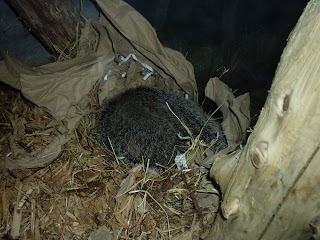
I took this photo, she was sleeping.

Not her best side. So my great friends from the The North Carolina Life and Science Museum let me share these photos with you.

This is Erin, one the Keepers with the Animal Department of the Museum. They have a blog, too. Check it out. Lots of great stuff about animals.

Related Posts with Thumbnails