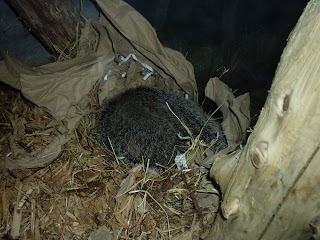
I've got to make a confession. I really don't give reptile (or amphibians) their just due on Urban Science Adventures! ©. I'm a mammalogist, true and through. But I'm also an opportunitist, which is why I feature so many plants, flowers, and trees in my post. They never go anywhere.
But I was able to get a really great photo of a garter snake this summer at camp.
On my list of 100+ Things to do outside – a growing list of suggestions for family-friendly outdoor activities, this is activity #47. See a wild snake.
Tuesday, November 02, 2010
Snakes up close
Monday, March 30, 2009
Book Review: Two More Books about Polar Biomes
The two year celebration of research, discovery, and social studies of the globe’s Polar Regions comes to a close. International Polar Year 2007-2009 ends March 31st. Educators and Research teams from the around the world ramped up efforts to learn as much as we can about the ends of the earth before they are changed forever by climate change.
This will be my final book review dedicated to IPY.
Title: Scary Creatures of the Arctic
Author: Penny Clarke
Publisher: Scholastic
The Arctic is a very cold and windy place, but it is teeming with life. For thousands of years the plants, animals, and people have managed to get what they need from this harsh climate by paying attention to the patterns. Presenting a combination of photographs and illustrations the book shows us arctic landscapes, wildlife, and the people who live on top of the world and how they survive. This is a perfect introductory ecology book about this biome for third-fifth graders.

The author recounts the life and aim to survive of an Ookpik, the Inuit word for snowy owl. This hardy species of owl lives all-year in the Arctic, hunting in open areas and in day light. But if food resources become limited they are known to migrate some seasons. They fly south to Canada and New England. This is the story of an ookpik who spent a winter in the Adirondack Mountains of upper state New York. Much to the delight of bird watchers, that owl spent the winter in a local town and farming community reaping the benefits of abundant mice, voles, hares, and small birds. It is a delightful book with beautiful watercolor illustrations.
Monday, March 23, 2009
Book Review: Ice Bears
International Polar Year is drawing to a close and I am still commemorating the occasion with posts dedicated to polar ecology.
Title: Ice Bears
Author: Brenda Z. Guiberson
Illustrator: Ilya Spirin
Publisher: Henry Holt and Company
So far, this book is my early favorite for the Outstanding Children’s Book Award in Animal Behavior for this year. The author accurately describes the behavior of polar bears, focusing on a mother-twin cubs unit. The illustrations supplement the narratives. I especially like how the author uses onomatopoeia to describe some of the animal behavior like nursing and vocalizations between mother cubs. Because of the endangered nature of this species, the book serves as a perfect example of how the fields of animal behavior, ecology, and conservation blend together to help us understand how species interact with each and their environment. And be sure to check out the Arctic Ice Report following the story proper. It summarizes the state of the polar bear and other polar animals to climate conditions of the arctic region. Ice is an important environmental condition that North Pole animals like the polar bear, seals, caribou, fish, and foxes require. The need each other and they all need the ice to survive.
It’s not too late to make your voice heard. Sign the Center for Biological Diversity’s petition to save the polar bear and bring awareness of the need to protect the habitat of other polar wildlife.
Monday, February 02, 2009
It’s Marmota monax Day!
What’s Marmota monax Day you’re asking? Well it’s Groundhog’s Day. Marmota monax is the scientific name for ground hogs, also known as woodchucks. And how much wood would a woodchuck chuck, if a woodchuck could chuck wood? None. They spend their time eating plant materials like flowers and roots and the occasional juicy bug.
Though we celebrate groundhogs today, it’s actually an inconvenience to them. They are hibernators and don’t usually wake up until spring time – in March or April.
Groundhog Day is celebrated in Canada and the United States but seems to have been a tradition brought over by European immigrants. The origins of the day are interesting and coincide with Candlemas Day, also February 2nd, a Catholic Celebration marking the end of Epiphany.
I’m super excited about both celebrations because it is also my birthday! I’ve always thought it was divine declaration that I, an animal-lover since babe-hood, would be born on an animal day and would become a biologist – a small mammal biologist at that.
So if you see me on Facebook, stop by and wish me a Happy Marmota monax Day!
And now to the book review. No, I didn’t forget.
Exploring the World of Mammals, published by Chelsea House Publishers. This is a six volume set that introduces the biodiversity of the Animal Kingdom, Class Mammalia. It is a dynamic series. These are trade books, truly intended for young readers, grades 4-7, but I find them handy and informative. Each book begins with an overview of the group of animals called mammals, defining them as ‘warm-blooded’ animals with hair or fur and special skin glands called mammary glands that produce milk. It really is an encyclopedia. It introduces every type of mammal, including the taxonomy, systematic, and an accurate overview of the animals’ natural history, behavior, distribution, and conservation status. Volume 5 of the series includes a picture of a Ground hog. So far, this is the only book I have reviewed for the Animal Behavior Society’s Outstanding Children’s Book Award that has every featured groundhogs or woodchucks. Pick up this set and learn more about ground hogs and their other mammal cousins.I leave with photos of Wendy the Woodchuck of North Carolina Life and Science Museum.
I took this photo, she was sleeping.
Not her best side. So my great friends from the The North Carolina Life and Science Museum let me share these photos with you.

Wednesday, January 28, 2009
Wordless Wednesday: Snow Tunnel
I’m participating in Thematic Photographic 33 - Surprise.
I was in Racine, Wisconsin for the holidays and discovered this perfect hole in the 18 inch snow next to my parents’ home. There was also a trail of small animal tracks leading away from that hole. Everything was all white so my camera could not capture the tracks. But the family dog was very interested in the spot. I think it was a mole or shrew tunnel and tracks. What a great surprise-wildlife find.
Monday, January 12, 2009
Book Review: Birds of Prey
This book includes lots of great Animal Behavior descriptions of Raptors, also known as birds of prey. You and your students will learn all about each of the different types of raptors – owls, hawks, eagles, falcons, kites, and vultures. And the illustrations are awesome and accurate. I highly recommend this book to accompany lesson about food web or Eagle Days. In fact, Eagle Days are coming this weekend in the Midwest (Jan 17 -18, 2009). It is a fabulous way to spend time with your family and share outdoor experiences. Bald Eagles are our nation’s symbol and spectacular bird to behold. Even if you are not an avid birder, spying a majestic eagle through a spotting scope is breathtaking. However, I will warn you it is very COLD outside, so dress warmly. The good news is that the colder it is, seems the Eagles love it and that improves your chances of seeing some.
Amazon Synopsis
Birds of Prey is a bird guide with a difference. Robert Bateman’s detailed, full colour paintings capture the incredible speed of falcons, the strength of eagles and osprey and the grace of hawks and vultures soaring overhead in a way that no photograph can. His paintings and sketches from around the globe bring to life these intriguing members of the bird world and also reveal Bateman’s deep understanding of their role in nature. Bateman has been fascinated by the beauty, speed and grace of these winged-hunters since he was a child. In the ravines and countryside near his home, he’d see snowy owls patiently waiting for mice in roadside fi elds, and he remembers that spotting a hawk was always a highlight of his day. The accessible text includes anecdotes of his encounters with hawks, eagles and owls and introduces young readers to the traits that birds of prey have developed to capture and eat their food. Unique "sketchbook" sidebars provide intriguing facts about the different species. There’s no better introduction to birds of prey!
Eagle Days Activities in the St. Louis, Missouri Metro Area
North St. Louis, Missouri
Missouri Department of Conservation
Chain of Rocks Bridge and Columbia Bottom Conservation Area
Jan 17, 18
Alton, Illinois
Eagle Meet and Greet
Alton Visitor Center
January 17, 24 & 31, 2009
Eagle Meet and Greet Sundays
National Great Rivers Museum
Sunday, January 18 & 25, 2009
Sunday, February 1 & 8, 2009
Grafton, Illinois
Bald Eagle Days at Pere Marquette
Pere Marquette State Park
January 20, 21, 24 - 28 & 31, 2009
February 1 - 4, 21, 22, 23, 25 & 28, 2009
March 4 & 8, 2009
Eagle Days in Wisconsin
Jan 16, 17
Eagles Days in Clarksville, Missouri
Jan 24, 25
Eagle Days in Boise, Idaho
Jan 29 -31
Wednesday, January 07, 2009
Wordless Wednesdays: Hairy is Scary
Wednesday, December 31, 2008
Wordless Wednsdays: What is it?
Kind of looks like fireworks. Very pretty, I think.
Take a step back..
.
.
.
.
It's Honeysuckle, the viney kind that grows on fences. This is what it looks like in the winter when the flowers die and I assume those are the exposed seeds.
Happy New Year!
Sunday, December 21, 2008
Winter Solstice - Happy Holidays
Enjoy the day and weather. If you indulge in winter recreation and sports that might not be so hard, but if you're not I know how it can be a challenge. However, bundle up and get out there anyway. The nature outside your window in winter is not the same as the nature in the spring, summer or fall.
and a happy holiday.
Happy Hannakah and Merry Christmas