Wednesday, July 13, 2011
Wordless Wednesday: Dragon Fly
This dragon fly is dead. I found it on the lawn of a friend's house, still in great condition. Dragon flies are wetland bugs. They live near water where the females lay eggs. The juvenile stage of dragon flies (and the closely related damsel fly) are called nymphs; and these little alien-looking bugs live in the water until they become mature exoskeleton-having, wing-bearing adults. You can always tell a dragon fly because of its large size and when it lands it holds its equal-sized double wings out, like the pictures above. And they come is a variety of pretty colors.
Sunday, April 10, 2011
Citizen Science Spring & Summer Field Season opens
Why get involved in a citizen science project?
It's a perfect way to spend time with your family. You're always wondering what you can do that's different, will make for a great adventure and doesn't cost alot of money.
Start a fun learning project. If you're a home schooling parent, after-school teacher or camp counselor and you want the kids to have a meaning experience that will go with them forever. This is it. Just a little time once a week or once a day yields the perfect opportunity to do a big end-of-camp presentation and capstone experience.
It is so easy! Seriously, simply visit a website, sign-up for a project (and sometimes you don't have to do that), and email the results back (or fill out an online form). If you find a local project, then you show up and lend a scientist a hand and get a chance to get up close and personal with some exciting plants and animals.
Here are some Citizen Science projects you can do right now!
Basically, you adopt a special place, like your backyard, special area of your neighborhood park, your school yard, or even the empty lot along your street. You visit your special place at least once a week. Make notes in your nature journal (are you journaling? if, not it is so much fun and you should do so right now) and share your results with the online data base. The data from you and others all over the nation will be used to track any changes our natural world is making to climate changes and human influences. Go to their website to learn more and sign up. Also follow them on Facebook and Twitter.4. Shark tagging. My friend David Shiffman needs volunteers to help him with his research for school. Do you like Shark Week? Then, you're going to love being a citizen science with David. He tags (small) sharks for his research in sharking feeding behavior and ecology; and his research also helps to measure the size and health of the shark populations in the Coastal South Caroline sea. Over 30 different species of sharks call that coast home. It's very interesting work and definitely will give you something to talk about at parties forever. You can learn more about his research here and follow his blog about sharks, marine biology and conversation of the ocean and its creatures at Southern Fried Science and on Twitter @WhySharksMatter.
DNLee
demystifying nature letting everyone experience
Thursday, March 03, 2011
Urban Wildlife Watch: How to Find Signs of Animals in City Parks (Guest Post)
Today's post was contributed by an Urban Science Adventures! © reader, Ashley Warner. Ashley is an astute animal observer and has always been interested in the ways that animals get around human habitation. Ashley asked to write a guest post for outlining tips for finding signs of wild animals in city parks. I am very glad to host her first contribution. Please be sure to leave comments.
"Living in the Northwest I get a lot of chances to see animals in and out of the city."
A city park does not need to be just for taking a casual stroll. Instead, it can be a learning opportunity for anyone that wishes to discover more about the animals that may be residing in an area. While finding animals in your local park may sound challenging, the truth is that you don’t need to have an online biology degree or even an encyclopedic knowledge of animals to do so. In fact, you can find wildlife almost anywhere by simply knowing how to look for their nests, dens or other areas that they may inhabit.
Undoubtedly, there are some animals that are going to be found no matter where you go. For example, squirrels are a common animal that can be found in most national parks, city parks, and even some back yards. Yet when paying a visit to your local park you are also likely to come across some less common animals as well, such as owls, ducks, geese and maybe even swans. These animals will especially be present in parks where visitors frequently put out food for wildlife or there is an abundance of open water.
The best way to spot a squirrel is to look very hard. These animals blend in with their surroundings very well. In fact, you might want to look for their nest first, which is about the size of a football and comprised of twigs, grass and bark. Many times these nests will be in between the branches of trees or sometimes in a hole inside the tree. Keep in mind that these nests are going to be more dominant in areas where there are many trees.
![]() |
| Squirrel Nest. Photo by Rodd Dierker. |
If there is some form of water in your park or if people frequently feed the wildlife there, there is a good chance ducks and geese will be at hand. One sign people can use to determine if there are indeed waterfowl in the area is the presence of a nest. These nests will usually be along the path of water or sometimes in the middle of a cluster of weeds. Most of the time the animal is hid from view among all the weeds so people may actually be stepping over them and not even realizing that they are there. The same can also be said for swans. However these birds usually prefer to have their nest right on the water and hardly ever venture far from their home.
Overall, a city park can be a great place to find wildlife. Squirrels, owls and waterfowl are just a few of the animals you can expect to find in your local park. Better yet, if the area was once home to wilderness, you may even encounter foxes, raccoons, ground squirrels or even coyotes.
That ws a fantastic post about spotting animals and animal signs in your backyard. Also check out Urban Wildlife Watch: Squirrels and Dreys. Thanks Ashley for sharing your own Urban Science Adventures! ©. I hope more of you feel excited about sharing your own stories of urban science exploration.
Friday, February 11, 2011
First Bird Friday! A Survey & New Nature Blogging Meme
I wish I could say this was my idea. It isn't. (But to my knowledge the title is my idea). Audubon California has a weekly survey. Each Friday they ask online readers to tell them the identity of of the first bird they see each Friday Morning and let them know your city. You can submit your answers until 12 noon (PST) and then they share the results on their blog - The Audublog. That's it. It's quick, easy, and fun. Click here.
| Me & a fledgling baby goldfinch. Fell out of the tree and one to one of my campers (Summer 2010). I had to take take some pictures with it...it's like a local urban wildlife celebrity. J |
But other than fun, another reason to do is to get you to start to deliberately taking notice of the wildlife around you. And that's what I inspire you to do everyday. We can't begin to make our communities safer and cleaner and greener until we take stock in what we have - the good and the bad. And Urban wildlife is all good.
All all bird life counts, as they say:
And if you don't see a Bald Eagle or a California Condor, don't worry. That's not what this is all about. This is about celebrating the common right alongside the rare and unusual.Don't worry if you don't know the name of the bird you saw. Make note of the bird's characteristics -- size, color, general shape. You can use that info to look up the bird's identity on the Audubon's online bird guide. Then complete the survey.
If you want to follow all of the First Bird Friday! excitement, then check out the Audubon California on Facebook, their blog, or Twitter @AudubonCA hashtag #firstbird.
And yes, I've submitted my answer....American Robin. I spotted it on a little patch of ground (cause it's snow all over the place here in St. Louis, MO) at Hazelwood East Middle School by a Paper birch tree.
Fellow nature bloggers, help spread the word. Readers, tell me in comments what you saw and visit their site to submit your answer.
Wednesday, February 02, 2011
Ground Hog's day 2011
Other than holidays that are celebrated with candy, Groundhog's Day is my FAV.O.RITE. I'm biased because it's my birthday. I didn't lay eyes on a for-real-groundhog until I was an adult, but I've always felt attracted to all animals, small rodents in particular. Seems coincidental that my research has been with field mice and in prairies and woodlands.
Since I was a kid, I was outdoors, playing in the grass, trying to get a closer look at the animals. Now that I'm a trained biologist, what are considered professional skills seem almost like super powers that I learned to wield. Part of me sometimes wonder if being born on Groundhog's Day pre-destined my steps in zoology. Is the Groundhog my spirit guide? Am I ruled by the Order Rodentia? I don't know.
But even as a young child - and still today - I always have had this unexplicable attraction to animals and wild places. I can just spot a nest or den or an animal hiding in plan sight. I've got the eye or ear or something. I always seem to be in the right place at the right time. (Though I seldom have a camera or a good lens to document the occassions). This was one of those luck times, however.
Groundhogs in the City.
Recorded summer 2010, behind a business park parking lot off of Brentwood Boulevard in St. Louis, Missouri. Shout out to my sister who pointed out the little guys to me.
Friday, January 21, 2011
Urban Wildlife Watch: Mountain Lion in the City
I'm not just pulling your leg here. A Mountain Lion really was spotted in the St. Louis, Missouri Metro area on January 12, 2011. Local news agencies have reported the sightings taken from a hiking trail camera in the suburb of Chesterfield, Missouri.
Mountain Lions, also called Pumas and Cougars (I prefer Cougar) - scientific name Puma concolor, are the ecological equivalent of their cousins in Africa - the Lion. Like their cousins, they are the big cats of North America. With the exception of the very young, only humans are a major threat to these top predators. However, in natural settings they do compete with Gray Wolves and Grizzly Bears (other top predators).
Mountain lions are solitary animals. Males and females mate and then go their separate ways. The female raises her 1-3 cubs alone for about a year and half. In the meantime, they ambush prey like deer, moose, or anything smaller than they are for food.
Before European colonization and expansion into the Americas, this great cat call all of North, Central, and South America home - from Canada to Chile. They are beautiful and majestic creatures. Though sightings in Missouri are still rare (only 13 confirmed sightings since 1994), this does signal a positive turn for the big cat. In fact, sighting of almost any predator in an urban area means that species' numbers are growing and individuals are spreading out looking for a territory of their own. Assuming this isn't someone's pet* or rehab animal, that's exactly what the Missouri Department of Conservation thinks this cat was doing - searching for mates and a home range.
As much as I am excited about this wildlife sighting in a urban area, I am also worried. Some wildlife are just not very well-suited to live along side people. Large animals and predatory mammals are such examples. Until we as people, learn to appreciate large wildlife and are willing to share space and resources with them, these animal just don't do well. All it takes is for someone to be frightened or startled and this beautiful animal will become a mount or trophy on someone's hunting wall.
![]() |
| A better picture of a Cougar from It's Nature! |
1. Do not advance on the cat or kittens (defending young is one sure way to irritate Mama cat and bring out the nasty. Walk away from the kittens - resist the cuteness and novelty. If Mama catches you there, then you're in big trouble). Cats hate to be cornered. Stay far away, but keep your eyes on them.
2. Do not make eye contact. Stare downs are threatening.
3. Do not run. Cats like to chase things. It's part of their predator behavior. Plus, they are rather fast.
4. Do not play dead. Cats are also very curious. Lying dead and still might cause the cat to approach and sniff you. You do not want to be in close contact to those claws or teeth.
5. Keep your distance if you can and stand wide and tall. Make calm loud noises. Large size and sounding powerful usually deters predators. You want it to think that you're just too much to fool with.
6. If the fat does advance and your life is threatened, then defend your self fully. Fight the cat, hit it, or put something between you and the beast. Make it your mission to come out alive.
And God forbide any of these things happen, but if it does and you live, report your incident immediately to park, wildlife, or conservation official. But use common sense. If you've been warned of sightings of cougars in a particular area, then don't go looking for them. It saddens me when I hear of wildlife being killed or put down for attacking a person who was doing or getting into something s/he knew fully well to avoid. Don't be that person.
* Owning wildlife as pets is illegal and is a practice that I certainly frown upon. I understand how exciting it can be to be next to exotic wildlife. no matter how adorable, cute, cuddly or drawn you are to them, remember they are wild. They have no domesiticated senses of loyalty to, affection for or willingness to obey humans. If you feel that drawn to being near wildlife, become a zoologist. That way you will learn the proper ways to handle and interact with wild creatures and can do so often.
Tuesday, November 02, 2010
Snakes up close
I've got to make a confession. I really don't give reptile (or amphibians) their just due on Urban Science Adventures! ©. I'm a mammalogist, true and through. But I'm also an opportunitist, which is why I feature so many plants, flowers, and trees in my post. They never go anywhere.
But I was able to get a really great photo of a garter snake this summer at camp.
On my list of 100+ Things to do outside – a growing list of suggestions for family-friendly outdoor activities, this is activity #47. See a wild snake.
Sunday, October 17, 2010
To Catch a Frog or Toad
I have a list of 100+ Things to do outside – a growing list of suggestions for family-friendly outdoor activities.
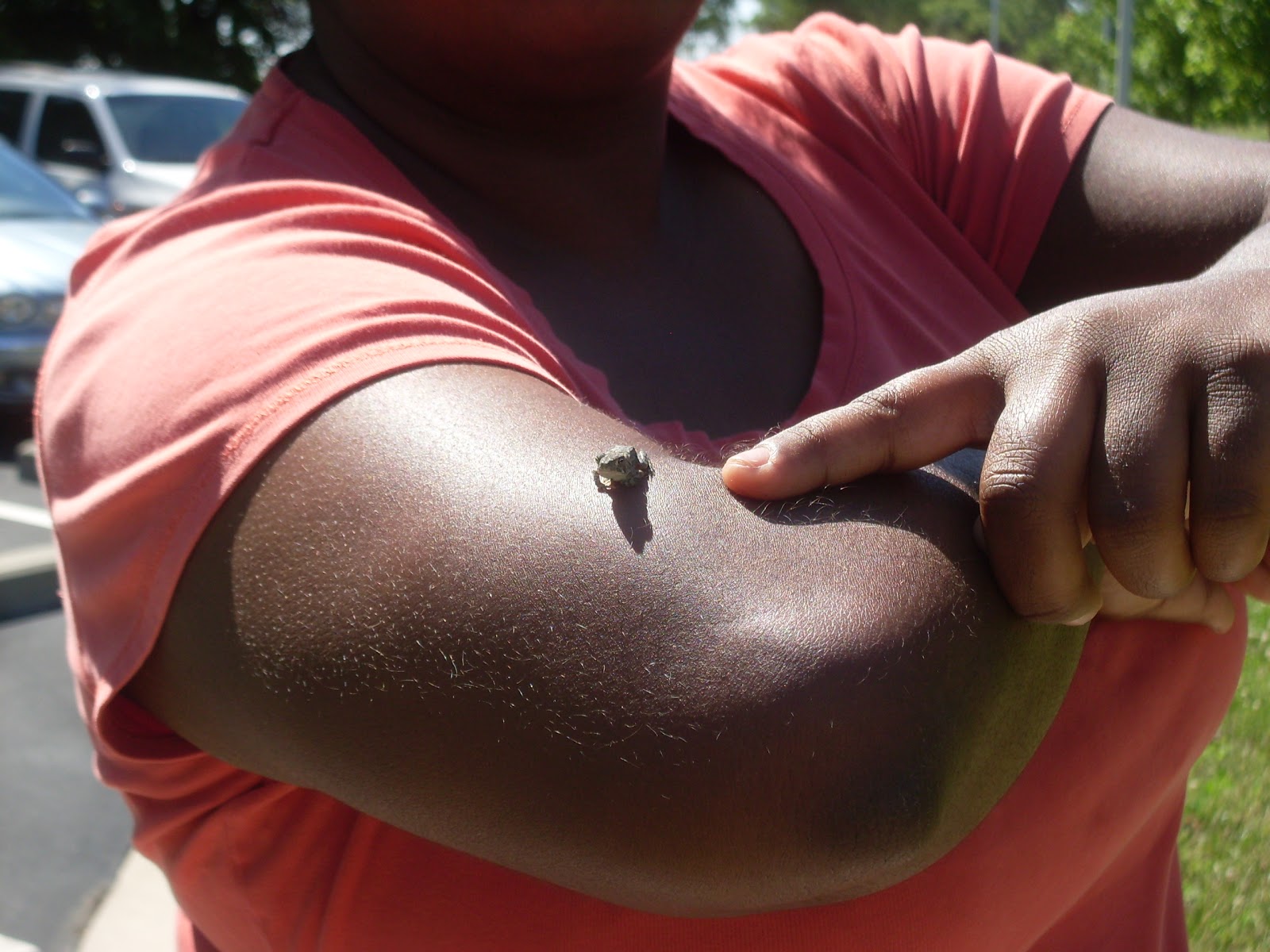
#77. Catch a Frog. I’m actually pretty good at this. I think it’s because of my years of handling voles. Voles are quick little field mice. I handled them throughout graduate school. I had to learn to handle them in a way that was firm – because they will squirm and wiggle and try to get away, but at the same time gentle – because I wanted them alive. After accidently killing a vole trying to handle it, I learned quickly how to catch, pick up, handle and move the little critters – both with gloves and without. I later found on a class field trip to Guyana, that this skill was transferrable to other small, fast critters.
So, I caught my very first frog. It was in the evening in the mountains near Kaiteur Falls. There are these teeny tiny frogs, about the size of a quarter, maybe smaller that have skin so thin you can see the organs in their bellies. Armed only with a head lamp and listening closely, I reached out onto the tall bushy grass and just grabbed at the distinctive metal like croak…and I caught one. In my hand, tiny and wet and fabulous was this little guy with a big voice, singing into the night – along with all of his brothers in search of a willing mate.
I was exhilarated. Since then, I’ve been a frog and toad catching queen. Grabbing and holding and posing away. Her e are some shots from this summer, the urban summer day camp with Boys & Girls Club kiddies.
Wednesday, September 22, 2010
Wordless Wednesday: Water Quality
I'll be at Spring Valley Park in Kansas City, Mo leading water quality monitoring activities with the families that come to the Kids Fishing Derby for Urban Outdoor Day presented by Urban American Outdoors and Kansas City Missouri Parks & Rec. I hope people see the obvious connection between the activity - fishing - and the importance of maintaining healthy waters for wildlife and future outdoor recreational activities. I also hope they make the next obvious connecton to their own daily habits and how that might relate to water quality.
Water Quality can be monitored in two different ways: abiotic monitoring and biotic monitoring.
Abiotic monitoring involves measuring the important physical parts of the water environment such as
- the pH of the water: how acid or basic it is
- the amount of dissovled oxygen in the water
- turbidity: how clear or cloudy the water is
- temperature: how warm or cool the water is
| Macroinvertebrates are very good indicators as to the health of a stream, lake, or pond |
| The presence of many different species and other predatory invertebrates is a good sign that the water habitat can support many food chain levels. |
| Healthy fish species are also a good sign. Remember, vertebrate species like fish and birds ultimately depend on invertebrate, microbe, and plant species for their survival, too. |
Monday, June 07, 2010
Mums the Word
Friday, May 21, 2010
Vole upstages President Obama's Rose Garden Press Conference
The headlines read: "Rodent Scurries Past Obama in the Rose Garden".
The vole has been described as a gate crasher and upstager, because the critter has definitely caught our collective attention. That may be true, but in actuality, maybe it was President Obama and the Press Corps that was disturbing the rodent. It was scurrying back and forth making its way from one safe area (the cover of bushes) to the other past the podium and eyes of hundreds of upright potential predators (the press).
Pictures and link to full article about the event from Huffington Post.
Wednesday, April 07, 2010
Happy International Beaver Day
The Beavers, Wetlands and Wildlife Organization is trying to show people how important beavers really are, and the group has produced an educational DVD and sent 1,000 copies to teachers all over the state of New York.
One member says the beaver is one of the most important wild animals for a number of reasons. First, because they build dams and prevent flooding. And second, because beavers protect us from greenhouse gas emissions.
"Beaver wetlands, like all wetlands, are the best ecosystem for storing carbon," said Sharon Brown, of Beavers, Wetlands, and Wildlife. "And if they are destroyed, carbon dioxide goes into the air and that's a dangerous greenhouse gas."
April 7 was chosen as International Beaver Day because it is the birthday of the late Dorothy Richards of Little Falls, who studied beavers for 50 years.
Understanding North American Beaver Behavior as an Aid to Management
by Bruce Schulte and Dietland Mueller-Schwarze
If you've ever notice a huge pile of sticks and branches in the water, then you can best believe you have come across a beaver dam. Another sign of beaver activity is this:

Sunday, March 28, 2010
Spotted on Sunday: Spring Fling
These posts are a fun way to help make visible people of color outdoors enjoying all types of recreational activities.
Anyone can submit a photo to Outdoor Afro via email, if you first obtain:
consent to take and share the picture
name(s) of the individuals — last names not required
location and brief description of the activity
I’ll select one SOS photo to post each weekend, but all submissions are entered into a monthly drawing to win an Outdoor Afro ceramic travel mug, through July 30, 2010. Winners will be notified via email.
So…join the SOS effort to help make people of color be visible in America’s natural spaces and get a chance to win some cool OA swag!
These are pictures of my niece, enjoying herself at the the Missouri Botanical Garden. She's a burgeoning naturalist, just like her Aunt. (Smile)
Tuesday, March 02, 2010
Honey Bees Buzz with Individuality
The researchers examined a behavior in honey bees known to regulate the social behavior of the hive – the retinue response. Retinue response is the amount of time and attention worker bees pay to the queen because of a special pheromone or chemical she sends out. This chemical keeps the hive socially connected. In any group of animals, individuals will behave differently. Some worker responses have a very high retinue response – spending a lot time very close to the queen and picking up the pheromone; and some others have a very low retinue response. The authors set out to measure the amount of individual differences in behavioral and physiological (internal body function) responses to queen pheromones.
Normally, the Queen pheromone is spread over the hive by daughter worker bees. However, there are some worker bees who either don’t prefer the pheromone or avoid the queen altogether. When that happens, physiological changes occur and these daughters have somewhat developed ovaries. These stand-offish daughters have been known to lay their own eggs (usually a no-no in polite Hymenopteran society) which can develop into reproductively capable sons. That doesn’t often happen because other sisters who find nephews (and not brothers) in the bee nursery have been known to discard or destroy the eggs or pupae.
Worker honey bees from two different sub-species (or races): Carniolan and Italian bees were observed. These are very old and well-known races of bees that are morphologically distinct (different physical appearance and shape). The researchers studied 5 colonies of the Carniolan bees and 4 colonies of the Italian bees.
Drops of diluted queen pheromone were placed on a slide and introduced to smaller groups of bees (from each colony). The researchers counted the number of worker bees that came into contact with the pheromone and the number of times each bee visited the slide over a period of time (25 minutes). They did this for 5 consecutive days, doing it in the spring and again in the fall.
What did they find?
So what could be driving these differences? Like I mentioned before, all of study bees were full sisters to each other so it can’t be the genes, right? Well, not quite. The researchers did identify the genes they believe responsible for retinue response. What they found was that although the sisters may have been similar to each other in the types of genes they had, gene expression differed from bee to bee. It’s one thing to have the same gene as another person. It’s something else to have that gene actually work and perform in your body. The same gene in your body may do more work (or less work) than that same gene does in my body. This is called individual variation in genetic expression and that is what seems to be at play with the bees. Retinue response is correlated to ovarian development which is correlated to gene expression.
Why does any of this matter?
Full Citation: Kocher SD, Ayroles JF, Stone EA, & Grozinger CM (2010). Individual variation in pheromone response correlates with reproductive traits and brain gene expression in worker honey bees. PloS one, 5 (2) PMID: 20161742
Related articles: Urban Wildlife Watch - The Buzz about Bees
My comments to this article: PLoSone.org
Thursday, January 21, 2010
Guide to Urban Ecology
Today, was a great day. It all started last week when I posted my New Year's Resolutions which included speaking and presenting more with my pending graduation. Later that day I recieved an email from the St. Louis Academy of Science Speaker Series Director. She said she had seen my Science Matters interview on the local PBS station and asked if I would speak at an upcoming event for middle schoolers. The program is called Green Your Future - a discussion about eco-related jobs. I spoke to the students about urban ecology.
It was my very first time speaking to a general audience group on request. It was also the first time I gave my Urban Science Adventures! © schpeel to a live audience. The 7th graders from the St. Louis Public Schools were great. They were attentive and asked lots of questions. Great questions. And they offered several of their own Urban Science Adventures! © stories. Many of the kids had their own sightings of urban wildlife including opossums (both roadkill and alive), rabbits, squirrels, and hawks. One student even saw a porcupine once! I'm jealous. I'm a mammalogist and I've never seen a porcupine!
I presented a short presentation that included photos of urban wildlife scences I've captured right here in St. Louis. The kids were really fascinated by by my hands....not really. But I had 2 classrooms of all boys who were impressed that I was holding a frog, a bird and stood close enough to various types of bugs to photograph them. I capped things off by encouraging them to explore and discover nature in urban areas.
I think shooting local scenes was important. A couple of kids knew this spot exactly.
I love outreach. I really do. It was a blast. I'll be traveling this semester - searching for jobs, attending meetings, connecting with fellow bloggers (science/nature/blogging while brown) and outdoor enthusiasts. I've booked one date already to give a formal talk (the dissertation presentation talk). I'm willing to do travel and do some two-fer presentations - the official science talk and the science outreach presentation.
Also, check out my KETC Science Matters video and let me know what you think.Thanks everyone for the support and encouragement.
DNLee
Demystifying nature, letting everyone experience