Urban Science Adventures! © was nominated for Best Science or Tech Blog again this year. As the sole science blog among the finalist this year, I would love for the blog to win the honor - and justify having separate Science and Tech Categories in the coming years. Many people and readers have reached to me and let me that they have voted already. Thank you, thank you, thank you. For those of you who have yet to vote, today is the last day.
What to know be fore voting:
1.Only one ballot is allowed per computer and email address. The ballot is 5 pages long. My blog and category are on page 4 so don't lose heart. I encourage you to vote in every category you wanted to vote in before submitting. A complete list of all finalist for the 38 catergories are here.
2. If you don't see a submit button, try pressing the tab key several times.
3. Vote here.
Winners will be announced live July 9, 2011 in Los Angeles. I will be there for the ceremony. If you would like to co-sponsor my attendance, then please consider making a donation. Any and all contributions are appreciated and give shout outs to my supporters!

4. You can attend the Blogging While Brown Conference and the Black Weblog Award Ceremony in Los Angelos, California, too. General Admission is open to all of the attendees of the Blogging While Brown Conference. Or purchase VIP tickets to attend the ceremony online.
 5. Category sponsorships are available contact lianne@blackweblogawards.com for more information.
Thank you again!
DNLee
Friday, June 17, 2011
Vote for my blog to be the Best Science Black Weblog Award, please


Sunday, June 12, 2011
Urban Wildlife Watch: 13 Year Cicadas
Cicadas, sometimes called locusts or katydids, seem to be everywhere right now. Here in my part of the country - St. Louis, Missouri and as far away as Nashville, Tennessee - the flying insects seem to be everywhere. And the numbers of them seem to be in biblical proportions. That's not a mistake or judgement day occurance, it's simply Mother Nature at play. The ones that we are witnessing right now are called 13 year Cicadas. Scientific name Magicicada.
 |
| from Bungalow Bill's Blogspot |
Coming from the south, I have always been familiar with Cicadas, in fact I think fondly of them. That characteristic an an an sound from the trees actually lulls me asleep on warm humid nights. However, I never actually laid eyes on a cicada until last year. I had only heard them! There are thousands of species of cicadas that live all over the world. But this year, we are seeing a whole lot of these:
 |
| from Bates County Live |
These 13 year cicadas are about an inch and half long with dark brown bodies with orange coloring and red eyes. Despite their annoyance, they are not harmful. They don't bite or sting; and I have heard some people say they don't have mouth parts or eat. (But I need to get an up close look at these guys to see if that part may be true. Look out for a blog post about dissecting a cicada.) So other than just being a pest, they really aren't a problem for people or pets. As to your plants, that's another story. Cicadas feed on the juices from plants, as well as lay their eggs in the bark of trees.
Overview of a cicada life cycle
 |
| from Enchanted Learning |
Eggs are laid by the females in brood patches of up to 20 eggs or so in the bark of trees. Incubation can last 6-8 weeks. When they are hatched tiny nymphs emerge and drop to the ground.
Nymphs burrow holes in the ground (near the tree where they were 'born' and live the majority of their lives underground as juveniles no wings) http://en.wikipedia.org/wiki/Nymph_(biology). Nymphs live in the soil eating tree root juice or sap, before finally emerging to the world above. Depending on their species, they remain underground 3, 4, 7, 13, or 17 years (periodical cicadas) or one year (annual cicadas) to feed on juices from roots of plants and trees. Once they are mature, they burrow to the surface and leave distinctive holes in the soil (about the diameter of a fat pencil or dime) often near trees, bushes and other tall green vegetation. The nymphs then hold on tight to a leaf or stem or tree tunk and begin its final metamorphosis into an adult cicada with fancy wings. The shell or exoskeleton of the nymph is left behind and serves as a great indicator of the abundance of cicadas in a particular area. (pic)

To answer some questions posed by others already:
Why are there so many of them all at the same time? 13 year Cicadas are what biologists referr to as a developmentally synchronized species. They all emerge at the same time and time their activity together. Right now, we are witnessing the finally stage in the life cycle of this cicada – the adult stage when they mate, lay eggs (the next generation) and soon die. This timing is actually benefical to them. With so many coming out at the same time they actually overwhelm predators such as birds, wasps, and praying mantises. With so many cicadas available the predators get plenty of food and there are still plenty of cicadas left to mate and continue the species.
Why do they make so much noise? That distinctive sound is the mating chorus of male cicadas announcing they are available for mating. So, that's their mating call we hear. Males perch in trees and chorus together in a rhythmic sound to attract females for mating. There are other calls for courtship as well as for distress - as when attacked by a wasp or praying mantis - but most people are not familiar with those sounds. I certainly am not.
Where does the sound come from? The sound comes from vibrations of tiny membranes lining the outside of the abdomen or belly of males. Males perch in trees and chorus together in a rhythmic sound to attract females for mating. There are other calls for courtship as well as for distress - as when attacked by a wasp or praying mantis - but most people are not familiar with those sounds. I certainly am not.
It seems like they make more noise when it's hot and sunny outside, does the weather condition have anything to do with how loud they are? Yes, the amount of noise they make seems to correspond with the temperature. For example, Saturday, June 11th was an overcast day and it was considerably cooler than it was earlier this week. Some people noticed that the cicadas in their yards and nearby parks were not as noisy yesterday compared to how they sounded before when it was very hot outside. The thinking is that it has to do with body temperature regulation. When it is cooler outside, the insects spend more energy staying warm and less on singing. It may also have something to do with sound traveling faster in warm air.
Those bugs are really annoying. They fly in my face, in my car, make a lot of noise and get everywhere. What good are they? As nymphs, cicada live underground and dig through the soil. This aerates the soil to benefit plants. Although we don't know very much about their behavior at this stage, I am pretty sure that nymphs are food for underground insect predators like moles and shrews, plus they are an important part of the food chain above ground for many animals.
Tuesday, May 31, 2011
Great American Backyard Campout Blends Outdoors, Family Fun and Science
Memorial Day is the kickoff to the summer and where is the best place to spend the summer? Outside, of course, and family camping is one of the most popular summer time actitivites. On Saturday, June 25, 2011, the National Wildlife Federation is asking everyone to go camping! The Great American Backyard Campout is a grassroots initiative to Leave No Child Indoors! The National Wildlife Federation is raising awareness and also trying to raise funds for more outdoor youth programs. They are also encouraging families and communities spending time together outside camping. And while you're spending time outside - in the fresh air - why not explore nature (and science)!

So get your family and neighbors together and go camping - at a local campground, state or national park, or in your backyard. Being outdoors is a perfect time to connect to science. You can explore biology, conservation, ecology, astronomy, geology, geography, environmental science, and more.
I wrote a piece for COPUS - the Coalition of Public Understanding of Science encouraging its readers to participate in the Great American Backyard Campout and use that time to not only connect with family/neighbors but hace fun exploring science, too. Check out the blog post (link here) and read the whole list of recommended Citizen Science and Arts and Science activities recommended. Plus here's one I overlooked: Waving at the International Space Station as it orbits over your night time sky! The International Space Station is visible in the sky, assuming the weather agrees, so you could actually keep an eye out for it while you tell campfire stories and eat s'mores. Visit the website http://www.isswave.org/ for details on how to plan your wave. You can also follow them on Twitter @twisst for a tweet when it's visible from your skies.
Or if you're ready to sign up right now, then go for it. You can register your 'camp site' - your family, church or community event with the National Wildlife Federation Great American Backyard Campout website (link here). And visit my friend, Rue at Outdoor Afro for camping recommendations. If camping is still new to you it might prove helpful to get some tips to make the night stress-free adn enjoyable.
In the meantime, let me know if you plan on participating and how. And be sure to do a little exploration, too. Can't wait to hear all about your Urban Camping Science Adventures! ©
Friday, May 27, 2011
My summer is off to an amazing start! Happy Memorial Day
Memorial Day weekend is the official start of summer and I plan on having a grand time. I'm doing what I love to do each summer - working the summer day camps. I have a seasonal position as the Supervisor of Summer Programs with the Missouri Department of Natural Resources the State Parks Urban Population Outreach Program. Basically, I get paid to take church and community center groups from the city to daily field trips to nearby State Parks. I get paid to play outside!
I also have some very promising longer term opportunities in the hopper, but nothing I can announce just yet. Stay tuned. I'll be making a big announcement by the end of the summer. In the meantime I can share this....

I was named the Young Professional of the Year by the Urban League Of Metropolitan St Louis Young Professionals. It is a great honor bestowed upon me and two other local young professionals. I will receive my award at the 2011 Urban Renaissance Gala on Saturday, June 4, 2011. I would love to see your faces there, if possible. Tickets are $50 and includes a cocktail hour, dinner, awards presentation, and after-party at the Renaissance Hotel Airport location in St. Louis, Missouri.

The other good news is that this blog was named as a finalist for the 2011 Black Weblog Award for Best Science and Technology category. I am humbly asking your support to vote for my blog in this category. I also ask you to vote in the other categories, too. It's an awesome line-up of finalists in 39 categories, finalist list here. I'm throwing support behind some of by bloggy friends in the following categories
Best Business Blog
BDPA Foundation
Best Fashion or Beauty Blog
Afrobella
Best Humor Blog
Awesomely Luvvie
Best Podcast Series
Blacking It Up with Elon James White, Bassey World and more.
Best Political or News Blog
The Black Snob
Best Science or Technology Blog
Urban Science Adventures! ©
Best Sports Blog
Black Sports Online
Best Travel Blog
Jay Travels
Best Lifestyle Blog
The Cubicle Chick and Ashy 2 Classy (both of St. Louis)
Best Green/Nature/Outdoor Blog
Outdoor Afro
This blog was nominated in this category, too.
Best Book/ Author/ Literature Blog
Notorious Spinks (of Memphis) and Reads for Pleasure (of St. Louis)
If you haven't taken to reading blogs, this is a great place to start. if you're a blogger, then I recommend working to get your blog on this list for next year. It's a perfect way to expand your audience (and brand). The link to vote is here. Voting ends June 17, 2011, and only one chance to vote per email address, so you can't save and comeback to vote for others later. Winners will be announced LIVE in Los Angeles at the very first Black Weblog Awards Ceremony at the Blogging While Brown Conference. I will be attending, with fingers-crossed, hoping to get my trophy. (And if anyone would like to contribute to my travel fund, then I certainly appreciate it.)

If you're flirting with the idea of attending either Blogging While Brown or the Black Weblog Awards, then I highly recommend that you do it. It is a great networking and learning opportunity. In the meantime, have a great and safe summer; and thank you again for all of your support, encouragement, and prayers.
DNLee
demystifying nature, letting everyone experience
Tuesday, May 24, 2011
When playing outside isn't safe: Gun fire on the playground in St. Louis
It was the middle of the day. A little more than a dozen children from the Peabody Apartments (near downtown St. Louis) were outside playing on the playground and jungle gym. Then shots rang out. Apparently a disagreement between two men who were nearby escalated with at least one of them wildly firing shots at the other. Did the assailant land a shot at his intended? No, instead one of his unaimed bullets hit a young 7-year-old girl in the head. The suspect is now in custody but the little girl is still in critical condition.
 |
| image courtesy of KMOV.com |
- National Trails Day - June 4, 2011: It's a volunteer event to help clean up and restore hiking trails at public lands all over the country. It's a great way to get outside and have fun. More info at Outdoor Afro.
- National Get Outdoors Day - June 11, 2011: It is an initiative that supports First Lady Michelle Obama's Let's Move Campaign to fight childhood obesity. Lots of state parks and campgrounds have signed on as official location partners for this event.
- Great American Backyard Campout - June 25, 2011: Many parks and campgrounds have signed up as partners. Check out the registry and events calendar and you could find a group near you.
- More? Please offer additional recommendations, local, regional or national.
Sunday, May 22, 2011
Summer of Science Book Reading Club kicks off May 23, 2011
Hey parents/grandparents/summer camp mentors!
Looking for fun yet academically engaging things to do with your young ones and teens this summer? Want to make sure they don't lose step and let all of that great knowledge slip out of their heads. Want to keep them on task with reading and literacy? Want to subtly kindle that inner science/engineering/tech spirit in them?
Well check out this super great summer reading program by SCIENTICITY, this amazing online community of people who promote the public understanding and engagement of science. They host a variety of science engagement programs, but the youth reading program is their summer emphasis.
There are actually two programs, broken down by age group.
1) Kids Read Science - for children ages 8-12 years of age
2) Teens Read Science - for teens 13-18 years of age
The rules for both are the same:
1. Choose a non-fiction book about nature, science, engineering, or math, or about people who work or worked in those fields. The book should help you understand more about what science is and how it works. Textbooks are not acceptable choices. If you need suggestions it's good to ask a science teacher or librarian for ideas.
2. Read your book.
3. Make a video about your book. It's like a video book report. The video must be less than 5 minutes long, and you must give the name of the book, the name of the author, and reasons why you would or would not recommend the book to your friends.
4. Post the video online. They prefer that you post it to your own account on YouTube.com and tag it with "KidsReadScience2011" or "TeensReadScience2011". There are other posting options in the long form of the rules. Visit the website for more details of both reading events.
5.Fill out our official online submission form, for Kids Read Science or Teens Read Science. This allows the judges to locate your video and they will know how to contact you if you win one of the fabulous prizes. Sorry, so far only US residents are able to win prizes this year.
6. Do all this before the deadline: 11pm (CDT) on 23 September 2011.
When I was a kid I participated in summer reading programs sponsored by our city library. I loved them! It was the highlight of my summer. At the end of the summer the library branch threw a party for all of us kids and had an award ceremony. Prizes were awarded to children in different age groups who read the most books. I was so competitive. Although children and teens who submit videos are competing nationwide for prizes, there is no reason not to reward students locally for participating in this event, and it doesn't have to be fancy or anything. Just something to keep them encouraged and let them know they are supported.

And if you're not sure what to read or where to get started, check out my blog posts about great science literature I've read - for youth, teens, and adults.
Happy reading!
Wednesday, May 18, 2011
Wordless Wednesday: Horizons of Barbados
I had a chance to visit the very beautiful island nation of Barbados on behalf of Outdoor Afro. While I partook in Barbados food, hosptitality, culture and scenery for my friend and kindred outdoor spirit Rue of Outdoor Afro (and blogged all about it), I also couldn't help myself and took in the beautiful nature. I'll be highlighting my wonderful nature and wildlife encounters of the Caribbean Island.
Today, I feature the beautiful landscapes photos of the islands. I think the pictures give a good sense of not only the naturl beauty of the country but give you a big picture view of the ecology of the island, too.
 |
| Dusk - view from the patio of the hotel. That's the Caribbean sea in the distance with various palm trees all around. |
 |
| Sailing out on the Caribbean sea. That's the island nation of Barbados in the distance. |
 |
| Beach view. Crystal blue waters of the Caribbean sea. |
 |
| Row of tall palm trees along the driveway of a former Sugar Plantation. Barbados was once a colony of the United Kingdom and the entire island was basically a series of big sugar plantations. |
 |
| Though sugar isn't the main export anymore, the legacy of the sugar plantation is not lost. This was once a sugar plantation, with a small sugar mill towwe in the distance on the left. This land now is being developed for residental propoerties. Notice the wide open flat landscape. |
 |
| Narrow shot of a gully. The island is only 14 miles long by 21 miles wide, but there are hundreds of miles of gullies - series of small inland streams, sloughs, and water ways. Lots of diverse species of plant, birds, amphians, reptiles and insects call these gullies home. There are some species that exist no other place on earth. But no snakes. Barbados has no snakes (they were all removed/extripated by the colonists long, long ago) |
 |
| View from the hilly region of Barbados called the Scotland district. That's the Altantic Ocean in the far distance. |
 |
| Scotland district, Atlantic Ocean in the background. |
 |
| Standing in that spot from the previous picture. Don't let anyone fool you. People become scientists (biologists, ecologists, geologists) so that we can travel to beautiful places like this and do research. Aren't you ready to become a scientist, too now? |
 |
| Geological formation from when Barbados was 'pushed out of the sea'. Barbados is a sandstone/coral island - connected to the seafloor, not a volcanic island. |
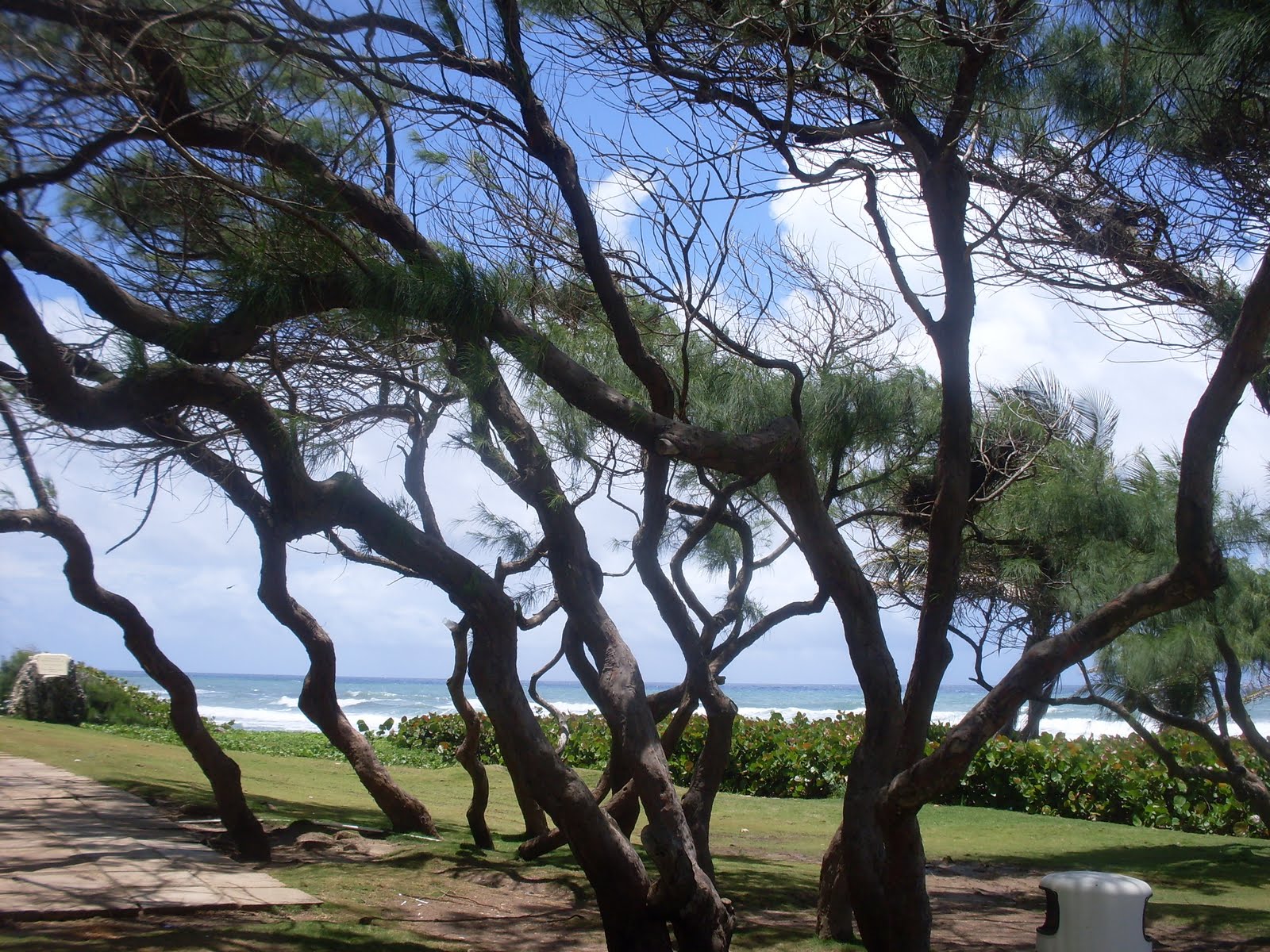 |
| Beach view of the East side of the island |
 |
| Beach view of the East side of island, Atlantic Ocean. Notice the plastic trash deposited on the beach. I walked past hat plastic laundry detergent bottle (and thousands of pieces like it) on my brief visit to that beach. No telling how far that plastic traveled before getting washed up on the beach. Learn more about plastic trash in the ocean at my friend's blog. She's doing her dissertation research on the impact of this very issue, link here. |
In the meantime, check out my posts, to date about the visit to Barbados for Outdoor Afro.
Barbados Bound: An Outdoor Afro Adventure in the Caribbean
Barbados – An Outdoor Afro Adventure (at Jack & Jill Politics)
Outdoor Fun in Barbados: Fun at Sea!
Games Outdoor Afros Play – Dominoes
Monday, April 18, 2011
2011 Black Weblog Awards Nominations are open
It's that time of year, a little ealy this time, but it's award season - the 2011 Black Weblog Awards Nominations season is open. Time to nominate your favorite blogs about any and every topic. Of course, I'm throwing my hat into the race, in several races in fact. But I'm also sharing my other favorite blogs to check out, too. Nominate your conscience, but either, please help me spread the word about the online award program.
Nominations:
Nominations are open from April 18 - May 7thThe official Nomination site is here.
You provide the web address (url) for your favorite blog in each category as well as your name and email address on the nomination form and that's it.
There are 37 categories.
Voting:
Finalists will be announced the week of May 15th and online voting commences May 16 – June 17, 2011. Again, you will need to cast your vote (your valid email address will confirm you are a person and not a bot).Winners will be announced live at the Black Weblog Awards Ceremony during the 2011 Blogging While Brown Conference in Los Angeles, California.

Here are the categories, along with some of my favorites for select categories.
Best Blog Design (This category is for well-designed blogs that incorporate a unique and eye-catching visual web design, keen use of typography, and a killer layout)
Best Blog Network (This category is for Black blog networks. Blog networks should be comprised of at least three (3) blogs with content updated regularly, include some level of quality control, and include some type of blog network indication (badge, link, etc.) which links to the blog network’s site.)
Best Blog Post Series (This category is for a series of posts in a blog about a particular topic. Posts can be fiction or non-fiction, but post series must be linked by a common and identifiable theme with the ability to skip forward or backwards through the series for judging purposes (i.e., archives, pagination, etc.))
I’m a fan of my Feministing Friday posts at SouthernPlayalisticEvolutionMusic, just saying.
Best Business Blog This category is for blogs that talk about the modern business world (advertising, marketing, finance, business trends, etc.).
MartyBLOGs
http://blog.rosspublicrelations.com/
Best Culture Blog (This category is for blogs which analyze and discuss Black culture and/or the African diaspora with respect to art, dance, Black history, music, and other related content.)
Rooted in Earth
Best Cooking or Food Blog
This category is for blogs which focus on food and/or recipes. Blogs may also include restaurant and product reviews.
Best Faith-Based Blog (This category is for blogs which feature unique religious and spiritual content from any religion or faith.)
Best Fashion or Beauty Blog (This category is for blogs which cover the topics of beauty, fashion, clothing, cosmetics, design, accessories, personal styling, and other related content for either men or women.)
Best Film Blog (This category is for blogs which promote or discuss films, actors, film culture, and other related content.)
Best Gaming or Comics Blog (This category is for blogs which promote or discuss films, actors, film culture, and other related content.)
Best Gossip Blog (This category is for blogs that focus on the reporting, satire, and lampooning of celebrities and pop culture.)
Best Group Blog (This category is for a single blog which is updated by a group of people (two or more people). This blog can be about any topic.)
Best Health or Wellness Blog (This category is for blogs that focus on health, fitness, living green, and overall physical wellness.)
Best Hip-Hop Blog (This category is for blogs that focus primarily on hip-hop culture, including urban fashion, current events, hip-hop music, and other related content.)
SouthernPlayalisticEvolutionMusic
Best Humor Blog (This category is for humor blogs or blogs which feature humorous content. All sites comedy-related, including humor sites, sites spotlighting comedians, and sites that simply make you laugh.)
Awesomely Luvvie
Best International Blog (This category is for blogs of any topic that are based in countries other than the United States. The country of origin for the blog must be clearly identified for judging purposes.)
Geotraveler’s Niche
The Urban Birder
Best LGBT Blog (This category is for blogs that relate to or are about the LGBT community, including news, pop culture, or personal stories)
Best Microblog (This category is for the following types of microblogs: Twitter profiles, Tumblr blogs, or Posterous blogs.)
Lola Gets Life
Blacking it Up!
Best Music Blog (This category is for blogs that focus on music; blogs can provide downloadable mp3s, and may cover more than one genre of music. The majority of the blog should be about music, not satire on pop culture.)
Best New Blog This category is for blogs of any topic which have been started on or after September 1, 2010.)
SouthernPlayalisticEvolutionMusic
Best Parenting or Family Blog (This category is for blogs which center around the topics of family, raising children, families, etc.)
Best Personal Blog (This category is for blogs written by individuals about themselves or about others. Blogs do not have to adhere to a specific theme, but should specifically be about the blogger’s life.)
Best Photography Blog (This category is for blogs which present and feature photographs taken by the blog author.)
For most part, I feature nature photos taken by me at Urban Science Adventures! ©, just saying.
The Urban Birder
Best Podcast Series (This category highlights podcasts — serialized audio files available to download — on any topic.)
Best Political or News Blog (This category is for blogs which are about politics or current newsworthy topics.)
Best Science or Technology Blog (This category is for blogs which feature content about biology, chemistry, physics, technology, the Internet, and the various realms of science) Let me say how excited to let you know that there are more science blogs out there by black authors – other than mine of course. Yay! Glad to say, you have some deciding to do!
SouthernPlayalisticEvolutionMusic
Urban Science Adventures! ©
Bashir
The Hermitage
On the Tech side, there are some awesome blogs, too.
Anjuan Simmons
BDPA Education & Technology Foundation
But You're a Girl
Best Sex or Relationships Blog (This category is for blogs which discuss or analyze romantic or interpersonal relationship topics, sexual health, and/or other sexual or relationship topics.)
Lola Gets Life
Best Sports Blog (This category is for blogs which discuss or analyze anything sports-related, including professional sports teams, fantasy sports, sports players, and other related content.)
Black Sports Online
Best Teen Blog (This category is for blogs of any topic where the author is anywhere from 13-19 years old.)
Best Travel Blog (This category is for blogs which explore world travel, travel plans, tourism, travel writing, or other related content)
Jay Travels
Geotraveler’s Niche
Best Video Blog/Vlogger (This category highlights blogs which feature original video content by the blog’s author on any topic. Blog content must be primarily video content.)
Glamazini
Best Writing in a Blog (This category is for blogs which have exceptional writing.)
Blog of the Year (The blog of the year has it all: great writing, frequent posts, active comments, and a strong reader base)
Dare I dream, either of my blogs…LOL
Blog to Watch (This category is for that great blog that not everyone knows about…but should! It’s undiscovered. It’s a best kept secret)
SouthernPlayalisticEvolutionMusic – I think my mash-up blog of hip hop and science is awesome and the neatest things I’ve ever conceived, but I am biased.
Best Lifestyle Blog
Naturally Leslie
The Cubicle Chick
Best Plus-Sized Fashion Blog
Best Automotive/ Car Blog
Best Green/ Nature/ Outdoor Living Blog (I’m super excited about his category. I recommended it!)
Outdoor Afro
Rooted in Earth
The Joy Trip Project
Black and into Green
The Urban Birder
Wednesday, April 13, 2011
Wordless Wednesday: Crab apple flowers

That tree was the focal part of the front yard. I would guess that others thought warmly of the tree, too. I remember for my grandparents 50th anniversay there was a special framed portrait/clock that included individual photos of my grandparents flanking a photo of that crab apple tree in the middle, with the thin gold clock hands originating at the branching part of the tree. Tiny little tics encircled the tree, which represented each of the 12 hours of the day.
A few years later, late 1980's/early 1990's the tree was struck by lightning, bring down the front portion of the limbs and leaving a very bad scar. It was large and quite dark. I remember being sad about it. Without its full rounded crown of leaves in the spring and autumn, it just seemed to droop on one-side. It looked like it was slumped over, like a family-member in declining health, feeling sad and awaiting death. Eventually, the decision was made to cut it down, because it was bad off afterall. I gasped with shock and lost when I saw missing one day.


Do you have any nostalgic memories of trees from your childhood? Do you hold some wild spaces or things as special friends?
Tuesday, April 12, 2011
Yuri Night - Celebrating 50 years of human space flight

Today marks the 50th anniversary of the very first human space flight, April 12, 2011. On this night, 50 years ago, Russian Cosmonaut, Yuri Gagarin completed an orbit around the earth. He became an instant international celebrity and a heor of the Soviet Union. Today, space flight and exploration isn't as new as it was then, but it's stilll exciting! Everybody's doing the moonwalk.
There's a celebration event here in my town, St. Louis, Missouri; but it's a worldwide party and you are invited. Ir create your own impromptu event like go outside and enjoy the beautiful night sky - alone or with friends and family.
You can also make a video about why you're excited about Yuri's Night. Say something cool about science, engineering, space and planetary science, and you could be the winner of the YURI'S NIGHT 2011 VIDEO CONTEST. The Yuri’s Night 2011 Video Contest is an open source competition to engage the public to create tribute videos for the 50th Anniversary of Human Spaceflight to share at Yuri’s Night events around the world. As more videos become available they will be posted on this website and notifications will be circulated via Facebook and Twitter @YurisNight.
Learn more about Yuri Gagarin at these links.
Yuri's Night
Biography of Yuri Gagarin, via Wikipedia.
Yuri Gagarin's space flight 50th anniversary: the view from Russia, includes video
 |
| Me, next to Space Exploration Patches, Boeing Museum taken at Boeing, St. Louis, Missouri - the Engineering company that designed and/or built most US space travel vehicle and equipment |
 |
| Skylab Patch at the Boeing Museum |
 |
| Commemorative glassware for US Space Flight, Boeing Museum |
 |
| Model of US Space Shuttle, Boeing Museum |
I know, my science geekiness surprises me, too.
See you outside, and tell me all about yur Yuri Night celebration!
Sunday, April 10, 2011
Citizen Science Spring & Summer Field Season opens
Why get involved in a citizen science project?
It's a perfect way to spend time with your family. You're always wondering what you can do that's different, will make for a great adventure and doesn't cost alot of money.
Start a fun learning project. If you're a home schooling parent, after-school teacher or camp counselor and you want the kids to have a meaning experience that will go with them forever. This is it. Just a little time once a week or once a day yields the perfect opportunity to do a big end-of-camp presentation and capstone experience.
It is so easy! Seriously, simply visit a website, sign-up for a project (and sometimes you don't have to do that), and email the results back (or fill out an online form). If you find a local project, then you show up and lend a scientist a hand and get a chance to get up close and personal with some exciting plants and animals.
Here are some Citizen Science projects you can do right now!
 Basically, you adopt a special place, like your backyard, special area of your neighborhood park, your school yard, or even the empty lot along your street. You visit your special place at least once a week. Make notes in your nature journal (are you journaling? if, not it is so much fun and you should do so right now) and share your results with the online data base. The data from you and others all over the nation will be used to track any changes our natural world is making to climate changes and human influences. Go to their website to learn more and sign up. Also follow them on Facebook and Twitter.

4. Shark tagging. My friend David Shiffman needs volunteers to help him with his research for school. Do you like Shark Week? Then, you're going to love being a citizen science with David. He tags (small) sharks for his research in sharking feeding behavior and ecology; and his research also helps to measure the size and health of the shark populations in the Coastal South Caroline sea. Over 30 different species of sharks call that coast home. It's very interesting work and definitely will give you something to talk about at parties forever. You can learn more about his research here and follow his blog about sharks, marine biology and conversation of the ocean and its creatures at Southern Fried Science and on Twitter @WhySharksMatter.
DNLee
demystifying nature letting everyone experience
Thursday, April 07, 2011
In Memorium: Jenni M. Higashiguchi

Jenni Malie Higashiguchi, a doctoral student in biology at the University of Missouri-St. Louis, was born in Hawaii on March 24, 1981, and passed away on April 4 after a brief but catastrophic illness.
Jenni received her undergraduate degree in biology from the University of Hawaii, where she studied some of the Hawaiian forest birds that occur nowhere else. She joined the large number of researchers interested in understanding why so many Hawaiian forest birds have become extinct.
She joined the PhD program in Evolution, Ecology, and Systematics in the Department of Biology at the University of Missouri-St. Louis in 2007 to work with Patricia Parker, the E. Desmond Lee Endowed Professor of Zoological Studies. Working with Parker's group she applied what was learned in Hawaii in order to help Galapagos birds escape the same sad fate.
She had identified the study of the mosquito vectors of bird diseases as a critical piece of the puzzle that she would solve, and one that would contribute importantly to the goal of preventing extinctions of Galapagos birds.
She was in her third Galapagos field season, and second on this project, when she fell ill. Parker said the mosquitoes Jenni caught before her illness may provide the understanding that will help preserve the birds in one of nature's most famous wild places.
Jenni was brought to Miami for treatment, and then to Cleveland, where she passed away. She did not have any infectious diseases, but died of acute liver failure of unknown cause.
"Jenni Malie Higashiguchi was a gentle and caring person who would make beautiful leis for her student colleagues in celebration of each of their successes and bring delectable homemade sushi to any gathering," said Parker. "She always preferred talking in person to email or phone and we will forever continue to see her face peeking around our doors. Her contributions to UMSL and to Galapagos have been enormous."
She is survived by her parents, Owen and Carol Higashiguchi of Makawao, Hawaii. She is also survived by all of the members of the UMSL biology community who regard her as part of their own family.
I didn't know Jenni very well, but I was aquainted with her. That's what often happens when fresh new students start a program and a few
A fund has been created in her name at the Whitney R. Harris World Ecology Center. Memorial donations should go to: Jenni Malie Higashiguchi Fund of the Whitney R. Harris World Ecology Center, at the University of Missouri-St. Louis, One University Blvd., St. Louis, MO 63121.
Wednesday, April 06, 2011
Wordless Wednesday: Red buds bloom
Red buds are by far my most favorite flowering tree. I think I've dedicated more blog posts to blooming red buds than to any other species. Here are photos I took recently, in St. Louis between the bouts of cold. Our spring is starting in spurts and fits, but the flowers are still blooming.
 |
| I love to photograph young red buds against the bright blue sky. The contrasts is just aaaah-mazing to me. |


Wordless Wednesday: Red Buds Blooming (from April 2009)
Have you spotted any red buds blooming in your backyard? What is your favorite flowering treet in your urban nature habitat?
Tuesday, April 05, 2011
Urban Environmentalism in Action: St. Louis North City residents sue city over recycling
We’ve only got one planet and the resources we need are limited. April is such an optimistic time for environmentalist and conservationists. Thanks to some great social marketing and patience, most people are now on board to Save the Earth and use our natural resources more responsibly. For a long time, major metropolitan areas were hold-outs on these efforts – slow adoption of recycling, fear of limiting water for recreational purposes. And many people had concluded that some people didn’t care at all. But as KSDK Channel 5 of St. Louis recently reported, North city women to file lawsuit over recycling.
Ms. Annie Cooper and Ms. Maxine Johnson, residents of North St. Louis residents are filing a discrimination suit against the city claiming their alderman, Mr. Jeffrey Boyd of the 22nd Ward, refused to provide city-ordered recycling bins because the residents in their neighborhood are "too dumb to recycle." Mr. Boyd says he never said such things; but he does admit to not making recycling bins readily available to his neighbors because saw other measures as having higher priority. To be honest, I wouldn’t be surprised if his decision to overlook placing recycling bins in his neighborhood was based on an opinion held by many that African-Americans and people from inner-city communities are not likely to be environmental advocates and his residents probably wouldn’t use them anyway. It’s not uncommon for neighborhoods like his to recycle less frequently and in smaller volumes than more affluent parts of the city. In fact, I’ve done some anecdotal observations of how often community recycling bins, the ones by the fire stations, would get filled in different neighborhoods in St. Louis. Just as a comparison, there are no fewer than 4 bins in my old neighborhood, Benton Park, which always seemed to get full rather quickly. However, in Old North St. Louis, where I worked and very near Mr. Boyd’s ward, there were only 2 and they seemed to be empty most of the time.
 |
| Ms. Johnson and Ms. Cooper claim their neighborhood did not receive alley recycling bins like these. (image courtesy of Threshold Properties blog) |
• engage his neighbors and help them understand why responsible trash removal is important to their health, well-being, property value, etc,
• raise awareness about the problem of filling up landfills, running out of natural resources, and illegal dumping,
• work with citizens to help them dispose of trash via ways that reduce environmental impact that are affordable, feasible and convenient,
• coordinate neighborhood cleanup efforts that give citizens a sense of pride and ownership in a clean, healthy community, and
• empower citizens to educate other residents in responsible trash removal and reporting illegal dumping activities.
Though it is often assumed that Black people and people from less-affluent neighbors aren’t interested in recycling and have more important things to worry about, that doesn’t seem to hold true for this neighborhood. Actually, I am quite energized by Ms. Cooper’s and Ms. Johnson’s actions; and I am proud of them, too! Far too often attention is placed on the lack of interest of people from urban, primarily minority, working-class neighborhoods to participate in environmental initiatives. This is a strong example of how people of color are as invested in environmental issues as well-to-do, mostly white citizens. It’s also a great example of citizens who have been traditionally marginalized, speaking up and demanding to be taken seriously on a very public issue. I think when citizens speak up, it behooves elected officials to listen and work with them. Especially in a situation that can be easily addressed like this one.
So, call me Alderman Boyd. I think I could help you out.
Wednesday, March 30, 2011
Wordless Wednesday: First signs of spring
 |
| Crocus, the first flower of spring |
 |
| Bi-color Daffodils |
 |
| tiny white lawn flowers, now identified as Star of Bethlehem flowers. (thank you, readers) |
 |
| Yellow pansies |
Thursday, March 03, 2011
Urban Wildlife Watch: How to Find Signs of Animals in City Parks (Guest Post)
Today's post was contributed by an Urban Science Adventures! © reader, Ashley Warner. Ashley is an astute animal observer and has always been interested in the ways that animals get around human habitation. Ashley asked to write a guest post for outlining tips for finding signs of wild animals in city parks. I am very glad to host her first contribution. Please be sure to leave comments.
"Living in the Northwest I get a lot of chances to see animals in and out of the city."
A city park does not need to be just for taking a casual stroll. Instead, it can be a learning opportunity for anyone that wishes to discover more about the animals that may be residing in an area. While finding animals in your local park may sound challenging, the truth is that you don’t need to have an online biology degree or even an encyclopedic knowledge of animals to do so. In fact, you can find wildlife almost anywhere by simply knowing how to look for their nests, dens or other areas that they may inhabit.
Undoubtedly, there are some animals that are going to be found no matter where you go. For example, squirrels are a common animal that can be found in most national parks, city parks, and even some back yards. Yet when paying a visit to your local park you are also likely to come across some less common animals as well, such as owls, ducks, geese and maybe even swans. These animals will especially be present in parks where visitors frequently put out food for wildlife or there is an abundance of open water.
The best way to spot a squirrel is to look very hard. These animals blend in with their surroundings very well. In fact, you might want to look for their nest first, which is about the size of a football and comprised of twigs, grass and bark. Many times these nests will be in between the branches of trees or sometimes in a hole inside the tree. Keep in mind that these nests are going to be more dominant in areas where there are many trees.
 |
| Squirrel Nest. Photo by Rodd Dierker. |
If there is some form of water in your park or if people frequently feed the wildlife there, there is a good chance ducks and geese will be at hand. One sign people can use to determine if there are indeed waterfowl in the area is the presence of a nest. These nests will usually be along the path of water or sometimes in the middle of a cluster of weeds. Most of the time the animal is hid from view among all the weeds so people may actually be stepping over them and not even realizing that they are there. The same can also be said for swans. However these birds usually prefer to have their nest right on the water and hardly ever venture far from their home.
Overall, a city park can be a great place to find wildlife. Squirrels, owls and waterfowl are just a few of the animals you can expect to find in your local park. Better yet, if the area was once home to wilderness, you may even encounter foxes, raccoons, ground squirrels or even coyotes.
That ws a fantastic post about spotting animals and animal signs in your backyard. Also check out Urban Wildlife Watch: Squirrels and Dreys. Thanks Ashley for sharing your own Urban Science Adventures! ©. I hope more of you feel excited about sharing your own stories of urban science exploration.